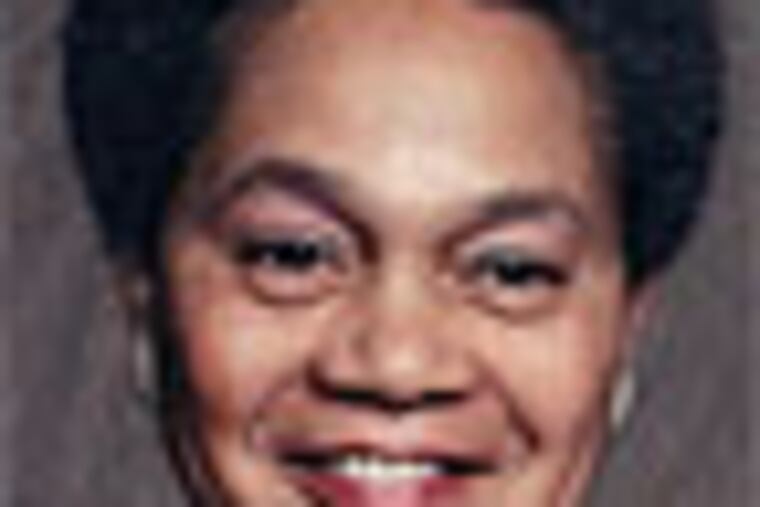
Shirley Turpin-Parham; teacher, black historian
HERE IT is, Black History Month, and how many people are aware that blacks were living and working in Philadelphia before William Penn showed up in 1681?
HERE IT is, Black History Month, and how many people are aware that blacks were living and working in Philadelphia before William Penn showed up in 1681?
Shirley Turpin-Parham knew. It was with some annoyance that Shirley saw the ignorance of many people, including members of her own race, about the history of blacks in this country, especially in Philadelphia.
She would fire off a guest opinion for the editorial pages of the Daily News, or a letter to the editor, when she felt that the public needed to be enlightened on some aspects of local black history.
Shirley Turpin-Parham, a 30-year teacher in the Philadelphia School District, a teacher at the African-American History Museum and Cheyney University, died Wednesday of chronic obstructive pulmonary disease. She was 73 and lived in Mount Airy.
As is typical of many historians, Shirley had a passion for details that some people might think of as more than you really wanted to know about certain events and people. But Shirley had a storehouse of information on black history that she never hesitated to dispense in lectures and writing.
Did you, for instance, need to know that Dr. Rebecca J. Cole, mentioned in a story about Black History Month in the Daily News as a pioneering African-American physician in the 19th century, was one of three children, or that her salary was $625 a year as a teacher at the Colored Public School at Centre Street and Germantown Avenue?
Daily News readers were apprised of these details in a February 2008 letters-to-the-editor column.
In a 1997 Daily News guest opinion, Shirley told about how Africans were brought to Philadelphia as slaves before Penn landed "to work in the making of the colony," as Penn himself wrote.
When Philadelphia was threatened by the British, who had occupied Washington in the War of 1812, the city called on Richard Allen, Absalom Jones and James Forten, iconic Philadelphia black leaders, to help build defenses.
Shirley wrote that "2,500 colored men were assembled in the State House yard and marched to Grays Ferry. There they worked for two days."
Shirley could go on and on with such information. It was her expressed desire to educate one and all on the history of blacks and their contributions to the city going back 300 years.
She was born in Brooklyn to Samuel Louis and Shirley Handy Turpin. After the family moved to this area, she graduated from Chester High School in 1956, and went on to Morgan State and Cheyney University, from which she received a bachelor's degree in education in 1962.
She later earned a master's in education and urban studies from Temple University, and a doctorate of education from Temple.
She taught in public schools for 30 years, retiring from the Jay Cooke School. She then taught at the African-American Museum, and later taught black history at Cheyney, where she was inducted into its Hall of Fame.
Shirley was an active member of Tindley Temple United Methodist Church, where she was a Sunday School teacher and involved in other church activities.
She married Joseph W. Parham Sr. in 1968. He died in 1985.
Besides her mother, she is survived by two sons, Rolison W. Turpin and Joseph W. Parham Jr.; two sisters, Naomi Tupin-Crumley and Cora M. Turpin; two grandchildren and four great-grandchildren.
Services: 11 a.m. Thursday at Tindley Temple United Methodist Church, 750 S. Broad St. Friends may call at 9 a.m.