Carter, who lifted Mets to Series title, dies at 57
NEW YORK - Gary Carter was nicknamed "Kid" for good reason. His smile, bubbly personality and eagerness to excel on a ball field made him a joy to watch at the plate and behind it.
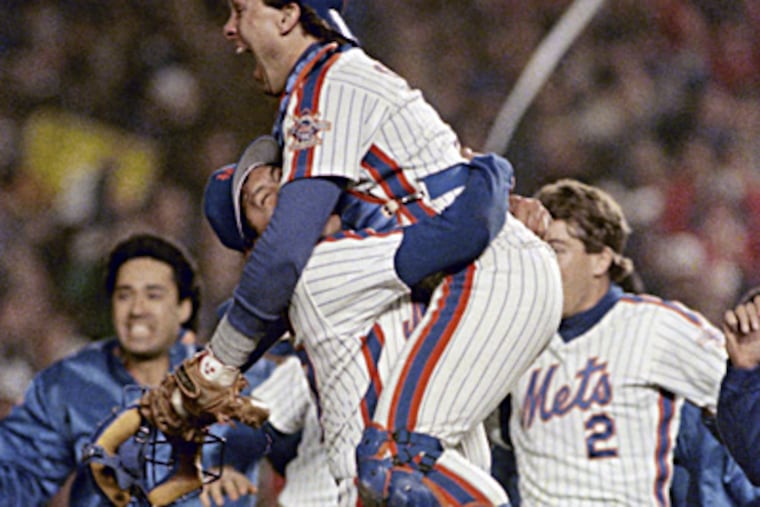
NEW YORK - Gary Carter was nicknamed "Kid" for good reason.
His smile, bubbly personality and eagerness to excel on a ball field made him a joy to watch at the plate and behind it.
Even his Hall of Fame bronze plaque at Cooperstown shows him with a toothy grin - the Kid forever.
The star catcher, whose single for the New York Mets in the 1986 World Series touched off one of the most improbable rallies in baseball, died Thursday. He was 57.
Mr. Carter was diagnosed with a malignant brain tumor last May, two weeks after finishing his second season as coach at Palm Beach Atlantic University. Mets spokesman Jay Horwitz said Mr. Carter died at a hospice in the West Palm Beach, Fla., area.
"I am deeply saddened to tell you all that my precious dad went to be with Jesus today at 4:10 p.m.," Mr. Carter's daughter, Kimmy Bloemers, wrote on the family website. "This is the most difficult thing I have ever had to write in my entire life, but I wanted you all to know."
Mr. Carter was an 11-time all-star and three-time Gold Glove winner. His single in the bottom of the 10th inning in Game 6 of the 1986 Series helped the Mets mount a charge against the Boston Red Sox and eventually beat them.
With curly, blond locks flaring out from beneath his helmet and a rigid, upright batting stance, Mr. Carter was immediately recognizable.
"His nickname 'The Kid' captured how Gary approached life," the Mets said in a statement. "He did everything with enthusiasm and with gusto on and off the field. His smile was infectious. . . . He was a Hall of Famer in everything he did."
Mr. Carter played nearly two decades with the Mets, the Montreal Expos, San Francisco Giants and the Los Angeles Dodgers. He led the Expos to their only playoff berth and was the first player enshrined in Cooperstown wearing an Expos cap.
"Gary was one of the happiest guys in the world every day," Mets teammate Mookie Wilson once said.
Mr. Carter was known as much for his effervescent personality as his talents. He earned his nickname as an eager teen in his first major league camp, and the label stuck for the rest of his career - and beyond.
"An exuberant on-field general with a signature smile who was known for clutch hitting and rock-solid defense over 19 seasons," reads his Hall plaque.
He was especially pumped during the biggest moment of his career. The powerful Mets were down to their last chance in the 1986 Series when Mr. Carter stepped up with two outs. No one was on base, and New York was trailing Boston, 5-3, in the bottom of the 10th inning in Game 6.
Mr. Carter said he had just one thought in mind: "I wasn't going to make the last out of the World Series."
True to his word, he delivered a clean single to left field off Red Sox reliever Calvin Schiraldi. Kevin Mitchell followed with a single, and when Ray Knight also singled, Mr. Carter scampered home from second base.
As Mr. Carter crossed the plate, he clapped his hands, pointed at Wilson on deck and clapped again. Moments later, Bill Buckner's error scored Knight for an amazing, 6-5 win. Mr. Carter rushed from the dugout to join the celebration at home plate, catcher's gear already on.
Overshadowed by the rally was the fact that Mr. Carter had tied the game with a sacrifice fly in the eighth. Then in Game 7, Mr. Carter drove in the tying run in the sixth inning, and the Mets went on to win their most recent championship.
Overall, Mr. Carter batted .262 with 324 home runs and 1,225 RBIs. He set the major league record for putouts by a catcher, a testament to his durability despite nine knee operations.
"Driven by a remarkable enthusiasm for the game, Gary Carter became one of the elite catchers of all-time," baseball commissioner Bud Selig said in a statement.
Mr. Carter twice was the MVP of the All-Star Game, remains the only player to have a two-homer performance in an All-Star game and a World Series game, and set the NL record for games caught.
Mr. Carter was recognized, too, for his contributions off the field when he was honored with the Roberto Clemente Award. He was elected to the Hall of Fame in 2003 on his sixth try.
Mr. Carter stayed in baseball after his playing days ended in 1992. He became a broadcaster for the Florida Marlins, coached and managed for the Mets in the minors, managed two independent minor league teams and coached in college.
In addition to his daughter, the softball coach at Palm Beach Atlantic, Mr. Carter, who lived in Palm Beach Gardens, Fla., is survived by his wife, Sandy; his son, Douglas James, known as D.J.; another daughter, Christy; and three grandchildren.