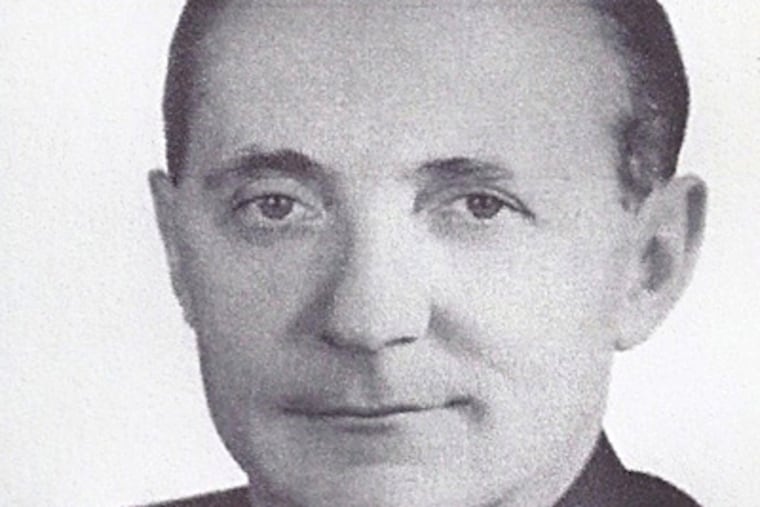
Pianist, concentration camp survivor Marian Filar
The train ride to the Majdanek concentration camp killed several of the Jews who had survived the 1943 Warsaw ghetto uprising.
The train ride to the Majdanek concentration camp killed several of the Jews who had survived the 1943 Warsaw ghetto uprising.
To avoid dying of thirst in a packed boxcar, the 25-year-old Marian Filar licked his own sweat.
And on the day he arrived at Majdanek, he had no shame in lapping, like an animal, from a puddle on the ground.
Still, how did he survive?
"I wonder myself," Mr. Filar told Inquirer music critic David Patrick Stearns in a 2003 interview.
On Tuesday, July 10, Marian Filar, 94, a concert pianist who from the 1950s to the 1980s was a music teacher, first at Settlement Music School and then at Temple University, died at his home in Wyncote.
In 2002, the University Press of Mississippi published his From Buchenwald to Carnegie Hall, which traced his travails through several concentration camps and beyond.
"Reading his book, you realize that he lived past 1945 only partly thanks to luck," Stearns wrote.
"Tenacity accounts for the rest. His brand is a less-than-reasonable refusal to accept overwhelming odds."
Still, Stearns noted, Mr. Filar was "frustrated by the bad luck that dogged him on the career front: He never had a manager and made few recordings. That's highly unfortunate.
"Filar's manner with Chopin, the composer most central to his life, remains highly distinctive, as revealed by European radio recordings over his 40-year career."
Charles Birnbaum, a close friend and longtime piano tuner for Atlantic City casinos, said in an interview that he was 10 in 1957 when he began studying with Mr. Filar at Settlement Music School. Settlement confirmed that for a time Mr. Filar was head of its piano department.
When Birnbaum entered what is now the Esther Boyer College of Music at Temple in 1964, Mr. Filar was his teacher as he earned bachelor's and master's degrees.
Birnbaum was born in a displaced-persons camp near Neu-Ulm, Germany, the son of Holocaust survivors, and so, "I think he was very sympathetic to my situation."
Mr. Filar became a full professor at Temple in 1973 and retired from there in 1989, Birnbaum said.
Besides performing with leading conductors and symphonies in Europe, Mr. Filar played occasionally with major classical orchestras in the United States.
But, Birnbaum said, "I would have to say he was one of those unknown gems, as far as the U.S. was concerned.
"What should have been an absolutely amazing concert career stalled in the U.S."
Even in retirement, though, Mr. Filar was in demand.
In 1991, The Inquirer reported that he was a judge in the fifth annual Palm Beach Invitational International Piano Competition.
And in 1992, it was reported that he would be the soloist with the Warsaw Philharmonic at its new Philharmonic Hall, where he had last played when he was 12.
"Playing Chopin in Warsaw takes nerve - and a lot of practice," Mr. Filar said.
Mr. Birnbaum said that Mr. Filar is survived by a nephew, Dubi Filar; a niece, Eti Frankel; and a grandnephew, Shai Filar.
A graveside service was set for noon Thursday, July 12, at Montefiore Cemetery, Church Road and Borbeck Street, Abington.