Meles Zenawi, 57, Ethiopian prime minister, U.S. ally
ADDIS ABABA, Ethiopia - Meles Zenawi, 57, Ethiopia's longtime ruler and a major U.S. counterterrorism ally who is credited with economic gains but blamed for human-rights abuses, died of an undisclosed illness after not being seen in his East African country for weeks, Ethiopian authorities said Tuesday.
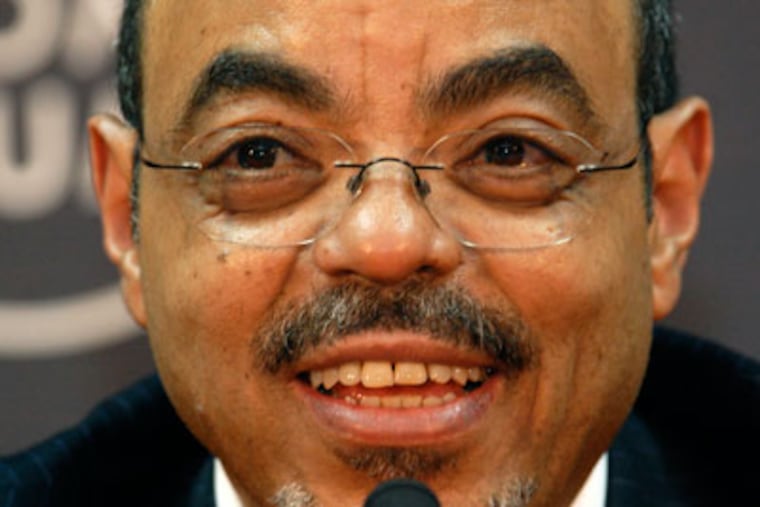
ADDIS ABABA, Ethiopia - Meles Zenawi, 57, Ethiopia's longtime ruler and a major U.S. counterterrorism ally who is credited with economic gains but blamed for human-rights abuses, died of an undisclosed illness after not being seen in his East African country for weeks, Ethiopian authorities said Tuesday.
Mr. Meles died at a Belgian hospital Monday just before midnight after contracting an infection, authorities said.
Hailemariam Desalegn, who was appointed deputy prime minister and minister of foreign affairs in 2010, became acting prime minister and will be sworn in as prime minister after an emergency meeting of parliament, said Bereket Simon, communications minister.
The death is not likely to have an impact on the strong U.S. diplomatic and military relations with Ethiopia, given the handpicked nature of the transition of power.
A European Union spokesman said that Mr. Meles died in Brussels. Officials had expected Mr. Meles to return to Ethiopia, but a sudden complication reversed what had been a good recovery, Bereket said.
Mr. Meles hadn't been seen in public for about two months. In mid-July, after he did not attend a meeting of heads of state of the African Union in Addis Ababa, Ethiopia's capital, speculation increased about his health problems.
On Tuesday afternoon in Belgium, an Associated Press Television News crew saw a car containing a casket being driven from Saint Luc Hospital in Brussels. After stopping to pick up personnel at the Ethiopian Embassy, the car drove to a private airfield where an Ethiopian plane was waiting. Mr. Meles' body was expected in Ethiopia later Tuesday.
Reaffirming the U.S. commitment to Ethiopia, President Obama said Mr. Meles deserved recognition for his contributions to his country's development, including "his unyielding commitment to Ethiopia's poor." But Obama also encouraged Ethiopia to enhance its support for democracy and human rights.
Born May 8, 1955, Mr. Meles became president in 1991 after helping oust Mengistu Haile Mariam's Communist military junta, which was responsible for hundreds of thousands of Ethiopian deaths. Mr. Meles became prime minister in 1995, a position that is both the head of the federal government and armed forces.
The United States has long viewed Mr. Meles as a strong security partner and has given hundreds of millions of dollars in aid over the years. U.S. military drones that patrol East Africa are stationed in Ethiopia. The U.S. goal for Somalia - a stable government free of radical Islamists - is in line with Ethiopia's hopes.
Mr. Meles grew up in the northern town of Adwa, where his father had 13 siblings from multiple women. He moved to the capital, Addis Ababa, on a scholarship after completing an eight-year elementary education in just five.
State TV said funeral arrangements would be announced soon.