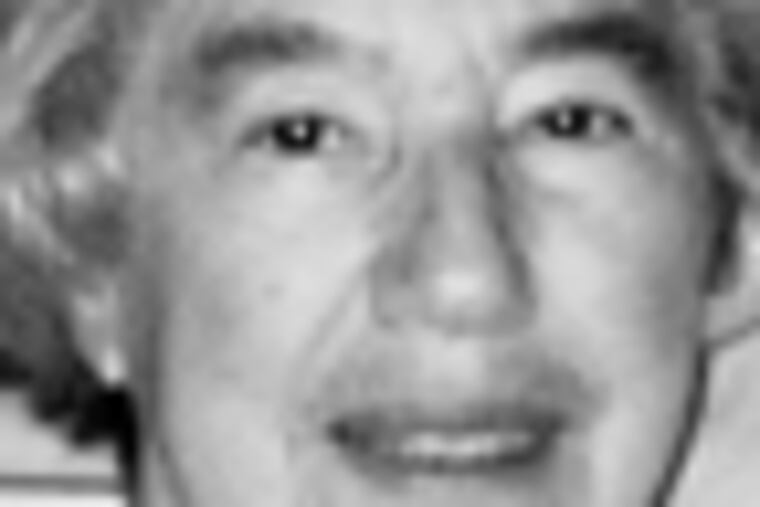
Frieda Levy, 86, Holocaust survivor
NAZI CONCENTRATION camp inmates were often packed into cattle cars and taken to other destinations. They never knew where they were going. All they knew was that it would no doubt be the same hellish nightmare.
NAZI CONCENTRATION camp inmates were often packed into cattle cars and taken to other destinations.
They never knew where they were going. All they knew was that it would no doubt be the same hellish nightmare.
In May 1945, Frieda Neumann, who was 19, was crowded once again into a cattle car of prisoners, all with bags over their heads.
When the train ground to a stop and the doors banged open, the inmates expected to behold another dreaded prison. But when the bags were removed, they were stunned instead to see smiling American soldiers waiting for them.
They were liberated!
It was only later that they learned they had been on their way to a death camp where they would have been gassed.
Frieda Levy, as she became after marrying fellow Holocaust survivor Michael Levy, came to South Philadelphia in 1949, raised a family and helped fellow Jewish immigrants adapt to America. She died of heart disease Wednesday at age 86.
Because she spoke seven languages, Frieda was able to work effectively with immigrants through the Hebrew Immigrant Aid Society in Philadelphia for many years.
Frieda was born and raised in Dobsina, a small town in Czechoslavakia. She was a teenager when the Nazis took her and her mother, Bela, captive.
Her son, Irv Levy, said, "After she was taken from her home by the Nazis, an officer asked her if the young-looking woman next to her was her sister or her mother.
"She answered innocently and honestly that she was her mother. Upon hearing that, the guards took her mother away and she never saw her again.
"When she asked a woman later where her mother was, the woman pointed at the smoke billowing from a nearby smokestack."
That was a horror that would never leave her. But there were others, such as the time when she was standing near a woman friend who was on her knees in prayer. A soldier shot her dead in front of Frieda.
After she was taken prisoner, she worked for a time in a German factory where she made airplane parts. But she was later taken to some of the Nazis' most notorious camps, including Auschwitz-Birkenau and Dachau.
"One of the reasons my mother survived was that a cousin would steal potatoes for her," said her daughter, Beverly Ashler. "After the war, she and her husband rented a home in a town in Germany with a beautiful garden. A German family was so good to them. In fact they wanted to adopt them."
After arriving in Philadelphia, Michael, who was Greek, worked in a shoe factory and later sold shoes. He died in 1999 at age 76.
When they met after being liberated, the couple spoke 13 languages between them, but did not share a common language. They must have found a way to communicate because they were married several months later.
Her father, Mordechai Neumann, survived the Holocaust and settled in Israel where he remarried and fathered three sons: Shlomo, Avram and Menachem. Frieda also is survived by two grandsons and two great-grandsons.
Services: Were Friday. Burial was in Shalom Memorial Park. Contributions may be made to the Michael J. Fox Foundation for Parkinson's Research.