Harold L. Gould Sr., welder and Negro Leagues pitcher
For most of his life, Harold L. Gould Sr. was a welder, by all accounts one of the best in South Jersey.
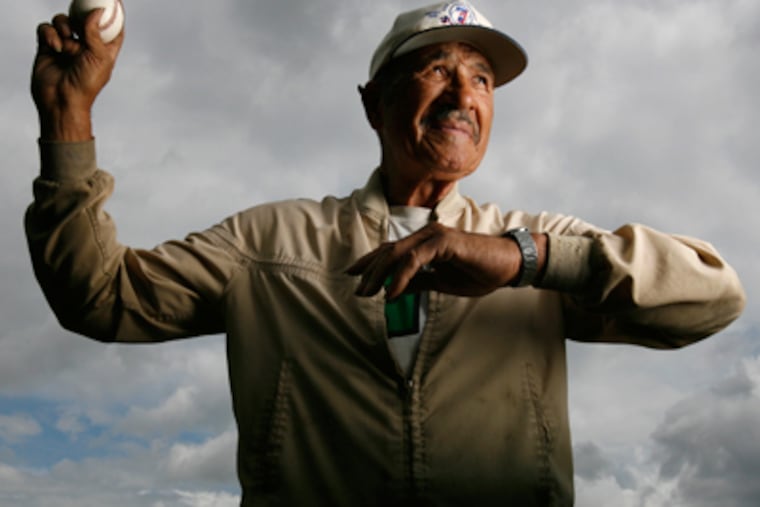
For most of his life, Harold L. Gould Sr. was a welder, by all accounts one of the best in South Jersey.
But for a couple of magical seasons in the 1940s, he was on the mound for the Philadelphia Stars, pitching against greats like Satchel Paige, delivering steaming fastballs to Minnie Minoso, and marking his place in the final chapters of Negro Leagues baseball history.
Mr. Gould, 88, of Millville, N.J., died of cancer on Friday, Nov. 9, at the New Jersey Veterans Memorial Home in Vineland. His death leaves one surviving team member.
Having rediscovered him in old age - and assiduously feted him, as if to make up for lost time - the baseball world paused this week to recall a power pitcher who, in the words of Phillies shortstop Jimmy Rollins, "helped make the game of baseball what it is today."
"Without his contributions and [those of] many others like him, the integration of Major League Baseball would not have happened when it did," said Rollins, who became friends with Mr. Gould in recent years. "He was among the pioneers, proving that all races can play at the same time."
Mr. Gould's career with the Stars lasted only from 1946 to 1948 and had begun almost as abruptly as it ended. Called by the team to New York to try out before a game, he was handed a uniform on the spot and sent onto the field. The righthander was soon in the firmament of Negro Leagues aces, finishing his rookie year with 14 wins and three losses. He was 19-4 in his second year.
Inspired to follow in Jackie Robinson's fresh footprints through baseball's color line, Mr. Gould joined the Canadian Provincial League in 1949. It was a well-trod route for black players hoping to be picked up by U.S. minor-league teams. But within a year, "his arm just gave out on him," said his nephew John Boykin.
Mr. Gould was too valuable for his own good. A successful pitcher was expected to go all nine innings in as many as three games a day. "They worked him too hard," said family friend Dave Hitchner.
Back home, he played ball until the early 1960s with local teams. "His arm could still hurt," Hitchner said. "But once a week, he could do that."
Mr. Gould was no stranger to dashed dreams.
He was a child of Gouldtown, a late-17th-century Cumberland County village said to be the oldest community of free blacks in the country. Like many residents, he was a direct descendant of the wedded founders, a black man named Gould and the granddaughter of a white Quaker landowner.
He attended the original Gouldtown School - three grades in each of three rooms - and went on to Bridgeton High. He was a standout pitcher, and at 6-foot-3 and about 200 pounds was a riveting presence on the diamond. Scouts from teams including the Philadelphia Athletics and St. Louis Browns had an eye on him.
When they arranged meetings, however, they discovered that the light-skinned phenom with straight black hair was not what they had counted on.
"They thought they were scouting white people," his nephew said. "They didn't realize what they were looking at. And when they did -."
Upon graduation in 1943, Mr. Gould enrolled in what is now Morgan State University in Baltimore but left to take a run at the Negro Leagues.
Along the way, he learned another skill, from an aunt and uncle working in the Philadelphia shipyards: welding.
When his athletic career ended, he spent two years in the Army, serving in Korea in the early 1950s. Back home, he turned to welding for a livelihood, and by 1964 was proprietor of Harold's Welding. Having gotten a degree in industrial arts from what was then Glassboro State College, he began to teach welding.
His nephew estimates that as many as 9,000 people came under his tutelage, whether in community programs across South Jersey, industrial arts courses for the Bridgeton School District, or at the old Leesburg State Prison, where he was director of the vocational program for inmates. When prisoners were released, Boykin said, his uncle helped them find work.
In the 1980s, Mr. Gould spent a few months teaching in the United Arab Emirates.
During it all, he also became a golf pro at a local course and raised and trained thoroughbreds for racing.
He was, simply, "excited by life," Boykin said. And while he spoke of the vagaries of segregated baseball, "he never begrudged anything."
Until recent years, Mr. Gould was more celebrated around town for his skill with a torch than a baseball.
Only in 1994 was he inducted into the New Jersey Baseball Hall of Fame, and seven years later the All Sports Museum of Southern New Jersey.
In 1999, Cumberland County named him one of its People of the Century, and in 2009 it included him in its Black Hall of Fame. That year, Mr. Gould teamed with Bob Allen, a Cumberland County College history professor, to produce an oral narrative titled He Came From Gouldtown.
The Phillies also embraced Mr. Gould. Each April 15, starting in 2004, he was among a dwindling group of surviving Stars honored at Jackie Robinson Day.
Bill "Ready" Cash and Stanley Glenn already were gone by the time Mr. Gould died. Only infielder Mahlon Duckett is left.
In addition to his nephew, Mr. Gould is survived by his wife of 61 years, Gwendolyn; daughters Valeria A. and Lorena E.; a son, Harold L. Jr.; a brother; and five grandchildren. He was predeceased by a daughter, Jocelyne.
In a public ceremony at 10 a.m. Friday, Nov. 16, Phillies general manager Ruben Amaro Jr., general partner and president David Montgomery, and members of the Business Association of West Parkside will place a wreath at the Philadelphia Stars Memorial Park, Belmont and Parkside Avenues.
From 4 to 7 p.m. that day, visitation will held at the Sray Webster Funeral Home, 62 Landis Ave., Bridgeton. Another will be on Saturday, Nov. 17, from 8 to 10 a.m. at Union Baptist Temple Church, 30 Martin Luther King Jr. Way, Bridgeton.
A funeral service will follow at the church at 10, with interment in Gouldtown Memorial Park, Bridgeton.
Memorial donations may be made to the Bridgeton Invitational Tournament Concession Stands, c/o Steve Terney, Century Savings Bank, 53 Cornwell Dr., Bridgeton, N.J. 08302.