Van Cliburn, famed pianist and pop-culture phenomenon, dies at 78
Van Cliburn, 78, the intrepid pianist whose 1958 win at the International Tchaikovsky Competition in Moscow was seized upon as a stroke of American triumphalism at the height of the Cold War, died Wednesday at his home in Fort Worth, Texas. He died of bone cancer, his publicist said.
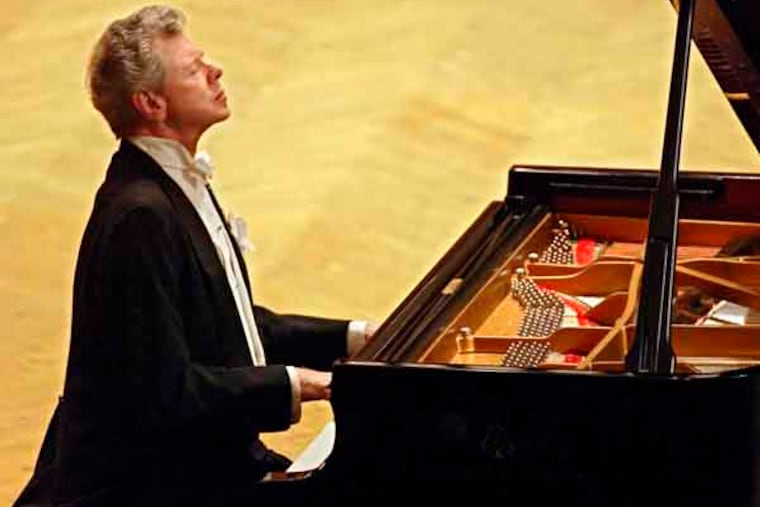
Van Cliburn, 78, the intrepid pianist whose 1958 win at the International Tchaikovsky Competition in Moscow was seized upon as a stroke of American triumphalism at the height of the Cold War, died Wednesday at his home in Fort Worth, Texas. He died of bone cancer, his publicist said.
Striking Soviet gold transformed Mr. Cliburn from pianist into pop-culture phenomenon. Inevitably described as a "lanky Texan," whose 6 feet, 4 inches were topped by a wavy, flaxen pompadour, he was welcomed home with a ticker-tape parade down lower Broadway that was compared to the one in 1927 for Charles A. Lindbergh. The crowd was estimated at 100,000 - a turnout for a classical musician that was unprecedented then and unimaginable now.
When he came to Philadelphia weeks later, teenage girls pounced on him at the Academy of Music stage door, ripping the door handle from his limousine and tearing his clothes. Time magazine suggested he was "Horowitz, Liberace, and Presley all rolled into one." He was 23.
His career arc burned bright for two decades, and then, by choice, went dark. After winning the Tchaikovsky, he realized nearly every solo pianist's ambition by entering the top tier of touring musicians. But in 1978, he withdrew from concert life. The self-described homebody performed only rarely and became more famous, perhaps, for being Van Cliburn than as a busy pianist with an expanding artistic life.
At least, that was the view from the public realm. His enormous early success turned competitions into an enduring fixation for classical soloists - a path to professional management and higher concert fees. And then, with his turn inward, he challenged definitions of what it meant to live a meaningful artistic life in the age of celebrity.
Long after his prime, Mr. Cliburn was said to be exploring Schubert's emotionally volatile piano sonatas late at night at his 18-acre Tudor estate.
The storyline threatened to overshadow the musicianship; there was a time when his playing grew sloppy. But at the core, Mr. Cliburn was an astonishing talent.
"Of all the Americans of his generation, Cliburn was able to produce the most sensuous of sounds - rich, never percussive, a real piano sound that reminded old-timers of the great romantic pianists of the past," wrote Harold C. Schonberg in The Great Pianists.
"He was a wild talent, a fantastic natural," said pianist Gary Graffman. "If I didn't agree with something, so what? It came from the heart."
"Better than Rachmaninoff," the composer Aram Khachaturian once declared. "You find a virtuoso like this only once or twice in a century."
Born July 12, 1934, in Shreveport, La., Harvey Lavan Cliburn Jr. first studied with his mother, Rildia Bee O'Bryan Cliburn, a student of Liszt protege Arthur Friedheim. He attended the Juilliard School in the studio of Rosina Lhévinne. In 1954, he won the elite Leventritt competition, and appeared with the New York Philharmonic. Even before Moscow, he was well on his way.
"His career started when Mark Schubart, the dean of Juilliard, called [artist manager] Bill Judd and said, 'You have to come hear this kid,' " recalled Naomi Graffman (wife of pianist Graffman), who was an assistant in Judd's office at the time.
The Moscow win, however, was the thing that rippled far beyond the classical world. It was seen variously as a vehicle for U.S. pride - the Soviets had launched Sputnik, and the space age, a few months earlier - or as a chance to achieve with music what diplomacy had failed to do in warming East-West relations.
"It's good to see artistic talent recognized," President Dwight D. Eisenhower said, "and I believe such contests are good for better understanding between peoples of all nations."
Mr. Cliburn later toured the Soviet Union, and he often reappeared for moments of cultural diplomacy, such as a 1987 White House state dinner honoring President Mikhail S. Gorbachev. President Obama awarded him a 2010 National Medal of Arts.
Philadelphia was among his first stops after returning from Moscow with his gold medal and 25,000 rubles. He immediately developed a mutual admiration society with Eugene Ormandy, appearing 72 times with Ormandy and other conductors leading the Philadelphia Orchestra between 1958 and 2005 - not only in Philadelphia, but also in Amsterdam, Brussels and Miami, and at Carnegie Hall, the Hollywood Bowl, and New York World's Fair.
The Academy of Music, Robin Hood Dell, and the Mann Center were settings for guest appearances, celebrations, and comebacks. Along with Maria Callas, he headlined the Academy of Music Anniversary Concert and Ball in 1959, returning for the same event in 1965.
After an 11-year absence from the stage, he chose the Mann as the scene for a 1989 concert - "for sentimental reasons," he said. He dedicated one piece to Ormandy, with whom he had recorded, and the other to Fredric R. Mann, the Philadelphia philanthropist who engaged him - and advised him to invest his concert fees in California and New York real estate.
"The resounding octaves, the big confident passagework and the Augustan view of the shape of the music, all hallmarks of his youthful performances, were back in place," Inquirer critic Daniel Webster wrote of that comeback.
Frequent iterations of Sergei Rachmaninoff and Tchaikovsky fueled criticism that his repertoire was limited, though so ardent were those interpretations that, for many listeners, that was enough. His 1958 Carnegie Hall recording of the Rachmaninoff Piano Concerto No. 3 with Kirill Kondrashin and the Symphony of the Air holds landmark status. A 1967 take of the piece, live from Montreux, Switzerland, places him in the company of Wolfgang Sawallisch, who with surprising sympathy mirrored every inch of the pianist's fluidity and flexible tempos.
Stadium concert-sized crowds may seem an invention of the Three Tenors, but in 1966, Mr. Cliburn attracted 12,000 listeners for a Philadelphia Orchestra concert at the Saratoga Performing Arts Center and 18,000 at New York's Lewisohn Stadium, to hear concertos of Brahms and Rachmaninoff. A 1971 appearance at the Robin Hood Dell drew a reported 30,000 - twice the capacity of the Mann Center today. The same thing happened the next summer.
Over the years, he lent his name to charitable causes - and gossip columns. Chronicled were the natty navy blue suits, donations to the Baptist church, his appearance at Madison Square Garden singing in Billy Graham's choir, and a palimony suit against him. (It was dismissed.)
His Tchaikovsky Competition win spawned an event in his honor. The Van Cliburn International Piano Competition, held every four years since 1962, has become an integral part of the circuit.
Audiences perpetually craved a reenactment of the 1958 win - "his one-Texan conquest of the Soviet Union," as Time called it - and critics wanted him to grow into an artist of greater artistic scope. But Mr. Cliburn never voiced a moment of self-doubt.
Asked in 1996 about those who might be disappointed that he hadn't turned out to be the next Vladimir Horowitz, Arthur Rubinstein, or Rachmaninoff, he told a Detroit music critic:
"But I couldn't be those people. Nobody can be. I can only be Van Cliburn. I'm still trying to do my best."
He is survived by his friend of long standing, Thomas L. Smith.
Gifts in Mr. Cliburn's honor can be sent to the O'Bryan Cliburn Cultural Foundation, Box 470219, Fort Worth, Texas 76147.
at 215-854-5611 or pdobrin@phillynews.com.
Read his blog at www.philly.com/artswatch.