Forever Britain's Iron Lady
LONDON - Love her or loathe her, one thing's beyond dispute: Margaret Thatcher transformed Britain. The Iron Lady, who ruled for 11 remarkable years, imposed her will on a fractious, rundown nation - breaking the unions, triumphing in a far-off war, and selling off state industries at a record pace. She left behind a leaner government and more prosperous nation by the time a political mutiny ousted her from No. 10 Downing Street.
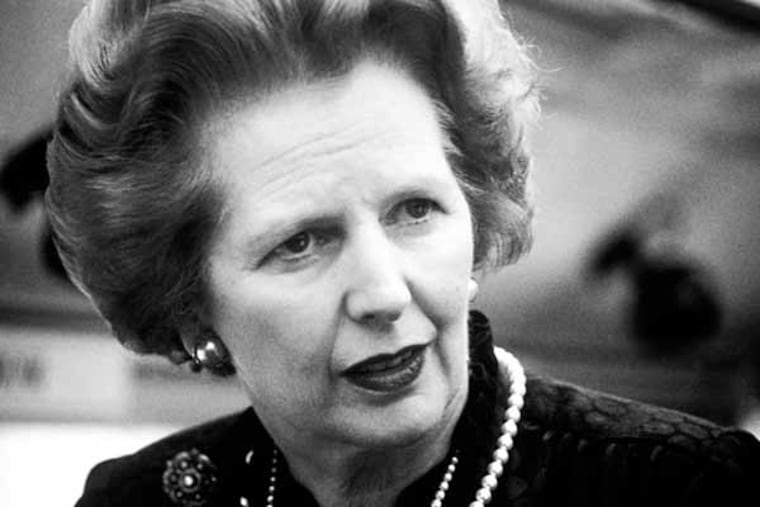
LONDON - Love her or loathe her, one thing's beyond dispute: Margaret Thatcher transformed Britain.
The Iron Lady, who ruled for 11 remarkable years, imposed her will on a fractious, rundown nation - breaking the unions, triumphing in a far-off war, and selling off state industries at a record pace. She left behind a leaner government and more prosperous nation by the time a political mutiny ousted her from No. 10 Downing Street.
Mrs. Thatcher's spokesman, Tim Bell, said the 87-year-old former prime minister died from a stroke Monday morning at the Ritz hotel in London.
As flags were flown at half-staff at Buckingham Palace, Parliament and Downing Street, praise for Mrs. Thatcher and her leadership poured in from around the world.
"Margaret Thatcher undoubtedly was one of the most remarkable political figures of the modern world," said Russian President Vladimir V. Putin.
Putin said Mrs. Thatcher "made a significant contribution to the development of the Soviet-British and Russian-British ties, which we will always remember with gratitude."
President Obama said many Americans "will never forget her standing shoulder to shoulder with President Reagan, reminding the world that we are not simply carried along by the currents of history. We can shape them with moral conviction, unyielding courage and iron will."
Queen Elizabeth II authorized a ceremonial funeral - a step short of a state funeral - to be held at St. Paul's Cathedral in London next week with military honors.
Prime Minister David Cameron cut short a trip to Madrid and Paris to return to Britain following news of Mrs. Thatcher's death, and said Parliament would be recalled from recess on Wednesday so lawmakers could pay tribute.
For admirers, Mrs. Thatcher was a savior who rescued Britain from ruin and laid the groundwork for an extraordinary economic renaissance. For critics, she was a heartless tyrant who ushered in an era of greed that kicked the weak out onto the streets and let the rich become filthy rich.
"Let us not kid ourselves. She was a very divisive figure," said Bernard Ingham, Mrs. Thatcher's press secretary for her entire term. "She was a real toughie. She was a patriot with a great love for this country, and she raised the standing of Britain abroad."
Mrs. Thatcher was the first - and still only - female prime minister in Britain's history. But she often found feminists tiresome.
Her boxy, black handbag became such a recognizable part of her image that her way of dressing down ministers and opponents became known as "handbagging."
Like her close friend and political ally Ronald Reagan, Mrs. Thatcher seemed motivated by an unshakable belief that free markets would build a better country than reliance on a strong, central government. Another thing she shared with the American president: a tendency to reduce problems to their basics, choose a path, and follow it to the end, no matter what the opposition.
She formed a deep attachment to the man she called "Ronnie" - some spoke of it as a schoolgirl crush. Still, she would not back down when she disagreed with him, even though the United States was the vastly stronger partner.
Mrs. Thatcher was at her brashest when Britain was challenged. When Argentina's military junta seized the Falkland Islands from Britain in 1982, she did not hesitate, even though her senior military advisers said it might not be feasible to reclaim the islands.
She simply would not allow Britain to be pushed around, particularly by military dictators, said Ingham, who recalls the Falklands War as the tensest period of Mrs. Thatcher's three terms in power. When diplomacy failed, she dispatched a military task force that accomplished her goal.
As prime minister from 1979 to 1990, Mrs. Thatcher upended decades of liberal doctrine, successfully challenging Britain's welfare state, in the process becoming the reviled bete noire of the left-wing intelligentsia.
She is perhaps best remembered for her hard-line position during the pivotal strike in 1984 and 1985 when she faced down coal miners in a successful bid to break the power of unions. It was a reshaping of the British economic and political landscape that endures to this day.
Margaret Hilda Roberts was born on Oct. 13, 1925. She learned the values of thrift, discipline and industry as the dutiful daughter of Alfred Roberts, a grocer and lay preacher who eventually became the mayor of Grantham, 110 miles north of London.
Educated at Oxford, Mrs. Thatcher began her political career in her mid-20s with an unsuccessful 1950 campaign for a parliamentary seat in the Labour Party stronghold of Dartford. She earned nationwide publicity as the youngest female candidate in the country, despite her loss at the polls.
She was defeated again the next year, but on the campaign trail she met Denis Thatcher, a businessman whom she married in 1951. Their twins, Mark and Carol, were born two years later. Denis Thatcher died in June 2003.