Edward Korostoff, 92, research engineer
A memorial service will be held Thursday, June 13, for Edward Korostoff, 92, of Philadelphia, a research engineer and University of Pennsylvania professor emeritus.
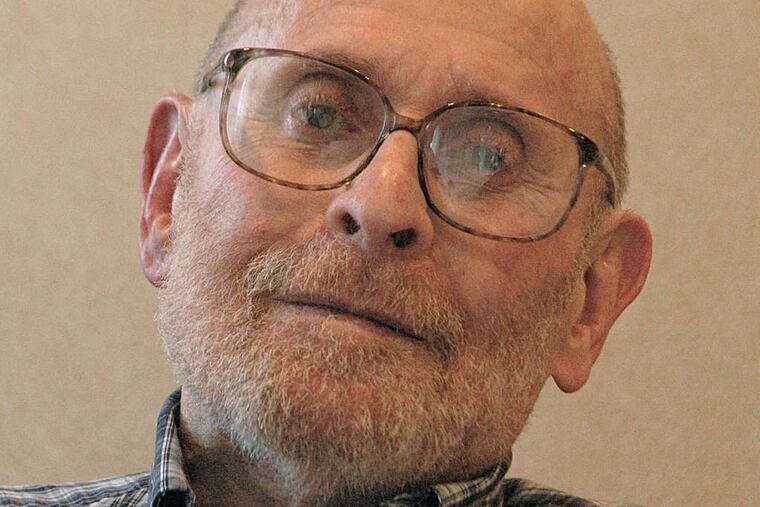
A memorial service will be held Thursday, June 13, for Edward Korostoff, 92, of Philadelphia, a research engineer and University of Pennsylvania professor emeritus.
Dr. Korostoff died of atherosclerotic vascular disease Monday, May 13, at the Quadrangle in Haverford, where he had lived since 2005.
Born in Philadelphia of Russian and Lithuanian parents, he entered Central High School for Boys at age 12 and the University of Pennsylvania at 16, graduating with a bachelor's degree in chemical engineering in 1941.
His precocity spanned adulthood. By 1975, he held triple appointments at Penn, as a full professor in the Schools of Dental Medicine, Engineering, and Medicine.
The link among the three was his research on materials for use in the human body, especially as it pertained to the mechanical and electrical properties of bone.
He retired in 1987, after publishing more than 50 scientific papers; he also was the author/editor of the 1968 book Research in Dental and Medical Materials.
Dr. Korostoff's first job was with the Tennessee Valley Authority in Muscle Shoals, Ala. He worked in electric furnace production of phosphate fertilizer, and of elemental phosphorus for use in U.S. Navy smoke bombs.
His second employer in 1943 was the National Defense Research Council; he worked on developing mobile liquid-oxygen production units.
Next, he was employed by Leeds & Northrup Co. as a research technologist on a variety of projects. In 1955, he was hired by Remington-Rand UNIVAC, as it entered the commercial computer age. He helped develop special memory tapes.
In 1959, he quit to pursue research at Penn. He earned a doctorate in metallurgical engineering in 1961; he had completed a master's degree in engineering in 1952.
When it became clear through research that the metals he was working with could not be sufficiently purified to use in standard experiments, Dr. Korostoff invented a new method.
In 1963, the Laboratory for Research on the Structure of Matter opened at 33d and Walnut Streets on the Penn campus.
Dr. Korostoff and Solomon Pollock, a solid-state physicist, established a research program in biomaterials and began their work on the effects of electric fields on bone growth, according to a history posted on Penn Engineering's website.
A daughter, Pamela K. Thompson, said Dr. Korostoff was a lifetime learner.
"My father never stopped educating himself or working to make new contributions," she said. "Even in retirement he found productive work, both as an engineering consultant in legal proceedings and as a principal in the start-up of a company based on an invention."
Another daughter, Heather Korostoff Murray, said that Dr. Korostoff taught her "the sanctity of curiosity and a humility for the endlessness of knowledge."
Daughter Lisa K. Rooney said her father was much more than an academician; he stayed involved in the lives of children and grandchildren for 31 years.
Dr. Korostoff met the former Loretta Marcase on an Atlantic City beach in 1948. They married in 1951. She died in 1997.
He enjoyed classical music, chess, Scrabble, crossword puzzles, cryptograms, science fiction, mysteries, and summer vacations in Longport, N.J. He never missed a chance to pun outrageously, his daughters said.
Besides his daughters, he is survived by nine grandchildren and a great-granddaughter. Two sisters died earlier.
The memorial service will be at 11 a.m. Thursday, June 13, at Roosevelt Memorial Park, 2701 Old Lincoln Highway, Trevose.
Donations may be made to the University of Pennsylvania, School of Engineering at www.seas.upenn.edu/giving/.