Elmore Leonard, crime novelist with ear for dialogue
Elmore Leonard, 87, a masterful crime novelist whose razor-sharp dialogue and indelibly realized lowlifes earned him an unusual mix of mass-market appeal and highbrow acclaim, died Tuesday of complications from a stroke at his home in Bloomfield Township, Mich., said his researcher, Gregg Sutter.
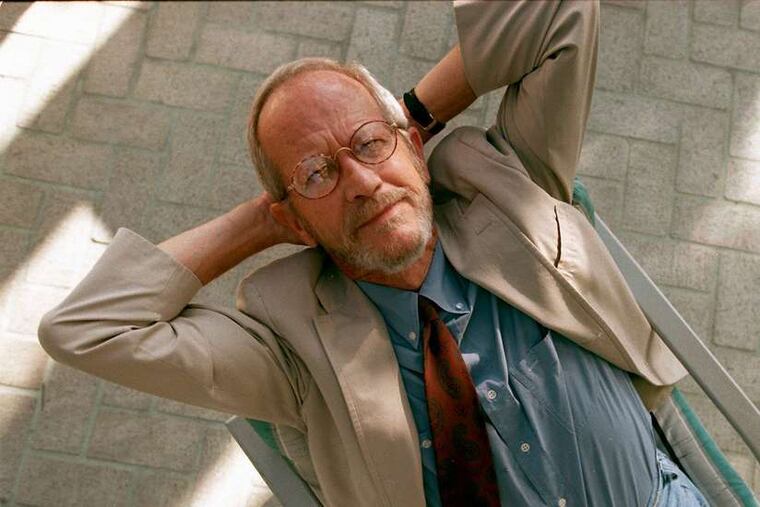
Elmore Leonard, 87, a masterful crime novelist whose razor-sharp dialogue and indelibly realized lowlifes earned him an unusual mix of mass-market appeal and highbrow acclaim, died Tuesday of complications from a stroke at his home in Bloomfield Township, Mich., said his researcher, Gregg Sutter.
A diligent, unpretentious writer who worked in relative obscurity for many years, Mr. Leonard went on to influence a generation of crime writers, whose sales may have eclipsed his, but whose adoration of him never waned.
His lean, violent stories also served up choice film vehicles for actors including Paul Newman (Hombre), John Travolta (Get Shorty), and Pam Grier (Jackie Brown).
What made Mr. Leonard stand out among other chroniclers of crime and punishment was his voice - laconic, funny, unsentimental - and his ruthlessly coherent vision of life in the lower depths.
What often galvanizes this gallery of rogues and scoundrels is a scheme - a kidnapping, con job, or robbery that will bring quick and easy money. As it turns out, the money is neither quick nor easy, and the schemes are doomed from the start, spinning down unexpected tangents and threatened at every turn by absurdity.
In Rum Punch (1992), would-be thief Louis Gara spends so much time crafting his "Do not panic" stickup note that the bank he's plotting to rob has closed by the time he gets there. In Switch (1978), two ex-cons abduct the wife of a rich, philandering builder, only to learn he has no intention of paying the ransom. (They gain a new ally in his wife.)
Time and again, bad guys pause in the middle of bad acts for extended bull sessions on music or clothes. Screenwriter-director Quentin Tarantino, who turned Mr. Leonard's Rum Punch into the 1997 film Jackie Brown, cited the author as a key influence on his own garrulous movie thugs.
Taken as a whole, the Leonard oeuvre serves to demolish the myth of the criminal genius. And yet what his villains lack in intelligence, they make up for in mayhem. Beatings, torture, and murder feature prominently in the author's pages.
Mr. Leonard, in marked contrast, was a quiet, reserved, owlishly bespectacled man who lived in the Detroit suburbs and sported Kangol caps and tweed jackets. He had no rap sheet; he never owned a gun; he gave up drinking in his early 50s after his first marriage crumbled.
Although critics tended to lump him into the hard-boiled detective school of Dashiell Hammett, Raymond Chandler, and Ross McDonald, Mr. Leonard resisted the tag of mystery writer, pointing out that his work lacked anything in the way of puzzles.
The mystery was all in the books' creation. "I develop characters, and I'm not sure where they're going until I get to know them," he told the London Independent in 1998. "In fact, I seldom know before I'm halfway through what the thing is about."
Nicknamed 'Dutch'
Elmore John Leonard Jr. was born Oct. 11, 1925, in New Orleans. His father, a dealership scout for General Motors, moved the family from city to city before settling in Detroit.
Nicknamed "Dutch" after a Washington Senators knuckleball pitcher with the same surname, young Elmore Leonard went on to serve in World War II. His bad eyesight consigned him to a job as store manager for the Seabees, doling out beer for the troops.
After graduating from the University of Detroit in 1950, Mr. Leonard married his college sweetheart, Beverly Cline, and took a job with a local ad agency. He nurtured his fiction habit in private.
He awoke at 5 every morning and churned out pulp Westerns for two hours before heading to work.
In 1951, he published his first short story in Argosy magazine for $1,000. His first novel, The Bounty Hunters, came out in 1954. Two of his early stories became popular Western movies, The Tall T with Randolph Scott, and 3:10 to Yuma with Glenn Ford (both in 1957); the latter remade in 2007 with Russell Crowe.
By the end of the 1950s, the Western market was saturated, so to support his wife and five children, Mr. Leonard turned to writing scripts for educational films.
Then, in 1967, 20th Century Fox bought the rights for his novel Hombre for $10,000. The resulting film, starring Newman, was only a moderate box-office success, but it gave Mr. Leonard the financial cushion he needed to reboot his fiction.
His next book, The Big Bounce, the story of an ex-con falling into the clutches of a psychotic young seductress, was rejected 84 times before finding a publisher. It placed Mr. Leonard for the first time in his natural milieu - the modern American underworld - while planting the seeds for the great work of the 1970s and early 1980s, including City Primeval and 52 Pick-Up.
This was also a time of personal turmoil for Mr. Leonard. His first marriage ended in divorce, and his heavy drinking was a contributing factor.
"I'd been drinking since I was a kid," he told People magazine, "and for 20 years, I was a happy drunk. Then I started to get wild." He tried three times before he quit alcohol entirely. "I had my last drink at 9 a.m. on Jan. 24, 1977," he said. "I think it was Scotch and ginger ale."
Two years later, he married Joan Shepard. She died in 1993. His third marriage, to Christine Kent, ended in divorce. Survivors include five children from his first marriage; 13 grandchildren; and five great-grandchildren.
Fans among intelligentsia
In recent years, Mr. Leonard's work inspired the FX TV series Justified, with Timothy Olyphant as a federal lawman busting heads in the hills of eastern Kentucky.
Even as Mr. Leonard's sales figures and box-office receipts mounted, he began winning kudos (much to his own surprise) from intelligentsia.
Walker Percy and Saul Bellow were fans. George Will gave out Leonard first editions as Christmas presents. Martin Amis declared that "for an absolutely reliable and unstinting infusion of narrative pleasure in a prose miraculously purged of all false qualities, there was no one quite like Elmore Leonard." In 2012, Mr. Leonard received the National Book Foundation's medal for distinguished contribution to American letters.
Mr. Leonard's art supplies human behavior in all its variety, but he is as notable for what he leaves out: imagery, metaphor, thematic summations, even psychological motivation. Most conspicuously, he leaves out Elmore Leonard. "If I ever show myself in there," he once said, "then there's something wrong."
He expanded on this principle in an essay on writing for the New York Times. Among his injunctions: "Never open a book with weather." "Avoid prologues." And "Try to leave out the part that readers tend to skip." His most important rule: "If it sounds like writing, I rewrite it."
His ear for American vernacular was unmistakably his own. Asked to explain his facility with idiom, Mr. Leonard replied: "There is no secret. I listen when people are talking. I listen when they're talking to each other, and I listen when they talk to me."
Elmore Leonard Books Into Films
A half-dozen (of the 27!) Elmore Leonard book-to-screen adaptations:
3:10 to Yuma (1957) Taut Western, with Van Heflin holding outlaw Glenn Ford until they can put him on the train. A posse of bad guys intervenes. Remade in 2007 with Christian Bale and Russell Crowe.
52 Pick-Up (1985) Roy Scheider and Ann-Margret in gritty neo-noir about blackmail and retribution.
Get Shorty (1995) John Travolta as a Miami mobster who comes to L.A. and finds he does just fine swimming with the sharks in the movie biz.
Hombre (1967) Paul Newman is a taciturn, Apache-raised white man caught up in a stagecoach robbery and its bloody aftermath.
Jackie Brown (1997) Quentin Tarantino's homage to blaxploitation is also one
of the best tributes to Leonard's books. Pam Grier is a flight attendant playing the Feds against arms smugglers, and falling in with a bail bondsman (Robert Forster) who has, quite understandably, fallen for her.
Out of Sight (1998) Jennifer Lopez is a U.S. marshal taken hostage by George Clooney when he escapes prison. She breaks free, but she can't break her attraction to the guy, who is out to pull off one last job.
- Steven Rea
EndText
INSIDE
Many of Elmore Leonard's books were turned into films. A look at a few. A6.
EndText