War hero Louis Zamperini, 97, lived 'unimaginable drama'
LOS ANGELES - Seventy years ago, the world was convinced that Louis Zamperini was dead. There had been no word of the track star and former Olympian since his World War II bomber crashed into the Pacific Ocean. The military told his parents he was dead, and an annual collegiate track competition named one of its races in his memory.
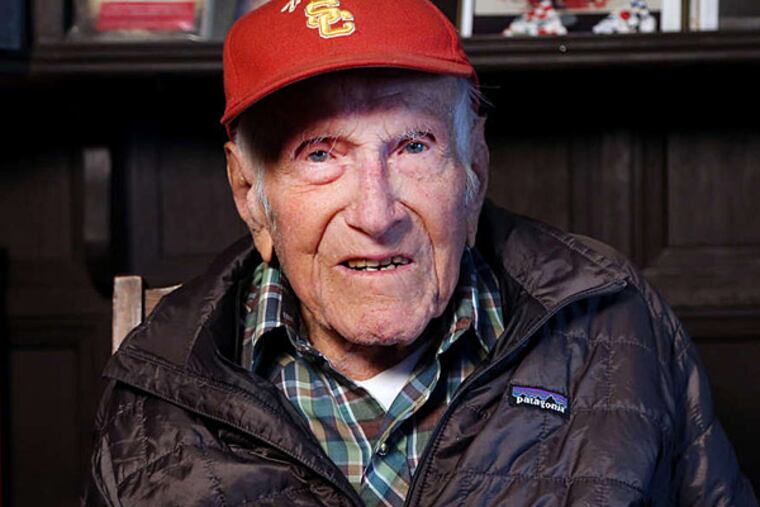
LOS ANGELES - Seventy years ago, the world was convinced that Louis Zamperini was dead. There had been no word of the track star and former Olympian since his World War II bomber crashed into the Pacific Ocean. The military told his parents he was dead, and an annual collegiate track competition named one of its races in his memory.
But Mr. Zamperini was alive, and very much so. After surviving 47 days on a life raft in shark-infested waters and enduring two years as a Japanese prisoner of war, he was liberated in time to attend the second running of the invitational mile named in his memory. It was a story fitting for an ordinary man who did extraordinary things.
Mr. Zamperini, a war hero, Olympian, and the subject of a celebrated book and, later this year, a movie on his story of survival against all odds, died after a long battle with pneumonia, his family said Thursday. He was 97.
He outlived almost all of those who watched him weave his way through his remarkable life, but the outpouring from those who came to know and love the man in his later years was as immediate and intense as the life he lived.
Resilience
Laura Hillenbrand, the author of the best-selling Unbroken: A World War II Story of Survival, Resilience, and Redemption, said that over countless hours of interviews Mr. Zamperini became a surrogate grandfather and beloved friend who helped her cope with her own debilitating illness, chronic fatigue syndrome.
"Louie greeted every challenge of his long journey with singular resilience, determination and ingenuity, with a ferocious will to survive and prevail, and with hope that knew no master," said Hillenbrand, whose book is being made into a movie directed by Angelina Jolie and is scheduled for a December release.
"It is a loss impossible to describe," Jolie said. "We are all so grateful for how enriched our lives are for having known him. We will miss him terribly."
Born Jan. 26, 1917, Mr. Zamperini's story began with a blue-collar upbringing in Olean, a city in western New York. When he was 2, the family moved to Southern California, where he spent a rebellious childhood before channeling his energy and tenacity into sports. He started with boxing, to defend himself from bullies, but became a world-class runner after joining his high school track team.
In 1934, Mr. Zamperini - nicknamed the "Torrance Tornado" for his California hometown - broke the 18-year-old interscholastic record for the mile in 4:21.2, a mark that would stand for 20 years.
A track star at the University of Southern California, Mr. Zamperini competed in the 5,000-meter run at the 1936 Berlin Olympics. He finished eighth but grabbed headlines by stealing a Nazi flag.
It was his World War II story that captured the imagination of millions back home.
He was a bombardier on an Army Air Forces bomber that crashed in the Pacific during a reconnaissance mission. He and one of the other surviving crew members drifted for 47 days on a raft in shark-infested waters, drinking rain water and eating fish and birds they caught with their bare hands, before being captured by Japanese forces. A third man died before they reached land.
When he and his surviving raft-mate, pilot Russell Allen Phillips, reached land on the Marshall Islands, they were captured by the Japanese, who had also strafed their raft from the air and riddled it with bullet holes.
Mr. Zamperini would spend more than two years as a prisoner of war being shuttled among Japanese prison camps, where he survived beatings, starvation, debilitating illnesses, and psychological torture designed to break him down and make an example of the famous Olympian-turned-war hero.
When he was liberated at the end of the war, he was a changed man and wrestled with rage, depression, and alcoholism that almost cost him his marriage.
"Pain never bothered me," he told the AP in 2003. "Destroying my dignity stuck with me."
Several years after his return, he attended a Billy Graham revival in Los Angeles and embraced Christianity - a faith that would sustain him for the rest of his life.
Forgiveness
Years later, he wrote a letter of forgiveness to one of his most horrific tormentors, a guard the other prisoners nicknamed "The Bird."
In 1998, he went back to Japan to run a leg of the torch relay at the Nagano Olympics and ran past the former camps where he had been imprisoned.
"Of the myriad gifts he has left us, the greatest is the lesson of forgiveness," Hillenbrand said.
In May, he was named grand marshal of the 2015 Rose Parade in Pasadena, Calif.
He was a guest of Jolie last year when she was presented with the Jean Hersholt Humanitarian Award by the Academy of Motion Picture Arts and Sciences.
Zamperini Field, a city-owned public airport in Torrance, is also named in his honor. A stadium at Torrance High School and the entrance plaza at USC's track and field stadium both bear his name.
His wife, Cynthia Applewhite, whom he married in 1946, died in 2001. His survivors include daughter Cynthia, son Luke, and grandchildren.