Jean-Claude Duvalier, 63; was Haitian dictator
PORT-AU-PRINCE, Haiti - Jean-Claude Duvalier, 63, the self-proclaimed "president for life" of Haiti whose corrupt and brutal regime sparked a popular uprising that sent him into a 25-year exile, died Saturday of a heart attack, his attorney Reynold Georges said. The former leader had been staying at a private residence in Port-au-Prince and died there, Georges said.
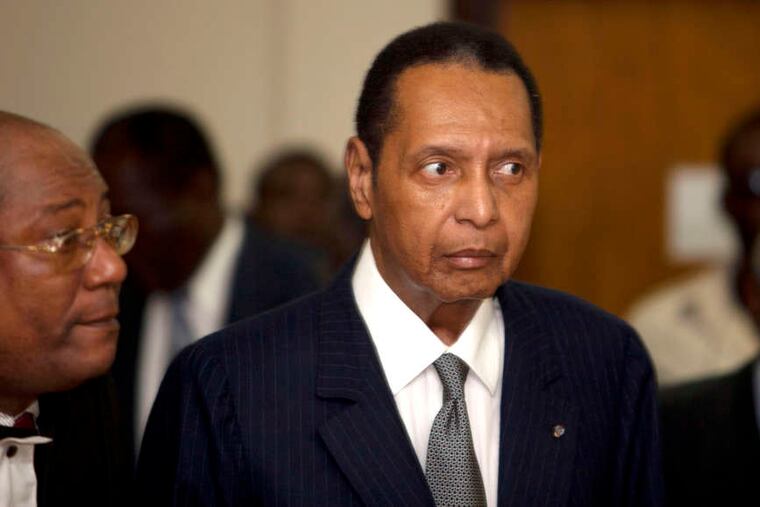
PORT-AU-PRINCE, Haiti - Jean-Claude Duvalier, 63, the self-proclaimed "president for life" of Haiti whose corrupt and brutal regime sparked a popular uprising that sent him into a 25-year exile, died Saturday of a heart attack, his attorney Reynold Georges said. The former leader had been staying at a private residence in Port-au-Prince and died there, Georges said.
The once-feared dictator known as "Baby Doc" made a surprise return to Haiti in 2011, allowing victims of his regime to pursue legal claims against him and prompting some old allies to rally around him. In the end, he spent his final years quietly in the leafy hills above the Haitian capital.
Haitian President Michel Martelly expressed his condolences to the ex-dictator's family, making no mention of the widespread human-rights abuses that occurred during the Duvalier era.
"On behalf of the entire government and people of Haiti, I take this sad occasion to extend my sincere sympathies to his family, his relatives, and his supporters across the country," Martelly said.
Jean-Claude Duvalier was the son of Francois "Papa Doc" Duvalier, a medical doctor-turned-dictator who promoted "Noirisme," a movement that sought to highlight Haiti's African roots over its European ones in a country divided by class and color. The regimes of both leaders tortured and killed political opponents and relied on a dreaded civilian militia known as the Tonton Macoutes.
In 1971, Francois Duvalier suddenly died of an illness after naming his son to succeed him. At 19, Jean-Claude Duvalier became the world's youngest president.
He ruled for 15 years, his administration seen as less violent and repressive than his father's. Echoes of press freedom and personal criticism, never tolerated under his father, emerged - sporadically - because of international pressure. Still, human-rights groups documented abuses and political persecution.
Since his return, victims of the regime have testified in a criminal investigation of human-rights abuses during his reign but the case has moved fitfully and there had been few signs of progress in recent months. His death brings an end to that effort without giving Haiti a chance to reconcile with that past, said Amy Wilentz, author of The Rainy Season: Haiti Since Duvalier, and other works about the country.
"What this means is that there will never be a trial against him and there won't be a chance for the Haitian people to have justice and to purge from its soul the true horrors of the Duvalier era," Wilentz said. "It's an end but there is no closure that comes with it."
Under Jean-Claude Duvalier's rule, Haiti saw widespread demographic changes. Peasants moved to the capital in search of work as factories popped up to meet the growing demand for cheap labor. Thousands of professionals fled a climate of repression for cities such as New York, Miami, and Montreal.
Aid began to flow from the United States and agencies such as the World Bank and International Monetary Fund. Tourists followed, some in search of a form of tropical hedonism that included booze, prostitution, and Voodoo ceremonies. But it was corruption and human-rights abuses that defined the regime.
The National Palace became known for opulent parties as the first lady, Michele Duvalier, took overseas shopping sprees to decorate and collect fur coats. The leader himself relished taking his presidential yacht for a spin and racing about in sports cars.
He made pretenses of improving the country's human-rights record by releasing political prisoners. Still, journalists and activists were jailed or exiled.
The New York-based Human Rights Watch estimated that up to 30,000 Haitians were killed, many by execution, under the regime of the two Duvaliers.
In 1986, a popular uprising swept across Haiti, and Jean-Claude and Michele Duvalier boarded a U.S.-government C-141 for France. They divorced in 1993 and he later became involved with Veronique Roy, who accompanied him on his 2011 return to Haiti.