Ray K. Metzker, 83, internationally known photographer
He specialized in scenes of Philadelphia streets.
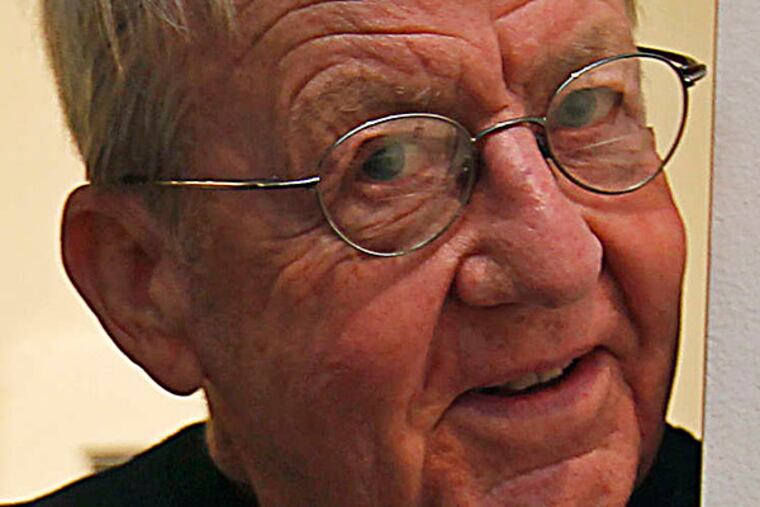
RAY METZKER stalked the streets of Philadelphia, Leicas slung over his shoulder, and captured images on film that only he could see:
Deep blacks and startling whites, mysterious comings and goings amid the crushing weight of buildings, and streets that no other Philadelphian ever saw.
You couldn't use Ray Metzker's photographs to make picture postcards of the city. No City Hall or Penn's Landing or other local landmarks. If Ray did photograph City Hall or Penn's Landing, it wouldn't have been from angles you would recognize.
And, besides, he worked only in black and white.
Ray worked hard with cameras and in the darkroom to make images that grip the imagination and startle the mind, that can cause observers to ponder the mystery and spirituality of city scenes that, before being exposed to Ray's photos, were thought of as ordinary.
Ray K. Metzker, an internationally known photographer whose photos have been shown in many of the nation's most prestigious galleries and museums, including those in Philadelphia, died Thursday. He was 83 and lived in South Philadelphia.
"He discovered things you'd never notice, never expect - the pattern of something or some cubbyhole," his wife, the photographer Ruth Thorne-Thomsen, told the Inquirer. "And the world would never be the same again."
Laurence Miller, whose gallery in New York City is now exhibiting Ray's work, said Ray's photos in later years "became more about light and darkness as a spiritual thing. The pictures became richer and richer."
"Ray chose to live a humble life and make pictures," Miller said. "His work wasn't on the cover of Vogue. He didn't need to scream out, 'I'm great.' He did it very quietly."
Ray Metzker, a native of Milwaukee, came to Philadelphia in 1962 to teach at the Philadelphia College of Art, now part of the University of the Arts.
In his career, he wandered Europe - Italy, France, Turkey - in pursuit of his vision, went into the woods and deserts, prowled the canyons of Moab, Utah, and even sloshed through the Tinicum Marsh outside Philadelphia, but he was always drawn back to the cityscape, the stark streets of Philadelphia.
Ray never went digital because much of his creativity happened in the darkroom. And he never used fancy lenses on his cameras. The normal 50 millimeter was sufficient for what he was trying to do.
"He's absolutely not about celebrity," Laurence Miller said in an interview about Ray in 2000. "He's about contemplation. The wonderful thing about Ray is that he's the real thing, as an artist and a human being."
Ray and Ruth Thorne-Thomsen worked together for years in a converted firehouse in South Philly, with separate his and hers darkrooms, before they married in 2000. Ray was 69.
Ray grew up in Wisconsin and attended Beloit College there. He received his master's degree in photography from the Institute of Design in Chicago in 1959. He studied under prominent photographers Harry Callahan and Aaron Siskind.
"What Callahan and Siskind gave to Ray was the belief that you could pursue a lifetime of making pictures, that it was worth doing, rather than being a journalist or fashion photographer or commercial photographer as most others did," Laurence Miller said.
Ray was able to earn a decent living as a photographer. One of his photographs, "Nude Composite: Philadelphia 1966," sold at Christie's last month for $68,750.
Along with his landscapes and cityscapes, Ray made a number of compositions, sometimes printing a full roll of film on one sheet. He gave them whimsical titles, like "Hot Diggedy," "A Maze 'N Philadelphia," "Flutterbye" and "Sea Salt."
He made a number of arresting photos of Atlantic City, playing with the light and shadows under the Boardwalk.
Ray exhibited widely, including two shows at the Philadelphia Museum of Art - Voyage of Discovery: The Landscape Photographs of Ray K. Metzker in 2000, and Unknown Territory: Photographs by Ray K. Metzker in 1985.
He won two Guggenheim Foundation fellowships and two fellowships from the National Endowment for the Humanities, among other honors.
Besides his wife, he is survived by a brother.
Services: A memorial service will be arranged.