Saudi King Abdullah, incremental reformer, dies at 90
RIYADH, Saudi Arabia - King Abdullah, 90, the powerful U.S. ally who joined Washington's fight against al-Qaeda and sought to modernize the ultraconservative Muslim kingdom with incremental but significant reforms, including nudging open greater opportunities for women, died early Friday, according to Saudi state TV.
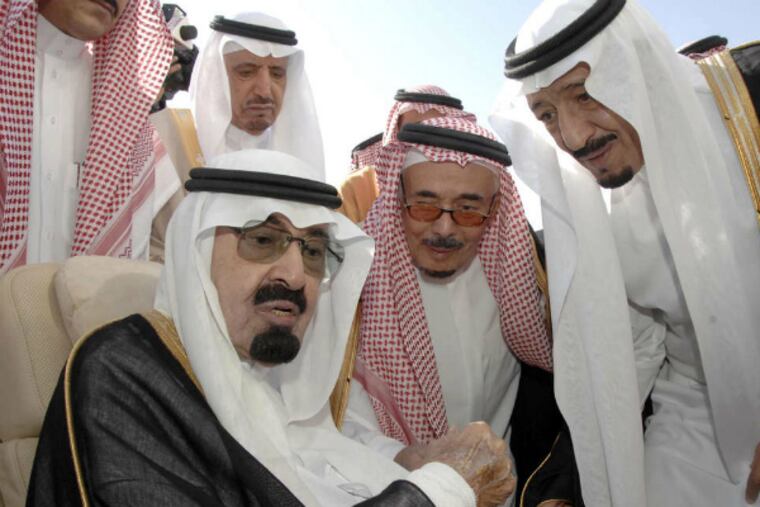
RIYADH, Saudi Arabia - King Abdullah, 90, the powerful U.S. ally who joined Washington's fight against al-Qaeda and sought to modernize the ultraconservative Muslim kingdom with incremental but significant reforms, including nudging open greater opportunities for women, died early Friday, according to Saudi state TV.
More than his guarded and hidebound predecessors, Abdullah assertively threw his oil-rich nation's weight behind trying to shape the Middle East. His priority was to counter the influence of rival, mainly Shiite Iran wherever it tried to make advances. He and fellow Sunni Arab monarchs also staunchly opposed the Middle East's wave of pro-democracy uprisings, seeing them as a threat to stability and their own rule.
He backed Sunni Muslim factions against Tehran's allies in several countries, but in Lebanon, for example, the policy failed to stop Iranian-backed Hezbollah from gaining the upper hand. And Tehran and Riyadh's colliding ambitions stoked proxy conflicts around the region that inflamed Sunni-Shiite hatreds - most horrifically in Syria's civil war, where the two countries backed opposing sides. Those conflicts in turn bolstered Sunni extremism that returned to threaten Saudi Arabia.
And while the king maintained the historically close alliance with Washington, there were frictions as he sought to put those ties on Saudi terms. He was constantly frustrated by Washington's failure to broker a settlement to the Israel-Palestinian conflict. He pushed the Obama administration to take a tougher stand against Iran and to more strongly back the mainly Sunni rebels fighting to overthrow Syrian President Bashar al-Assad.
Abdullah's death was announced on Saudi state TV by a presenter who said the king died at 1 a.m. Friday. His successor was announced as Prince Salman, his 79-year-old half-brother, according to a Royal Court statement carried on the Saudi Press Agency. Salman was Abdullah's crown prince and had recently taken on some of the ailing king's responsibilities.
President Obama, who visited with the ailing king in his desert compound last March, spoke Thursday of "our genuine and warm friendship." He praised Abdullah's dedication to the education of his people and said one of Abdullah's legacies was the strength of the relationship between the U.S. and Saudi Arabia.
Abdullah was born in Riyadh in 1924, one of the dozens of sons of Saudi Arabia's founder, King Abdul-Aziz Al Saud. Like all of Abdul-Aziz's sons, Abdullah had only rudimentary education. Tall and heavyset, he felt more at home in the Nejd, the kingdom's desert heartland, riding stallions and hunting with falcons. His strict upbringing was exemplified by three days he spent in prison as a young man as punishment by his father for failing to give his seat to a visitor, a violation of Bedouin hospitality.
Abdullah was selected as crown prince in 1982 on the day his half-brother Fahd ascended to the throne.
Abdullah became de facto ruler in 1995 when a stroke incapacitated Fahd. Abdullah was believed to have long rankled at the closeness of the alliance with the United States, and as regent he pressed Washington to withdraw the troops it had deployed in the kingdom since the 1990 Iraqi invasion of Kuwait. The U.S. finally did so in 2003.
The U.S.-Saudi alliance was tested in 2001, after the Sept. 11 terror attacks. The kingdom was home to 15 of the 19 hijackers, and many pointed out that the baseline ideology for al-Qaeda and other groups stemmed from Saudi Arabia's Wahhabi interpretation of Islam.
When al-Qaeda in 2003 began a wave of violence in the kingdom aimed at toppling the monarchy, Abdullah cracked down hard. For the next three years, security forces battled extremists, finally forcing them to flee to neighboring Yemen. There, they created a new al-Qaeda branch, and Saudi Arabia has played a behind-the-scenes role in fighting it.
The tougher line helped affirm Abdullah's commitment to fighting al-Qaeda. He paid two visits to President George W. Bush - in 2002 and 2005 - at his ranch in Crawford, Texas.
When Fahd died in 2005, Abdullah officially rose to the throne. He then began to more openly push his agenda.
His aim at home was to modernize the kingdom to face the future. One of the world's largest oil exporters, Saudi Arabia is fabulously wealthy, but there are deep disparities in wealth and a burgeoning youth population in need of jobs, housing, and education. For Abdullah, that meant building a more skilled workforce and opening up greater room for women to participate. He was a strong supporter of education, building universities at home and increasing scholarships abroad for Saudi students.
He for the first time gave women seats on the Shura Council, an unelected body that advises the king and government. He promised women would be able to vote and run in 2015 elections for municipal councils, the only elections held in the country. He appointed the first female deputy minister in a 2009. Two Saudi female athletes competed in the Olympics for the first time in 2012, and a small handful of women were granted licenses to work as lawyers during his rule.
One of his most ambitious projects was a Western-style university that bears his name, the King Abdullah University of Science and Technology, which opened in 2009. Men and women share classrooms and study together, a major departure in a country where even small talk between the sexes in public can bring a warning.
The changes seemed small from the outside but had a powerful resonance.
But he trod carefully in the face of the ultraconservative Wahhabi clerics who hold near total sway over society and, in return, give the Saud family's rule religious legitimacy. For example, beyond allowing debate in newspapers, he did nothing to respond to demands to allow women to drive.
"He has presided over a country that has inched forward, either on its own or with his leadership," said Karen Elliot House, author of On Saudi Arabia: Its People, Past, Religion, Fault Lines.
"I don't think he's had as much impact as one would hope on trying to create a more moderate version of Islam," she said.
And any change was strictly on the royal family's terms. After the 2011 Arab Spring uprisings in particular, Saudi Arabia clamped down on any dissent. Riot police crushed street demonstrations by Saudi Arabia's Shiite minority.