Donald L. Schotland, doctor, researcher
Donald Lewis Schotland, 84, of Wynnewood, an internationally known researcher into muscle disorders and for 38 years a leading figure in the University of Pennsylvania's neurology department, died Thursday, Aug. 13, of a stroke at Bryn Mawr Hospital.
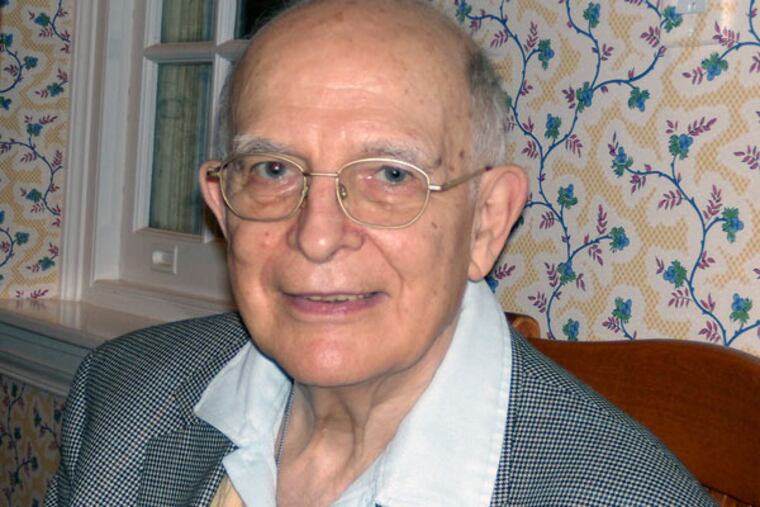
Donald Lewis Schotland, 84, of Wynnewood, an internationally known researcher into muscle disorders and for 38 years a leading figure in the University of Pennsylvania's neurology department, died Thursday, Aug. 13, of a stroke at Bryn Mawr Hospital.
Dr. Schotland's career as an MD spanned almost 50 years. He arrived at Penn in 1967, rising through the ranks to become professor of neurology and, later, professor emeritus. He closed his lab in 1998 and retired from clinical practice in 2005.
Using techniques from cell biology, including then-newly available electron microscopy, he pushed into the emerging field of neuromuscular disorders. He parsed out the minute components of the muscles themselves - central cores, lamellar bodies, and satellite cells.
He contributed to the field an understanding of the biochemistry, cell biology, and physiology of neuromuscular diseases, including McArdle disease, myotonic dystrophy, Duchenne muscular dystrophy, myasthenia gravis, mitochondrial myopathies, periodic paralysis, and Luft disease.
He looked at what can go wrong in such heartbreaking conditions as floppy infant syndrome.
Although the long-term goal was to learn enough to develop therapies for the diseases, those have remained elusive, his son John Schotland said. Most neuromuscular diseases remain untreatable, but Dr. Schotland's work laid the foundation for further advances.
When he began his research in the early 1960s, little was known about the biochemical and genetic causes of neuromuscular disease. He recognized an enormous opportunity for research, his son said.
Along the way, Dr. Schotland trained a generation of academic neurologists, many of whom now hold leadership positions in universities, medical schools, and research institutes in this country and abroad.
Robert L. Barchi, a young neurology resident when Dr. Schotland was a faculty attending physician at Penn, is president of Rutgers University.
"Don was a remarkable clinician, teacher, and scientist," Barchi recalled in an email. "Unassuming in spite of his erudition, he had time for anyone, whether a patient, a student or a colleague. Soft-spoken, empathetic, supportive, sensitive - all the things that many of us wished we were."
Dr. Schotland was an invaluable clinical resource to physicians within and outside Penn's neurology department.
"He always set aside time to meet with neurologists who needed his help to understand a case," wrote Mark Brown, a longtime colleague.
Dr. Schotland was "a quietly brilliant, thoughtful, kind, and gentle man. He was a highly regarded scholar, a caring clinician, a generous teacher, and a devoted mentor," Brown wrote in an email.
Born in Orange, N.J., Dr. Schotland attended Bloomfield High School and earned his bachelor's and medical degrees from Harvard University. He was a resident in neurology and a fellow in neuropathology at Columbia University, where he was on the faculty from 1962 to 1967.
At Penn, he was the founding director of the Henry Watts Center for Neuromuscular Research, over which he presided from 1976 to 1990.
Dr. Schotland was motivated to go into medicine by an uncle who was a surgeon. He chose neurology partly because his grandmother Elsie Schotland had died of an aggressive brain tumor.
Dr. Schotland taught neuroscience to first-year medical students at Penn. He also taught the basic course in clinical neurology to third-year medical students, and was especially active in teaching the fellows - physicians who had completed residency training in neurology.
"He was an exceptionally clear thinker and had the rare ability to translate complex scientific subjects into easily understandable language," said his son. That quality was leavened by a dry sense of humor; he was popular with patients, his son said.
He enjoyed tennis, playing the clarinet, and reading voraciously on historical subjects, especially the history of medicine.
He was married to Marilyn Goldfeder Schotland, a pediatrician, until her death in 1974 of breast cancer at age 42. They met during their first year at Harvard Medical School.
In 1977, he married Estherina Shems.
Besides his wife and son John, he is survived by sons Tom and Peter and four grandchildren.
At his request, no memorial services were held.