Philly Common Pleas Judge Alex Bonavitacola, 85, cleared caseload quagmire
Alex Bonavitacola, 85, of Haverford, a Philadelphia Common Pleas Court judge for 28 years, who was hailed for clearing a staggering backlog of cases in the 1990s, died Friday, July 29, of heart failure at Beaumont at Bryn Mawr.
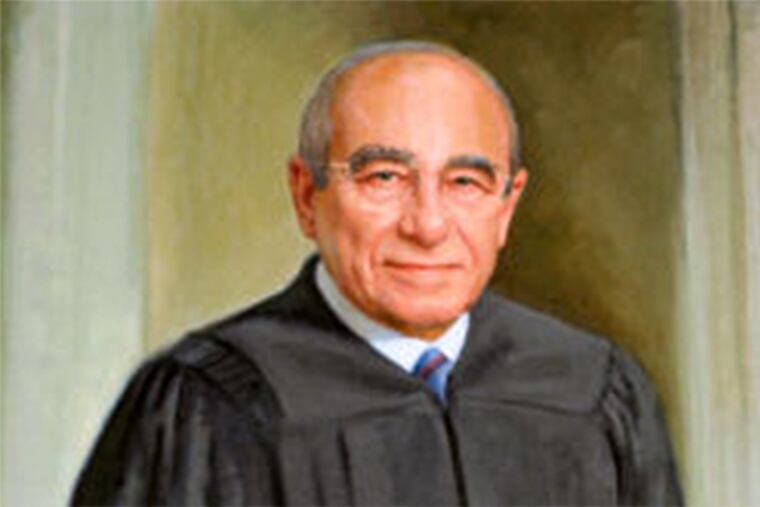
Alex Bonavitacola, 85, of Haverford, a Philadelphia Common Pleas Court judge for 28 years, who was hailed for clearing a staggering backlog of cases in the 1990s, died Friday, July 29, of heart failure at Beaumont at Bryn Mawr.
Elected in 1973, Judge Bonavitacola was a president judge for five years and chairman of the First Judicial District of Pennsylvania, overseeing Common Pleas, Municipal, and Traffic Courts.
He was one of only a few judges who served in Family Court, Orphans' Court, and criminal court, all divisions of Common Pleas Court.
Before retiring in 2001, he developed a reputation as a specialist in hearing class-action litigation.
His most lasting contribution, however, was turning Philadelphia's civil courts from a quagmire into a model of efficiency by eliminating years of lawsuit logjams. When the state Supreme Court named him administrative judge for the trial division in 1992, about 28,000 lawsuits were waiting to be heard by juries.
"Our civil backlog was almost a national disgrace," then-Senior Common Pleas Court Judge Bernard Goodheart said in 2001. "If you brought a lawsuit, you might wait seven or eight years for a trial."
By engaging seasoned litigators to hear cases and oversee settlement agreements, and assembling a crack team of judges for trials when settlements were elusive, Judge Bonavitacola whittled down the caseload.
As the backlog shrank, other judges followed suit, implementing strict deadlines to make sure new cases did not languish.
"We have no backlog of old cases now," Judge Bonavitacola announced in January 2001. "They're gone."
Goodheart said at the time, "Philadelphia has gone from being one of the worst places in this country to get a trial, to a model."
In 1995, Judge Bonavitacola's colleagues elected him president judge, a five-year post with considerable power. The president judge presides over the Board of Judges and the court's budget.
"He was a wonderful president judge," said Common Pleas Court Judge John W. Herron, who replaced him as administrative judge. "He has a clear vision of the court from years and years of service."
Judge Bonavitacola had a firm grip on the court's purse strings, paring the fat from the budget.
"He was a real strength in the budget process with the city," Herron said. "He kept the place together in terms of those budget discussions, which can be very rancorous."
In an Inquirer interview in 2001, Judge Bonavitacola said he was particularly proud of the technological advances the court had made. Until 1993, it had been dependent on typewriters and rotary phones.
"We have really come into the 21st century with technology. We are pretty much completely computerized now," he said in the interview. "That I feel very, very good about. It takes us out of the pen-and-ink era."
During his term as president judge, the court launched its own website, http://courts.phila.gov/.
"You don't have to come down to the courthouse to look at records," the judge said. "You can access it from your own home if you have the internet."
Judge Bonavitacola was not immune to controversy. In 1997, he became embroiled in a dispute involving Common Pleas Court Judge Bernard J. Avellino, who had refused to preside over nonjury trials in minor criminal cases.
Judge Bonavitacola placed the matter in the hands of the state Supreme Court, which suspended Avellino for three months. Avellino resigned in July 1998.
Judge Bonavitacola grew up in South Philadelphia, and graduated from Central High School. For 18 months, he played second base for a B-class Alabama-based affiliate of the Dodgers. Eventually, though, he realized his future was not on the diamond.
Trading bat for books, he earned a bachelor of science degree from Temple University in 1953.
He earned a law degree from Temple School of Law in 1956 and completed advanced legal study in 1962.
Judge Bonavitacola served as an assistant city solicitor and trial attorney in Philadelphia before being elected to the judiciary for the Court of Common Pleas on the Democratic ticket in 1973. He was retained in 1983 and 1993.
He received many awards, including the Justice William J. Brennan Distinguished Jurist Award and the Philadelphia Bar Association's Bar Medal.
As president judge, he acted to restore the law library in City Hall to its original splendor without using public money. It was christened the Alex Bonavitacola Law Library.
"He was a modest man," said daughter Portia. "What he did was not for personal recognition - it was for the public good."
In November 2015, the Philadelphia Bar Association Civil Litigation Section named its annual award for outstanding service the Hon. Alex Bonavitacola Award.
Off the bench, the judge enjoyed reading history, traveling, following the Phillies, and spending time with his family in Margate, N.J.
He met Flora Jane Catalano at a Sons of Italy banquet in South Philadelphia. They married in 1963 and had two children, Marc and Portia. They lived in the Packer Park section of South Philadelphia for 50 years before retiring to Haverford. He moved to Beaumont amid declining health.
In addition to his wife and children, he is survived by two grandchildren.
A visitation from 7 to 9 p.m. Tuesday, Aug. 2, will be at the D'Anjolell Memorial Home, 2811 West Chester Pike, Broomall. A second visitation will begin at 8:30 a.m. Wednesday, Aug. 3, at St. John Vianney Church, 350 Conshohocken State Rd., Gladwyne, followed by a 10 a.m. Funeral Mass. Burial is in SS. Peter and Paul Cemetery, Marple Township.
Donations may be made to the St. John Vianney Scholars Fund, The Rectory, 1110 Vaughan Lane, Gladwyne, Pa. 19035.
610-313-8102