Shimon Peres, 93, Israeli statesman, dies
Shimon Peres, 93, the Israeli statesman who helped build his country into a nuclear-armed regional military power, shared a Nobel Peace Prize for laying out a short-lived framework for peace with the Palestinians, and more recently defended Israel's controversial military actions in the Gaza Strip and Lebanon, died Wednesday at a hospital in Tel Aviv, Israeli media reported.
Shimon Peres, 93, the Israeli statesman who helped build his country into a nuclear-armed regional military power, shared a Nobel Peace Prize for laying out a short-lived framework for peace with the Palestinians, and more recently defended Israel's controversial military actions in the Gaza Strip and Lebanon, died Wednesday at a hospital in Tel Aviv, Israeli media reported.
The cause was complications from a massive stroke earlier in the month, according to reports.
Mr. Peres, who held nearly every high office in his country and whose influence spanned 10 U.S. presidencies, was the last of a generation of politicians who came of age as Israel did, and helped guide it through regional conflicts and economic restructuring.
In addition to having been the president and serving as prime minister three times - once briefly in an acting capacity - he had been foreign minister, information minister, finance minister and defense minister. It was during his time as defense minister that Israel pulled off the exquisitely orchestrated 1976 rescue operation of Israeli hostages at Entebbe International Airport in Uganda.
After more than a half-century of involvement in the most important events of Israel's history, Mr. Peres had become "the grand old man of Israeli politics," said Chuck Freilich, a senior fellow at Harvard's international security program and a former deputy national security adviser of Israel. "You could feel his influence everywhere."
Yet Mr. Peres left a complex legacy. At every stage in his career, the European-born Mr. Peres had to fight the sense that he was insincere, consummately political, and opportunistic.
The late Prime Minister Yitzhak Rabin, his longtime rival, once called him an "inveterate schemer."
To many, Mr. Peres seemed a contradictory figure. Although he served as prime minister three times, he was never elected to the office and remained unpopular with voters. He projected intellectualism but had little formal education. He spoke of moderation and compromise, but was notorious for his vitriolic feuds with other politicians.
As foreign minister, Mr. Peres shared the Nobel Peace Prize in 1994 with Rabin and Palestine Liberation Organization leader Yasir Arafat after helping to create a program for negotiating with the Palestinians that later stalled and sputtered out.
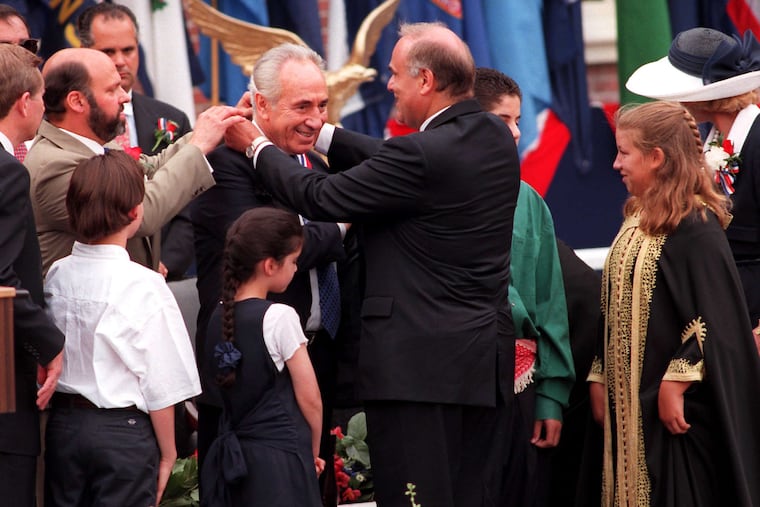
Mr. Peres received the Liberty Medal from Mayor Ed Rendell in 1996. He shared the Philadelphia prize that year with King Hussein of Jordan.
The man best known internationally for promoting peace started his public career procuring weapons at a young age.
While still in his 20s, as director general of the Defense Ministry in the 1950s, Mr. Peres embarked on a sweeping program to make Israel a major military force.
In the 1970s, as defense minister, Mr. Peres encouraged Jewish settlers to claim land in the occupied West Bank, Gaza Strip and Golan Heights.
Yet, by the 1980s, he said peace with the Arabs could not be achieved through military means. As prime minister from 1984 to 1986, he pulled Israeli troops out of most of Lebanon.
On the premise that a sound economy could promote peace, Mr. Peres devised a plan to lower inflation from more than 400 percent annually to less than 20 percent. He made overtures to Jordan and to the Palestinians, and he moved to thaw the cold peace with Egypt, which in 1979 had signed a peace treaty with Israel but remained aloof.
By the early 1990s, a growing number of Israelis were rejecting the occupation of the West Bank and Gaza Strip as morally wrong - on the grounds that it violated principles of democracy and equality; that it was demographically undesirable, because it brought millions of Palestinians under the authority of the Jewish state; and that it was militarily impractical, because it committed Israeli troops to confronting Palestinian civilians instead of the potential threat from foreign enemies.
Meanwhile, the Palestinians were ready to make a deal. The PLO was nearly bankrupt. Wealthy Arab donors had withdrawn financial support after the PLO backed Iraqi leader Saddam Hussein during the Persian Gulf War, and other funding vanished after the collapse of the Soviet Union in 1991.
Mr. Peres, then foreign minister, authorized his deputies to pursue secret contacts with Palestinian leaders.
"It's not that I changed my character. I found a different situation," Mr. Peres told Newsweek, speaking of the transformation in his policy.
In 1993, in a sudden breakthrough, Mr. Peres and Rabin sealed the peace accords with Arafat, their mortal enemy, on the White House lawn under the gaze of President Bill Clinton.
"We live in an ancient land, and as our land is small, so must our reconciliation be great," Mr. Peres said at the ceremony. "As our wars have been long, so must our healing be swift."
Mr. Peres was born Szymon Persky on Aug. 2, 1923, in Vishneva, a Jewish shtetl in what was then Poland and is now Belarus. He attended a Zionist school that advocated the return of Jews the world over to the biblical land of Israel - then under British rule and populated largely by Palestinian Arabs.
After his family immigrated to Palestine in 1934, he joined a socialist youth movement and signed up for an agricultural school at Ben Shemen to remake himself in the Zionist ideal: as a farmer. As a young man, he changed his name to the Hebraized Peres, meaning "vulture," after coming across a majestic bearded vulture while crossing the Negev desert.