Reporter who chronicled fight with cancer dies
Fawn Vrazo, 60, who shared the heartaches and triumphs of her long struggle with breast cancer in a moving Inquirer series called "The Cancer Chronicles," died of the disease yesterday. She lived in Manayunk.
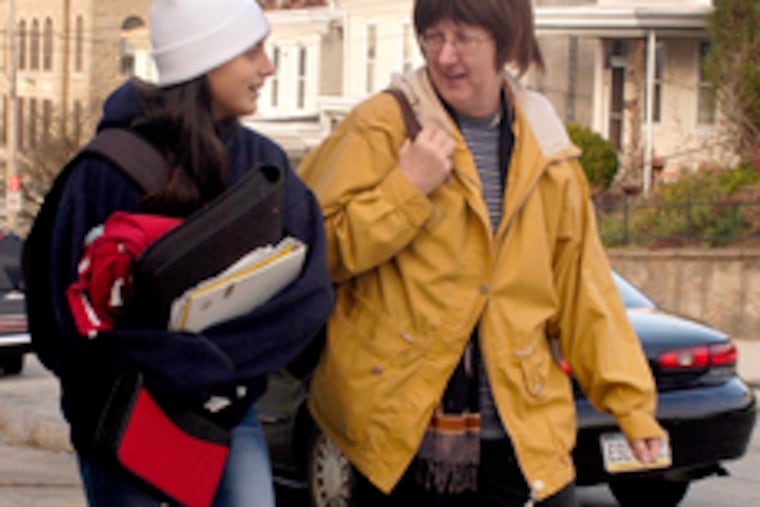
Fawn Vrazo, 60, who shared the heartaches and triumphs of her long struggle with breast cancer in a moving Inquirer series called "The Cancer Chronicles," died of the disease yesterday. She lived in Manayunk.
Mrs. Vrazo's 41-year newspaper career took her from small-town Indiana to the killing fields of Kosovo, assignments she embraced with a joyous drive few peers could match.
She spent 23 years at The Inquirer, where she was a local, national and foreign reporter who also wrote editorials, investigative pieces and medical stories. She pioneered coverage of women's health issues in the early 1990s, long before most media began paying attention. In 1991, Mrs. Vrazo was a Pulitzer Prize finalist for that coverage.
Then, when she fell ill with the very disease she had written so much about, she shared her experiences with Inquirer readers, who poured out their own stories to her.
"She had hundreds and hundreds of e-mails," said Trish Wilson, science and medicine editor at The Inquirer. "She tapped into this invisible world, and when she did, she got this incredible outpouring."
In late 2005, Mrs. Vrazo took a buyout from The Inquirer, calling her career there "the most fun, the best time anyone could ever want." But she did not retire from life.
Despite medical setbacks, Mrs. Vrazo spent her last year in overdrive. She went on the road - to Texas, North Carolina and Mexico - with her children, Matt, 25, and Anna, 16, and Matt's girlfriend, Alex Amick.
The trip to Houston, where the family once lived, was especially memorable. Matt said his mother insisted on eating oysters at a special seafood restaurant and getting Matt barbecue at another. They ended up missing their plane home.
"I was so mad, but it was a really good sandwich," Matt said. "That was my mom. She didn't want anything to get in the way of enjoying life."
Mrs. Vrazo was famous for her annual backyard "crabfest," which she managed again last summer. Until a few months ago, she was still, as she put it, "driving Miss Anna" everywhere she needed to go.
Inquirer editor William K. Marimow said he would always remember Mrs. Vrazo for her "absolute, never-say-die, indomitable spirit."
Born Fawn Bifoss in rural Indiana, Mrs. Vrazo was named by her father, then a lumberjack, who had seen some deer in the woods one day. "He vowed to name his first kid Fawn, or so the story goes," Mrs. Vrazo recalled in a series of interviews before her death.
The oldest of three children, she grew up in Griffith, Ind., attending a three-room schoolhouse in her early years.
A skinny "goody two-shoes who never got in trouble," she spent her free time in the public library. She even looked the part then, with nerdy, bug-eyed turquoise glasses.
She loved writing, hated math, and dreamed of being a poet or novelist, but quickly felt "the incredible pull of journalism."
By age 11, she was a columnist in the Griffith weekly shopper. Later, she edited her high school paper, cutting class to work on it. "I just felt that this is what I wanted to do," she said.
Early on, Mrs. Vrazo also exhibited the competitive determination that would distinguish her as a reporter.
Upon learning that a high school home-economics classmate was ahead in a Betty Crocker coupon drive, Mrs. Vrazo redoubled her efforts - and surpassed her nemesis.
"I am almost obsessively competitive," she said. "If I set my mind to it, nobody can beat me."
In 1964, Mrs. Vrazo headed off to the University of Missouri, the first in her family to go to college. She squeaked through freshman year, only to get kicked out in sophomore year for cutting gym.
"A few years later, you could burn down the administration building with administrators inside and still not get kicked out," she said, "but cutting gym class at that time was enough."
She tried college again, but flunked out. "I screwed up," she said.
For all her accomplishments, Mrs. Vrazo spent her adult life feeling self-conscious about not finishing college, carefully indicating on her resume that she had attended - not graduated from - the university.
Over the next few years, she worked at three small papers. At one, she was both reporter and printer, clocking once-a-week 36-hour shifts.
"I loved it. I loved it," she said with a grin.
At the Daily Calumet on Chicago's South Side, Mrs. Vrazo wrote a humor column, which - to her feminist chagrin - the editors called "Skirting the Issue."
She soon bolted to the Hammond Times in Indiana, which she described as "a newspaper so conservative, Janis Joplin's death was a brief and Kent State was no big deal." But she was a star, the "go-to gal to write the sob-sister stories," no matter that her grueling schedule spanned 5 a.m. police checks and 11 p.m. community meetings.
While at the Detroit Free Press, she met social worker John Vrazo at a neighborhood party. They married in 1978. Through him, she discovered a world outside of journalism, one inhabited by filmmakers and philosophers, chefs and artists.
"He taught me everything," Mrs. Vrazo said. "We would just talk and talk and talk."
The couple soon moved to Philadelphia so that Mrs. Vrazo could work at the Bulletin. A favorite story involved no-show workers in Camden City Hall.
She followed one worker home every night for a week, sitting in her car outside his house until 3 or 4 a.m. She was trying to prove that the man was lying about having a night job with the city. (He was, and she did.)
When the Bulletin folded in 1982, Mrs. Vrazo - on maternity leave with her son - was offered a coveted job at The Inquirer.
The night before returning to work, she recalled, she lay on the rug beside her sleeping baby and sobbed her heart out. "I was so sad to leave him," she said.
At The Inquirer, she won plum assignments, scoring its Houston bureau in 1986 and its London bureau in 1995.
In Kosovo, she witnessed raw revenge, writing: "Vengeful crowds of returning ethnic Albanians torched the homes of Serb sympathizers here yesterday as nearby NATO soldiers refused to intervene."
Mrs. Vrazo donned a helmet and baby-blue flak jacket on assignment, which often entailed driving - or running - through heavily mined areas. "I was terrified out of my skull," she recalled.
Perhaps her best remembered journalistic contribution was "The Cancer Chronicles," which she began in 2004.
"Like millions of other Americans," she wrote, "I inhabit a world in which a life-threatening disease has become a routine part of daily life. The doctors and staff at the Rowan center do their best to make me and other patients feel optimistic and nurtured. But there's no escaping the stark fact that my cancer will kill me someday, unless I get lucky and a bus hits me first."
First diagnosed with breast cancer in 1992, she often called it "the disease that keeps on giving." Just a year before, the Vrazos had adopted Anna.
Life was sweet, but hectic, on their 19th-century farm near Coatesville. The couple were raising their two youngsters, along with goats, ducks, geese and chickens, while commuting 96 miles round-trip to their jobs in the city.
They assumed she would be the first to die. But in 1996, as Mr. Vrazo was rushing to pick up his wife's 50th-birthday cake, he collapsed on a sidewalk near their home in London, where she had been posted. He died several hours later from a torn aorta. He was 46. They had been together 20 years. Mrs. Vrazo would later write that her husband's death was "the single most traumatic event" in her life. Even breast cancer "suddenly seemed minor in comparison."
Her cancer returned in 1999 and again in 2002, two years after she moved back to Philadelphia. It returned once more in 2004. As the disease spread, she fought it with the same drive she'd brought to her career - with chemo, radiation, surgical treatments and endless CAT scans, MRIs, bone scans and PET scans.
Again and again she bounced back.
Then, in December 2005, Mrs. Vrazo shared the news with readers: The cancer was back, this time in her brain.
"But she would not let her life be wasted in any way," her son recalled yesterday, "even when she couldn't walk anymore and was sitting in a chair."
In November, she presided over her 60th birthday party from the couch, greeting guests in a sparkly silver evening jacket. Ever the bargain hunter, she had bought it at a Salvation Army store.
Mrs. Vrazo died early yesterday at the Hospital of the University of Pennsylvania, as Matt slept in a chair by her bed. "I can't help but think, it was typical of her not to make a fuss, even at the end," he said.
Around the time of her death, Mrs. Vrazo had been working on the final installment of "The Cancer Chronicles," which will be published in later editions of tomorrow's Inquirer.
Besides her children, she is survived by her mother, brother and sister.
A viewing will be from 7 to 9 p.m. Tuesday and 9:30 to 10:30 a.m. Wednesday at James J. Terry Funeral Home, 736 E. Lancaster Ave., Downingtown. A memorial service will follow at 11 Wednesday at Downingtown Friends Meeting, next to the funeral home. Burial will be at Northwood Cemetery, Downingtown.
Memorial contributions may be made to Hope Afloat, attention Tobi Goldberg Maguire, 900 Valley Rd., D-102, Melrose Park, Pa. 19027.
Contact staff writer Virginia Smith at 215-854-5720 or vsmith@phillynews.com.