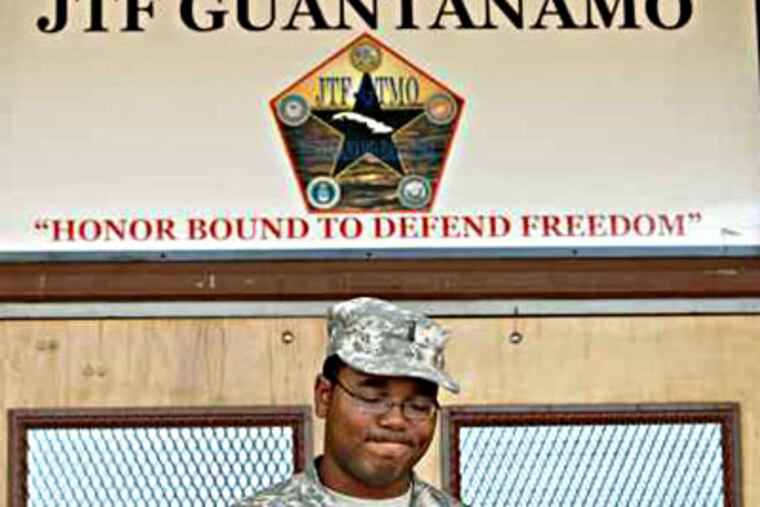
WHAT'S THE MOST terrifying aspect of the recent 5-4 Supreme Court decision affirming the right of habeas corpus for detainees at Guantanamo?
Take your pick:
(A) Most of Congress was intimidated into allowing the denial of the 800-year-old Great Writ, the bedrock right of Western civilization.
(B) Four justices of the U.S. Supreme Court - including its chief - think this is constitutional.
(C) A presidential candidate, John McCain, believes that Americans are still so easily manipulated by fear, and so ignorant of our political heritage, that calling Boumediene v. Bush "one of the worst decisions in the history of this country" will get him a lot of votes.
There's a strong case for each. This third-straight Supreme Court repudiation of the Bush administration's tactics at Guantanamo is an important victory, to be sure. But it's a battle that should never have had to be fought. That it was says something disturbing about how vulnerable America has become to fear and deceit.
Justice Anthony M. Kennedy's majority opinion in Boumediene reads like the first chapter of a civics book: No government has the right to imprison people without giving a reason. You can't circumvent the Constitution by setting up an off-shore gulag where "anything goes." Of course. Any eighth-grader knows that, or should.
Yet this nation's leaders defended doing just that, and others went along. The descendants of Americans who vowed "better dead than red" in the face of a Communist enemy cowered after the 2001 terrorist attacks, ready to relinquish this basic right in exchange for a false sense of security.
How false was it? Some of the 770 prisoners who have been held at Guantanamo may indeed have been "the worst of the worst," as President Bush asserted. There is evidence that many were not. An eight-month investigation by McClatchy newspapers recently revealed that possibly hundreds of men were wrongfully imprisoned based on "flimsy or fabricated evidence, old personal scores or bounty payments."
Some may have been very low-level members of the Taliban, while others were fully innocent of wrongdoing. Some were in their 70s and 80s, others were teenagers. In any event, they posed no real danger to the people of the United States.
Yet they were held for years, and some are still being held, without charges.
In the recent case, Lakhmar Boumediene was one of six men charged in Bosnia, not Afghanistan,for allegedly plotting to blow up the U.S. Embassy in 2001. A Bosnian court found no evidence to convict them, but as soon as they were released, they were taken into custody and sent to Guantanamo, where they have been held ever since.
Did Boumediene and his friends pose a real danger to our national security? We have no idea. We do know that, even if he were among "the worst of the worst," he would be entitled to his day in court - a right guaranteed even to the Nazis at Nuremberg, for pity's sake.
And we can state with certainty that devising legal schemes to hold Boumediene and the others without charge, as the Bush administration did, poses a far greater danger to the American way of life than any of the "worst" ever could.
In its decision, the Supreme Court did not order anyone released. It did not stop the current military tribunals trying the alleged al Qaeda masterminds. It simply said that detainees have a right to know the charges against them.
What to do after that is up to the courts and, eventually, Congress. In the meantime, it's time for us as a nation to start repairing our broken commitment to the rule of law. *