Christine M. Flowers: And then there were four. . .
Also I heard the voice of the Lord saying, whom shall I send and who will go for us? Then said I, here am I, send me.
Also I heard the voice of the Lord saying, whom shall I send and who will go for us? Then said I, here am I, send me.
- Isaiah 6:8
TIMOTHY Simpson heard a call in the night and answered without hesitation.
He was no different from all the others who put on a uniform in the morning, walk out the door and place their lives at the service of strangers. Simpson, 46, married, father of three, was killed while rushing to a robbery in progress, trying to protect people he didn't know and, tragically, would never meet.
He was the fourth this year.
Patrick McDonald, 30, son and brother, was gunned down in cold blood by a man who never should have been walking the streets. His killer was a parole violator, the lowest of the lowest who fill the streets already groaning under the weight of such trash.
He was the third.
Isabel Nazario, 40, mother, sister, daughter, was killed when her police van was struck by a young thug who wasn't even born when the 18-year police veteran joined the force and who passed his days terrorizing neighbors. She was the second.
Stephen Liczbinski, 39, married, father of three and friend of Sgt. Simpson, was assassinated after he responded to a radio call of a robbery in Port Richmond, the scene of Simpson's death. One of his killers was shot to death. The other wasted lives survived.
He was the first.
Four lives destroyed in a matter of months, a bloody trail from May to November, starting on a warm spring day and ending - please, God, let it end! - on a bitterly cold autumn eve.
Four deaths, 58 years of service, an incalculable loss.
And before them, two others in recent memory. Officer Charles Cassidy, fatally shot by a man with a baby face and a monster's heart. Gary Skerski, felled by a shotgun-wielding thug who cut a deal for his own miserable life.
2008 has been the most dangerous year for Philadelphia officers since 1996, when four were killed. A prayer to Michael the Archangel, patron of police, that we don't break the record.
And even though each death is different, some brutal assassinations, others reckless accidents, the effect is the same: overwhelming grief, followed by uncontained anger.
And it's a different sort of anger from when civilians die.
Yes, it's an ugly aspect of nature that innocent children should be caught in a drug cross-fire on their way to school.
It pierces the heart when elderly women are raped in their bedrooms by teen intruders, when retired army vets are bludgeoned to death in their living rooms, when young mothers are murdered by the fathers of their babies.
IT'S A MISERABLE world in which such things not only happen but become commonplace. And Philadelphia is a part of that world.
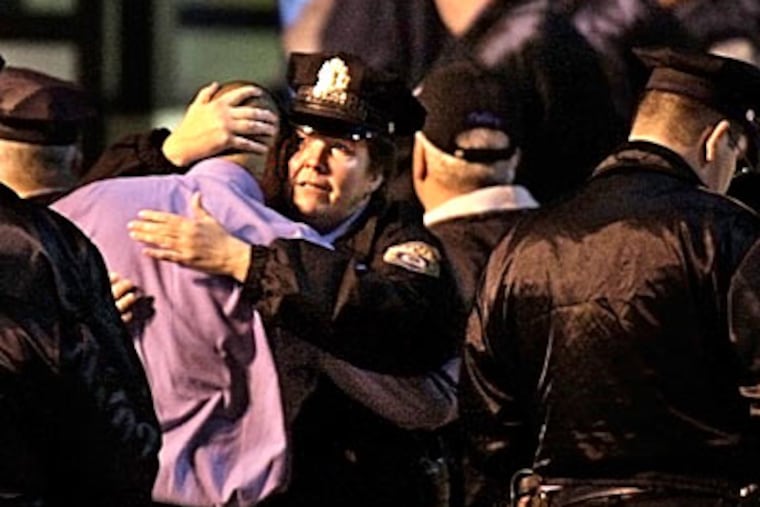
But there's something surpassingly sad when you see men and women grouped at the entrance of a hospital, tears in their eyes for a stricken comrade. The grief that accompanies the coffin of a fallen officer is unlike any other because the occupant of that coffin met death on our behalf.
And the symbolism of a rider-less horse following close behind reminds us that - for a moment at least - the city is defenseless.
Of course, that's only a brief illusion. For every officer who falls in the line of duty there are hundreds more ready to take his or her place in the thin blue line. While no one can replace the one who has been taken, the obligation is picked up by brothers and sisters, an unbroken continuum of faith and service.
We saw it with Timothy Simpson. Stephen Liczbinski's friend took the murdered officer's handcuffs and placed them on his accused assassin's wrist when he was apprehended back in May. Simpson honored that debt. Now, tragically, he and Liczbinski are together again.
Some people complain about the attention given when an officer is slain.
Some judges think we should not elevate their deaths above "the rest of us," those without the bulletproof vests and the shields. Some citizens think that color excuses criminality, or that poverty is an explanation for antisocial behavior, or that grief is misplaced for those who willingly enter a dangerous profession.
These sentiments are heard in the streets, seen in the courtrooms, read on the letters page.
But they are wrong. Decent people understand it. The rest are irrelevant.
Four officers won't see the New Year. Four men and women have made the ultimate sacrifice for a city and a system that often seems to care more about rehabilitating criminals than honoring heroes.
And still, they keep answering the call.
No greater love. *
Christine M. Flowers is a lawyer.
E-mail cflowers1961@yahoo.com.