Michael Smerconish: GOP fights, White House laughs
LAST WEEKEND, Republican National Committee Chairman Michael Steele called Rush Limbaugh's work "incendiary" and "ugly." Limbaugh, in turn, complained that Steele was "off to a shaky start" at the RNC. The back-and-forth was portrayed as a case of politicide. That cheering you hear is coming from the White House.
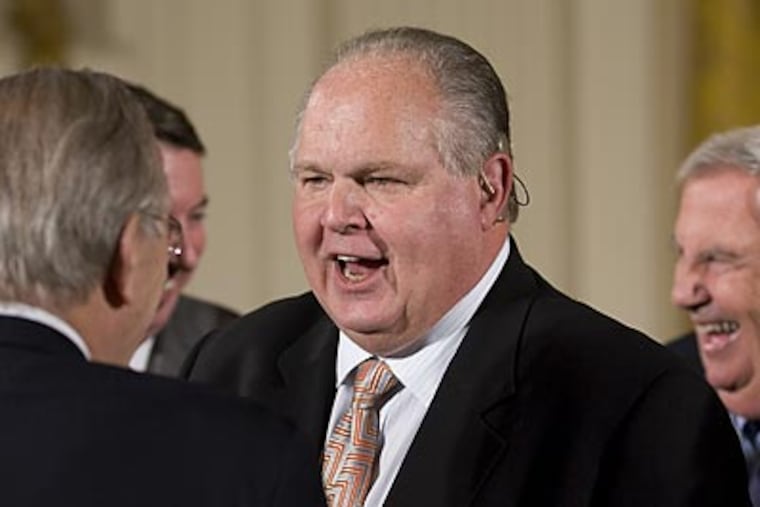
LAST WEEKEND, Republican National Committee Chairman Michael Steele called Rush Limbaugh's work "incendiary" and "ugly."
Limbaugh, in turn, complained that Steele was "off to a shaky start" at the RNC. The back-and-forth was portrayed as a case of politicide. That cheering you hear is coming from the White House.
Overlooked? The fact that Steele and Limbaugh have different objectives. And, in responding to one another, each was just fulfilling his role.
The drama began when Limbaugh donned what Chris Matthews referred to as Johnny Cash's wardrobe and spoke at the Conservative Political Action Conference in Washington.
Taking note of live coverage by C-SPAN, CNN and Fox News, Limbaugh joked that it was his "first-ever address to the nation," before offering his prescription for what ails the conservative movement.
"We conservatives have not done a good enough job of just laying out basically who we are because we make the mistake of assuming that people know," he said. "What they know is largely incorrect, based on the way we're portrayed in pop culture, in the drive-by media, by the Democrat Party."
THE SAME night, Steele corrected CNN's D.L. Hughley after the host called Limbaugh "the de facto leader of the Republican Party." Steele said Limbaugh was "an entertainer," during an exchange for which the newly minted RNC chair would apologize a few days later.
The spat was quickly hyped by the White House and portrayed as a fracture in the loyal opposition. But that analysis assumes Steele and Rush are unified in purpose. They aren't.
Ringing in my head are the words of a government professor from my alma mater, Lehigh University. I recall Frank Colon offering these words during a lecture: "Political parties," he said, "exist for one reason, and that is to win."
He was right. Steele's mission at the RNC is to right the ship, raise money, win elections.
Limbaugh, meanwhile, has no portfolio in the party. He's a headliner fit for keynote addresses like the one he offered last weekend. As I wrote in October 2007 after watching him speak at the Academy of Music: "Rush Limbaugh is radio's Riccardo Muti. He is an entertainer par excellence, and it is his gift of communication that sets him apart. The message, his politics, is his encore."
That's not a swipe, just acknowledgment that his role is not the same as Steele's. Limbaugh's job is to build an audience. Premiere Radio Networks isn't paying him $400 million to get Republicans elected to Congress.
The bigger picture is that both Steele and Limbaugh were right.
The founder of the Limbaugh Institute for Advanced Conservative Studies was correct to implore Steele to "go behind the scenes and start doing the work that you were elected to do instead of trying to be some talking-head media star, which you're having a tough time pulling off."
Meanwhile, it's sound politics for the head of the RNC to be deferential to Limbaugh. The GOP - no matter who's really leading it - can't win elections without appealing to Limbaugh's base.
But the GOP shouldn't cede control to that crowd. The base might be enough to land Limbaugh atop Talkers magazine's Heavy Hundred. It's just too narrow to win elections.
The White House knows that. Which explains why Robert Gibbs and Rahm Emanuel were tossing gasoline on the GOP conservative conflagration.
Nonetheless, the debate is the latest evidence of the void at the head of the GOP. Not long after CNBC contributor Rick Santelli made a better impression than Louisiana Gov. (and prospective GOP presidential candidate) Bobby Jindal, the GOP is again reduced to philosophizing about its own identity crisis.
This is not to say that everyone from Steele to Limbaugh to Jindal and Mitt Romney needs to be in lockstep in message or mission. It's just that the party can't afford to continue to get caught up on semantic issues like a talk-show host's desire to see the president fail.
The country has bigger problems to solve, and the GOP should get to offering a viable alternative to Democratic proposals for solving them.
As usual, the real answers won't be found among the sound-bites and split screens. *
Listen to Michael Smerconish weekdays 5-9 a.m. on the Big Talker, 1210/AM. Read him Sundays in the Inquirer. Contact him via the Web at www.mastalk.com.