The media's love affair with President Obama
Perhaps John McCain was right about Barack Obama being the "biggest celebrity in the world." The news media, focused on profiting from the president's celebrity, have been failing to report objectively on his policies.
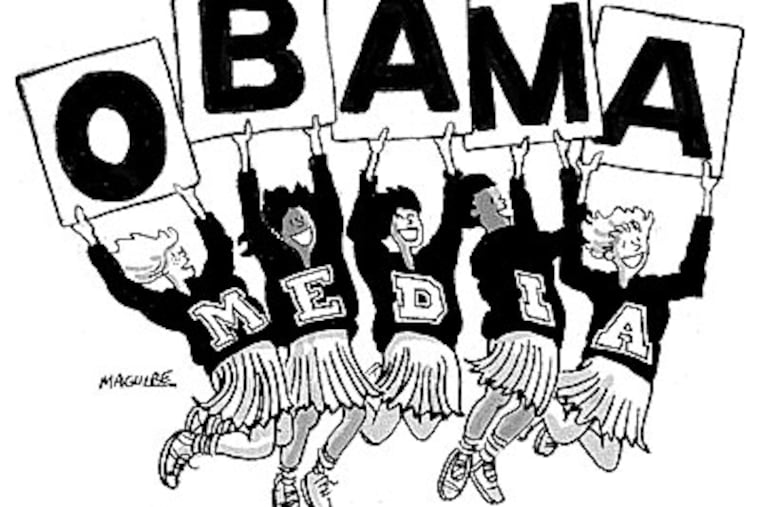
Perhaps John McCain was right about Barack Obama being the "biggest celebrity in the world." The news media, focused on profiting from the president's celebrity, have been failing to report objectively on his policies.
We have seen a number of outrageous examples of media bias in the five months since Obama's inauguration. And in recent weeks, Obama completed a "triple crown" of extended interviews on the three major networks.
Before Obama left for the Middle East, NBC News aired four hours of interviews in prime time over two nights to give viewers a portrait of a "day in the life" of the White House.
CBS News weighed in last week with its "Two Sides of Barack Obama." It aired the first part, "Barack Obama: An American Dad," on Father's Day, and the second, "Barack Obama: The American President," the next day.
And on Wednesday, ABC News aired "A Conversation with the President," an hourlong prime-time special on health-care reform taped in the East Room of the White House - not exactly a neutral site. ABC rejected reasonable requests to include opposing voices during the infomercial, which was essentially a political contribution masquerading as news coverage.
There are several troubling aspects to ABC's relationship with the administration. Linda Douglass, a former ABC News journalist, is now communications director in the White House's Office of Health Reform. The Washington Times recently reported that employees of ABC gave 80 times as much in contributions to Obama's campaign ($124,421) as they did to his Republican opponent, McCain ($1,550). And a study released this month by the Business and Media Institute found that ABC News had aired stories with positive reviews of Obama's health-care policy 55 times, while it featured just 18 negative stories on the subject.
But the fawning coverage has not been limited to the broadcast networks. A recent study by the Center for Media and Public Affairs examined all the evaluative comments in New York Times stories during Obama's first 50 days in office. It found that 73 percent of them were favorable.
The Pew Research Center's Project for Excellence in Journalism compared coverage of this president and his two immediate predecessors over their first 60 days in office by several major media outlets: the networks, the Times, the Washington Post, Newsweek, and PBS' Newshour. It found that Obama was favorably covered 42 percent of the time, compared to 22 percent for Bush and 27 percent for Clinton.
This bias was not limited to straight news. Unlike his predecessors, Obama received more favorable than skeptical treatment in newspaper opinion pages, too.
Underscoring the celebrity factor, the study found that about twice as much of the coverage of Obama dealt with his "personal and leadership qualities" - not his policies. Media coverage of the trivial is crowding out coverage of important issues.
How many hours and column inches were devoted to the Obamas' recent dates on Broadway and in Paris? We've even been subjected to coverage of Obama's quick reflexes in swatting a fly during an interview.
A Google News search for "Barack Obama" returns 330 million results - more than 10 times the results for Pope Benedict XVI. Even teen star Miley Cyrus (also known as Hannah Montana) returns only 90 million results.
Bill Maher, a liberal comedian with his own show on HBO, recently remarked, "I don't want my president to be a TV star."
David Zurawik, a television critic for the Baltimore Sun, has called on the networks to question their Obama coverage. Referring to a CNBC interview in which Obama complained that "one television station is entirely devoted to attacking" his administration, Zurawik wrote, "I hesitate to write these words, but good for Fox [News]," he wrote. "It must be doing something right, if it has the president complaining about the tiny bit of scrutiny he gets on TV."
With the sweep of Obama's policy ambitions - and growing public skepticism about his agenda - unbiased, fair, issue-based reporting is especially important. In a poll recently released by NBC News and the Wall Street Journal, 56 percent of Americans said they lacked confidence in Obama's economic policies, 56 percent opposed the bailout of General Motors, and 52 percent opposed the closing of the prison at Guantanamo Bay.
Rather than covering date nights and personality, the media should further investigate these issues so they can better inform the public. They will probably have the airtime to do so once their Obama specials are over.