City Howl Help Desk: Philadelphia Streets Department explains potholes
City Howl is a Web site that allows citizens to post their raves or rants about city services. Every Wednesday, we publish highlights of our investigations into some of these problems.
City Howl is a Web site that allows citizens to post their raves or rants about city services. Every Wednesday, we publish highlights of our investigations into some of these problems.
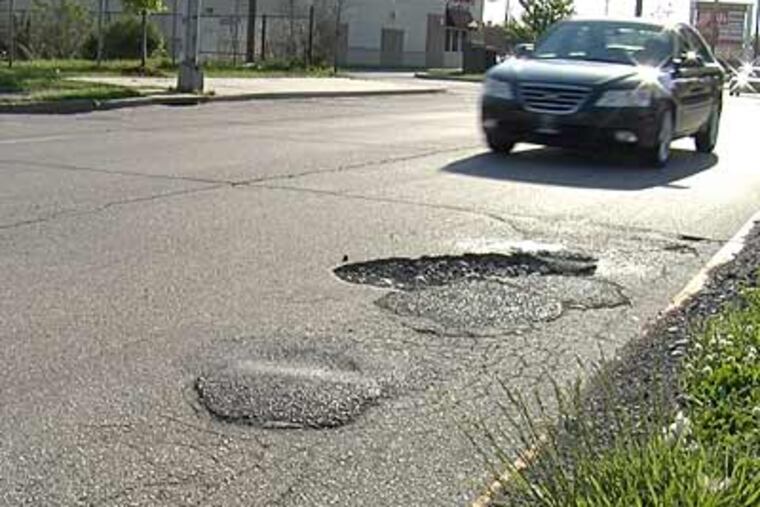
THE PROBLEM: In April, a visitor to the City Howl Web site (www.thecityhowl.net) posted an unfavorable review of the Streets Department, citing the number of unrepaired potholes in South Philly. The stretch of Oregon Avenue between 9th and 24th streets, the user wrote, was especially bad, filled with "not just potholes, but sink holes."
WHAT WE DID: We started by taking a ride along Oregon between 9th and 24th in early May.
We didn't find much, other than one long stretch of holes between 21st and 22nd streets that had been almost entirely repaired. It looked like there had once been close to a dozen holes in the left lane, but only one remained unfilled.
Curious, we called the Streets Department and spoke with Steve Buckley, deputy commissioner of transportation. We went in looking to learn about Oregon Avenue. We came out with a tutorial on all things pothole-related, including how to get one fixed, and a lesson on why this has been a particularly bad year for potholes.
First things first: The repair between 21st and 22nd took about a half day and cost between $6,000 and $7,000, Buckley said. It consisted of a thin layer of asphalt called a "skim coat" applied to the road.
Although Buckley didn't see the problem before the repair, he said he doubted that the holes had been technically potholes, based on the type of repair.
"What the public deems a pothole isn't necessarily a pothole," said Buckley. According to the Streets Web site (www.phila.gov/streets/potholes.html), real potholes are "bowl-shaped openings that usually have raveled edges and can be up to 10 inches deep." They occur when the top layer of asphalt wears away and reveals a concrete base. (Potholes aren't to be confused with two other common road defects: cave-ins and ditches. But we digress.)
Once a pothole is reported, Buckley said, the Streets Department repairs it within three business days using a machine called "the Pothole Killer."
The Killer sprays a substance into a pothole, fills it and tops it off with a coating made of recycled tires - the whole thing takes just minutes.
This season, Streets has averaged 1.7 days to repair a pothole after it's reported, Buckley said. But if, like us, you think you spotted an unusually high number of potholes this winter and spring, you weren't hallucinating.
In a typical year, Streets will repair 10,000 to 12,000 potholes along the 2,500 miles of city roads that it oversees.
This fiscal year, the department had repaired 19,400 potholes as of May 21 - and it's on track to fill more than 20,000 before the fiscal year ends on June 30.
Why? This winter's cold, wet conditions created more potholes because when moisture gets beneath asphalt, it freezes and pushes the asphalt up. Passing vehicles then push it back down. The back-and-forth movement weakens the asphalt, creating potholes, especially in areas with older roads, like Center City and South Philly.
Naturally, the extra work costs - the Streets Department's highway maintenance unit spent several thousand dollars to lease two additional Pothole Killers for two months, and the man-hours had to be taken from somewhere. But, Buckley said, those costs won't get fully accounted for until the end of the year, and aren't a substantial part of the budget in any case.
So why do I see still see so many potholes?
Contrary to what some people may think, Buckley said, the Streets Department doesn't have a giant map of the city that lights up each time a new pothole is born.
Instead, it relies on residents to speak up when they spot one.
The best way to notify the Streets Department is actually by calling 3-1-1. Residents can also call the department directly at 215-686-5560 or report a pothole on its Web site (potholes.phila.gov/).
When reporting a street defect, provide as much information as possible, like which lane the defect is in, the address it's in front of, how large it is, if the hole is filled with water, etc.
SINCE ONE person's pothole may be another's cave-in, it also helps to take a look at the Streets Web site first to try to figure out what type of defect you've seen. Repairing a cave-in requires more time and more resources than repairing a pothole (the Pothole Killer is useless for cave-ins), so don't expect it to be taken care of immediately.
Also worth noting: Not all sections of roads in the city are actually the responsibility of the Streets Department. PennDOT, for example, maintains state roads like Broad Street (state Route 611), and SEPTA maintains sections of roads located inside trolley tracks and within 18 inches on either side of them.
When in doubt, though, Buckley said, report the defect to the Streets Department, and they'll figure out whose headache it is.
And if you're having trouble reporting a defect or if it's taking a while to get it repaired, call us at 215-854-5307, and we'll see what we can do.
Kirstin Lindermayer reports for It's Our Money.