Judicial activist par excellence
WHAT'S NEXT, renaming the Baltimore Airport? On the first day of confirmation hearings for Elena Kagan on Monday, Republican senators attacked, not the Supreme Court nominee, but the revered justice and civil-rights lawyer Thurgood Marshall, for whom Kagan once clerked (and for whom the airport is named).
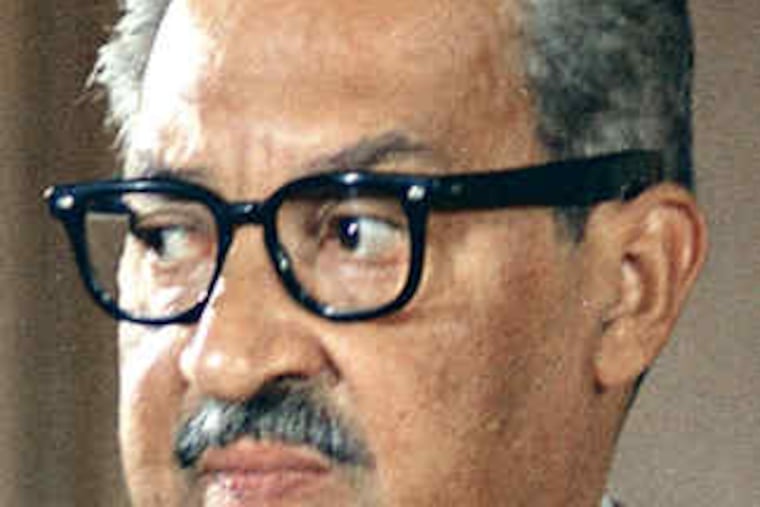
WHAT'S NEXT, renaming the Baltimore Airport?
On the first day of confirmation hearings for Elena Kagan on Monday, Republican senators attacked, not the Supreme Court nominee, but the revered justice and civil-rights lawyer Thurgood Marshall, for whom Kagan once clerked (and for whom the airport is named).
"Activist judge," "outcome-driven," out of the "mainstream," are just a few examples of the talk about Marshall. Reporters toted it up and found that Marshall, who died in 1993, was mentioned 35 times during the hearing. President Obama's name came up only 14 times.
Later, when a liberal blogger asked three senators on the Judiciary Committee to name a case that most exemplified Marshall's menace to the Constitution, two couldn't come up with one. A third said it was Marshall's consistent dissents in death-penalty cases.
And none suggested that he considered Brown v. the Board of Education - which ended school desegregation and which Marshall famously argued and won before the Supreme Court in 1954 - to be an example of the dreaded "judicial activism" that both conservatives and liberals like to decry.
But of course it was.
And the court needs more, not less, of this view of the Constitution as a living, evolving document to be interpreted to protect the rights of ordinary Americans.
As the opponents of Brown argued at the time, the 14th Amendment's "equal protection" clause - the constitutional basis for outlawing racial segregation in public schools - says nothing about education. And Congress was not about to pass a law requiring racial integration of schools "with all deliberate speed."
So, Marshall believed, it was up to the court to do it. The Brown decision exemplified what Kagan described admiringly as Marshall's judicial philosophy: "It was the role of the courts in interpreting the Constitution to protect the people who went unprotected by every other organ of government."
If the Supreme Court were to follow Chief Justice John Roberts' analogy of judges as umpire calling balls and strikes or if they were to rely solely on the "original intent," of the Framers, Americans would still be paying poll taxes, abortion would be illegal, racial intermarriage would not be allowed, equal work would not require equal pay and there would be no environmental regulations. These are among many rights protected by the Constitution, although not named specifically within it.
If confirmed, it's unlikely that Elena Kagan is going to be free to exercise liberal activism anytime soon since she'd replace the retiring "liberal" Justice John Paul Stevens.
BUT AS THE NATION faces new and complicated issues - of executive power in the so-called Age of Terror, of the reach of corporate money into the political process, to name just two - we should be so lucky to have a justice dedicated to protecting the people who go "unprotected by every other organ of government."