Why we need disclosure on Greene's foreclosure
CARL GREENE WANTS to keep his mortgage problems private. And who can blame him? It's bad enough to be facing foreclosure, but it has to be devastating to be running the fourth-largest public housing agency in the country and have your own roof about to cave in and your financial difficulties the subject of public debate.
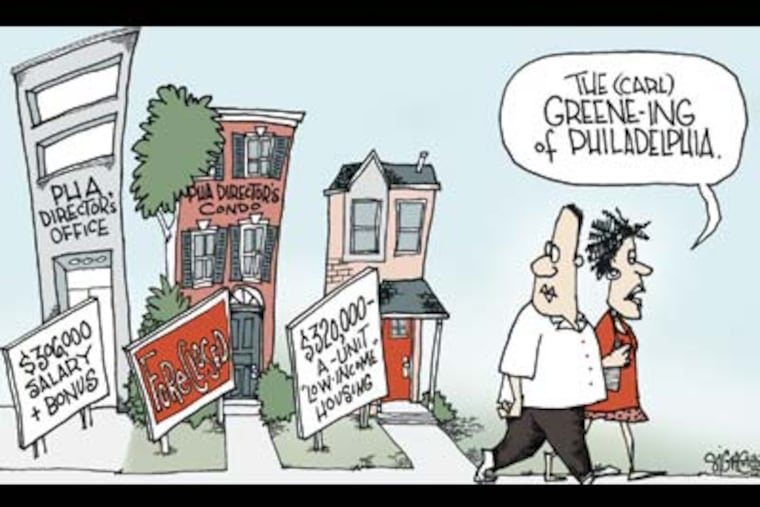
CARL GREENE WANTS to keep his mortgage problems private. And who can blame him?
It's bad enough to be facing foreclosure, but it has to be devastating to be running the fourth-largest public housing agency in the country and have your own roof about to cave in and your financial difficulties the subject of public debate.
But this is our business.
We need to know why his financial woes - troubles that not only include impending foreclosure, but also an IRS tax lien for four years of unpaid taxes (the lien has been paid) - do not impede his effectiveness as leader of a large public agency.
Carl Greene sits at the center of huge piles of public money: A $345 million annual budget primarily from the federal government and hundreds of millions more in stimulus funding (as of September of last year, the agency had received $127 million in stimulus money), for which he gets paid a very generous salary of $306,000 with perks and bonuses.
In fact, according to our rudimentary math, last year's $44,188 bonus alone would about cover a full year's worth of mortgage payments.
The serious financial struggles of an agency's executive raises fair questions, not only about the public's confidence, but about how well the agency's finances are being handled and whether enough oversight is being provided. It also calls into question matters of judgment. For example, while Greene is no stranger to disputes, we should know why his decision to dispute his mortgage company justifies staking his job and professional credibility on it. (His spokesman said Friday that it was "unfortunate that the dispute is now public," but Greene should know that foreclosures are part of the public record.)
Plenty of people have faced mortgage crises recently, and eroding home values and high unemployment rates have devastated many families. But Greene's case seems far removed from these.
And this isn't a dispute with his tailor, or his Lamborghini dealer. This is a dispute over one of life's basic needs: shelter. Most of us would go hungry before skipping a mortgage or rent payment. As head of the agency providing public housing, doesn't his job include communicating a message of responsibility to the city and to his clients? That's why red flags should be raised, and that's why he and the PHA board owe the public an explanation.
Greene has so far remained silent. PHA board chairman and former Mayor John F. Street issued a statement yesterday that said, in part, that "news accounts detailing significant financial issues by our executive director are a matter of concern to me. Although I have not been able to speak personally to Director Greene it is my intention to do so; after which I will consult with the other board members to determine of the situation warrants any board action . . . Any high-level public official responsible for administering publicly funded programs must conduct himself with integrity and transparency."
Carl Greene is usually described as "transformative" for his public-housing programs, and he's relied on a combination of passion and personality to attract federal funds and positive attention for his programs.
But his personal black eye means a black eye for the city and the agency. This is a black eye that the city and the PHA board can't afford to ignore. Huge federal dollars for the city's housing programs are at stake, as is the integrity of a public agency and its leader. *