Editorial: Tea party takeover
The Republican Party wrapped up its polarizing primary-season purge Tuesday by nominating conservative tea party candidates in Delaware and New York.
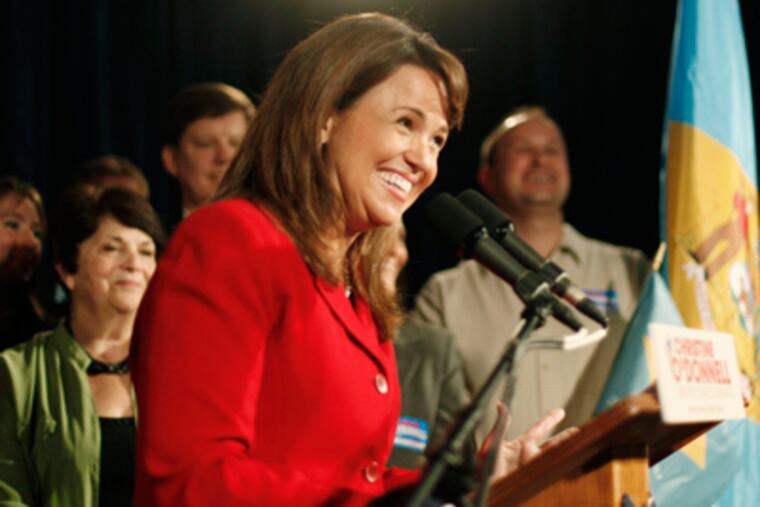
The Republican Party wrapped up its polarizing primary-season purge Tuesday by nominating conservative tea party candidates in Delaware and New York.
The most disappointing result was Christine O'Donnell's triumph over Rep. Michael N. Castle (R., Del.) in the race for a U.S. Senate seat in Delaware. Castle, one of the most decent and thoughtful public servants around, was beaten by a candidate who has trouble telling the truth about her credentials.
O'Donnell's victory should have Republicans asking who's in charge of their party. She is at least the 18th tea party challenger to win this year, mostly against candidates backed by the Republican establishment.
In New York Tuesday, tea party ally Carl Paladino also swamped former Rep. Rick Lazio in the GOP primary for governor.
Unlike some other victorious tea party candidates around the country, O'Donnell didn't sneak up on the Republican establishment in Delaware. Castle's camp knew O'Donnell could win, and it fought back hard with ample resources. She won anyway, by six percentage points.
Democrats are reacting with glee at O'Donnell's victory, believing that it gives Democrat Chris Coons a better chance of winning Vice President Biden's former Senate seat in November. Even GOP insider Karl Rove said O'Donnell's win virtually ends Republicans' chances of taking control of the Senate.
So the tea party groups will win some battles but lose the war.
Even if Democrats keep control of the Senate, the influence of the tea party movement will continue to be felt in Washington. Moderates such as Castle are an endangered species, and their extinction lessens the chances for both parties to cooperate on solving the country's challenges.
This revolt is taking out Republican incumbents, but it is also aimed at the Democratic Party that controls Washington. Tea party supporters are angry about soaring deficits and government growing too big. Those sentiments are shared by many independents and Democrats.
The unanswered question is what the tea party movement would do if its candidates arrive in Congress in January.
Since they perceive cooperating with Democrats as treasonous, would they rather shut down the government? And let's not forget the movement's fringe obsession with questions about Obama's citizenship, or the percolating hysteria that he's a socialist.
Joe Miller, the Senate candidate from Alaska, believes government shouldn't pay for unemployment insurance. Sharron Angle, the Senate candidate from Nevada, said in a radio interview that unemployment insurance "really doesn't benefit anyone." (That's not too far from the rhetoric of Pennsylvania's Republican gubernatorial candidate, Tom Corbett.) Rand Paul, the GOP candidate for Senate in Kentucky, said private businesses shouldn't be forced to abide by civil-rights laws (although he wouldn't try to repeal the 1964 Civil Rights Act).
Gov. Rendell was right when he said recently that the GOP is being "taken over by wackos."
Checks and balances are necessary for any administration, but these election results are shaping up as a road map to paralysis.