DN Editorial: The track of our tears
It was supposed to be rail's time. What happened? What happens next?
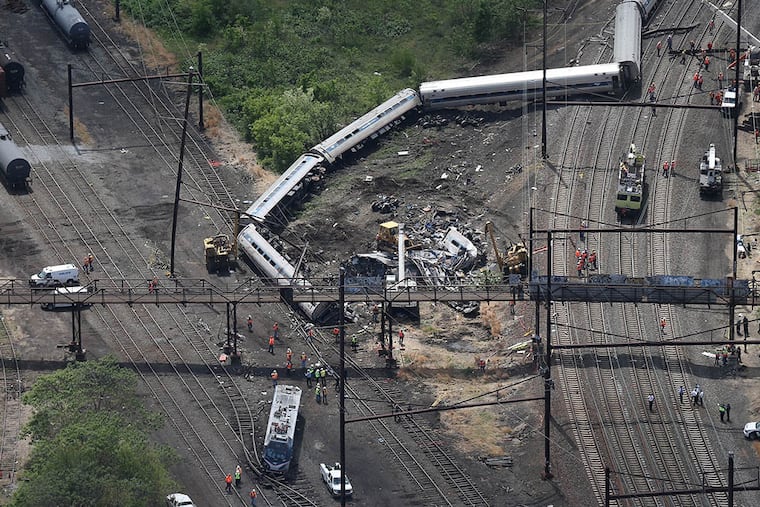
OFFICIALS ARE still investigating the cause of last week's horrific Amtrak derailment that claimed eight lives and injured hundreds more, and it will take a while before we know the truth. But like most disasters, the incident highlights a tangled complex of issues both large and small.
It's actually the smallest that has us worried: that a "projectile" such as a rock was thrown at the train. This has not been confirmed, and reports have been contradictory, but the possibility that someone out there in our rough-and-tumble city might have caused such havoc has us wincing.
The main focus of the investigation is the high speed at which the train was traveling, a mystery that remains since the engineer doesn't remember events before the derailment. The lack of track-safety technology on the track, either Automatic Train Control or the more advanced Positive Train Control, has also been criticized. The final irony: that the derailment happened a day before Congress voted to cut $1 billion from President Obama's $2.45 billion Amtrak budget, which led to partisan bickering on who exactly is to blame - Train 188 or big government.
The arguments have the potential to swamp the larger, most critical issue: our ambivalence to the importance of a smart and consistent policy on transportation, especially rail transportation.
What's ironic is not just that the congressional vote to reduce funding came a day after the crash, but that it occurred months after Northeast Corridor Amtrak ridership reached an all-time high in 2014. Over the past 15 years, Amtrak ridership increased by about 50 percent. The environmental benefits of rail travel and other factors that make it a smart option have clearly caught on with the public. And comparisons of our system with highly efficient high-speed trains in Europe, China and Japan, which generate higher government investment, don't help.
The shame is that we were supposed to be having a moment in rail transportation. In his 2011 State of the Union address, Obama announced ambitious plans for building high-speed rail: "Within 25 years, our goal is to give 80 percent of Americans access to high-speed rail," he said.
But partisan politics derailed that dream, and we're left with the sad fact that not only do we not have a state-of-the-art system, but also that we can't keep upgrades on our current system current. The infrastructure backlog just on the Northeast Corridor totals $21 billion, according to a recent five-year plan.
As for the Automatic Train Control system? According to CNN, Amtrak installed it on the Frankford Junction rail this past weekend. This kind of response - fixing a problem only after a disaster has occurred - is sadly becoming the American way.
More than 50 years ago, President John F. Kennedy announced the startlingly ambitious dream of putting a man on the moon. Nine years later, the dream was accomplished. It's sad that, in 2015, our ambitious dream involves putting a man on a safe, fast train traveling at high speed between New York and Washington. But it can and should be done.