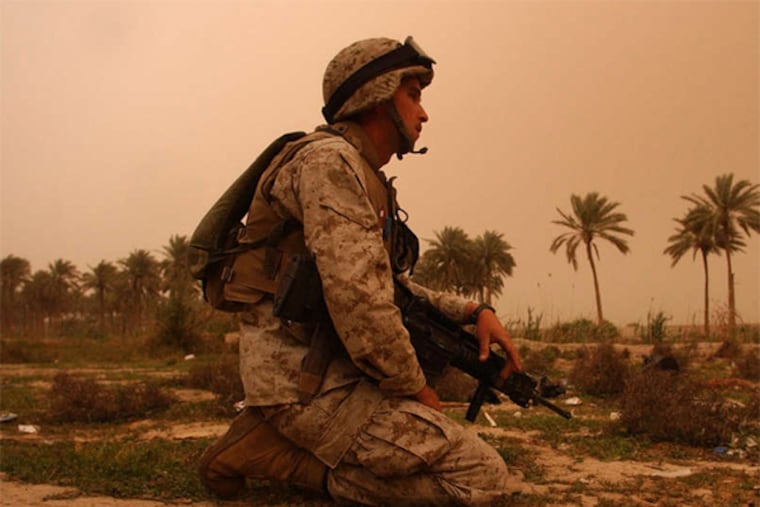
In April 2004, members of the Second Battalion, Fourth Marine Regiment, known as the Magnificent Bastards, were fighting in Iraq's Anbar province. They shared their reaction to last weekend's fall of Ramadi with Inquirer photographer David Swanson, who was embedded with the Marines 11 years ago.
Although tragic, the fall was inevitable. He who wants it more will get it - as with anything else in life.
As history has taught us time and time again, you can teach tactics all day long, but you cannot teach an indigenous force the intangibles - heart, bravery, loyalty, courage under fire, resolve. We cannot teach the Iraqis to love their country enough to die for it, to love their brothers-in-arms enough to die for them, to love their neighbors and strangers alike enough to give up their own lives for them.
When we were there in 2004, Ramadi was overrun with insurgents. The conventional U.S. Army unit we turned over with told us not to go into a certain areas because every time they did, a firefight ensued. But Marines run toward the sound of chaos, not away from it - so we did our job and captured or killed those that were responsible for inhibiting Ramadi from becoming a thriving city. We trained the local Iraqi forces to the best of our ability. By the time we left, shopkeepers were able to work freely and boys and girls alike were able to go to school.
But rest assured, should we get the call again one day to return, the next batch of Marines will surely do harm to bad people. The baby-faced 18-year-old Marines that would see Ramadi today would've only been 9 years old when we fought. But I can guarantee that these new warriors . . . do what Marines do best - they'll be polite, they'll be professional, but they'll have a plan to kill everybody they meet (taken from quote by retired Gen. James Mattis).
Charles Lauersdorf
Corporal during deployment, from Texas, is now a photographer and staff sergeant in the Marine Corps Reserve
In some ways, I still haven't disconnected from Ramadi. As an infantry Marine, you eat, sleep, and go to the bathroom with your weapon in arm's distance. That can make coming home difficult. I've had combat flashbacks that have lasted up to two days.
So when I first heard months ago that ISIS might take Ramadi, I threw a handful of pens across my house. That broke my television. I then started having intense combat dreams about killing ISIS. I started focusing on getting into shape and getting strapped up. A few months later, I heard that they took over again. The sense of betrayal I felt moved me to the point of depression. . . . My focus on school began to drop and thoughts of combat took over. Luckily for me, I realized that I was headed toward another episode. Instead of hitting rock bottom, I decided to talk with my Navy-Marine Corps Relief Society nurse. We came up with a plan to get back on track. So when I heard that ISIS had taken over Ramadi for the third time, I wasn't freaked out like before. . . . I don't want to get so worked up about it that I lose focus on my primary mission of taking care of myself and my family.
Theophus Tor
Corporal from California now majoring in biomechanics
I despise the thought . . . that we have given everything and asked for nothing. Our youth, health, emotions, blood, sweat, tears, friends, husbands, fathers, mothers, brothers, sons, and daughters. Ramadi was the worst of the worst and not one person gives a good goddamn except the ones that were there in the flesh and the families of our fallen.
Ryan Downing
Lance corporal from Iowa, now with the Department of Homeland Security
When we were there in '06, it was more about rebuilding and giving the city back to the people. I wasn't there in '04 with my senior Marines who fought in the battle for Ramadi, so I can't imagine their pain. But it still hurts. The people were starting to be happy, taking control of their lives, and not living in fear. The city deserved peace. The city and its people deserved to be defended, and I'd gladly go back for free if the government offered some kind of veteran reenlistment war contract.
Robert Sweeney
Lance corporal from Chicago, now a student
'04, '07, and '08 - spent each of these summers in Ramadi. I was witness to the devastation and chaos in the beginning, the rebirth and sense of self in the middle, and the struggle for respect as a legitimate government near the back end. I see faces and names of people, American and Iraqi, on TV and in the news now that I've interacted with, fought with, laughed with, and suffered with, and can't shake this feeling that we've betrayed them. I don't know what changed after 2008, but they were heading in the right direction when I left. To see what has become of all of the sacrifices made in this city, in our city, is tragic.
Brandon Marks
Staff sergeant from Louisiana, now a paramedic and firefighter
It's on us to always remember what we did over there. Our stories are the ones people will remember and it's on those who served to continue to share. The sacrifices of the 34 Marines and one Navy corpsman who died will never be forgotten or overshadowed by anyone.
Paul Ochoa
Corporal from California, now a project services coordinator for Stria L.L.C.
It's hard to see something get lost, something you fought so hard for and brothers that gave so much for. The battle for Ramadi is still in effect in us all, just in a different way.
Toby Winn
Corporal from Texas, now a self-employed artist
For those who walked the streets of Ramadi in 2004 day in and day out, fighting enemy combatants and giving kids soccer balls, all in the same patrol, this stirs emotions and memories good and bad. ISIS taking control of the city will never mean our fallen brothers have sacrificed their lives in vain. This, however, angers me and makes me want to dust off a pair of deserts, grab my gun, and hop on a plane to the sandbox.
Ryan Stith
Staff sergeant from Indiana, now a machine technician
Back then we did our job amazingly and we literally fought every day to help that city and we lost many brothers for it. Yes, I understand that the city we fought for is now being taken back over and, yes, it is irritating, but I honestly believe this is not our fight anymore. The Iraqi army needs to be able to take on this one on their own this time. If we continue to go back over there to help them they are just going to rely on us to do there dirty work and that's just more brothers and sisters we don't need to lose. Oo-rah to my fallen brothers.
Kyle Katz
Lance corporal from Colorado, now a correctional officer
I would not care if the whole damn place got turned to glass. There is also something that makes me happy about terrorist killing terrorist. But, honestly, when I read the news, I wanted to slam my phone through the wall.
Jonathan Samuels
Sergeant from Indiana, was hit by grenade that took off part of his right hip and peppered his right side with shrapnel