The driver should have known better. He was getting too close. The U.S. Marines in Iraq's Anbar province watched warily as the vehicle crept up on their convoy.
They'd seen comrades killed by suicide bombers, IEDs, and snipers during tours of duty there and in Afghanistan so they were on guard, ready to defend themselves.
With the driver ignoring a sign in Arabic that warned motorists to stay back 200 feet, the order was given. The turret gunner unleashed a storm of gunfire, killing the man at the wheel.
No bomb or weapons were found. All the Marines could do was place the driver - a local student - in a body bag and take him home to his family.
The tragic death in 2006 was one of many that has haunted Sgt. Matt Bailey of Medford, Burlington County. The infantryman also recalls a suicide bomber who detonated an explosives-laden truck onto his forward operating base in Karabilah, Anbar, killing several Iraqi National Guard soldiers. Bailey was detailed to clean up the body parts - more grim images to carry inside.
And he remembers other deaths, close calls in firefights and IED explosions in Afghanistan in 2004 and Iraq two years later that left him with a traumatic brain injury and post-traumatic stress disorder.
"I felt proud and happy to be home at first, ready to take on the civilian world as a hard-charging infantry Marine," Bailey said of the days after his departure from the service in 2006. "Surprisingly enough, the civilian world wasn't the place for me. . . . I had a hard time adjusting."
Bailey considered suicide and was "at the end of the barrel of my Glock 17 several times, contemplating pulling the trigger." After later appearing on an episode of TV's Dr. Phil Show to talk about PTSD and 90 days of counseling at a private facility in Texas, he felt "much better but incomplete."
His fuller recovery came over the last three years with the intervention of comrades he served with and a program that's been lauded by veterans: the Bar X Project, which helps heal Marines suffering from the mental and physical wounds of war in an idyllic Montana setting.
Far from urban confines and life's everyday stresses, they reconnect at the Bar X Ranch near Big Timber to face another battle together, this time overcoming the lingering pain and regrets of war.
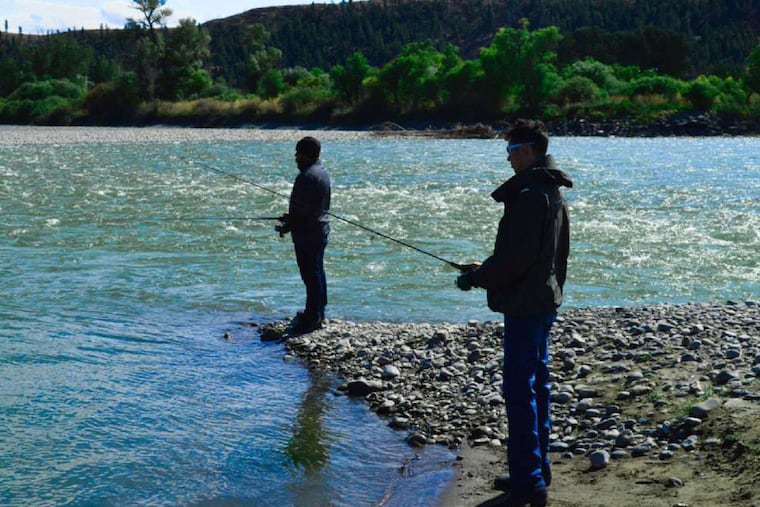
Marines who haven't seen one another in years relax, decompress, drift in boats along the peaceful Yellowstone River, go fly-fishing - and talk about experiences and feelings that can be understood only by their combat "brothers."
"When I got home, I thought everything was great, but you do feel isolated," said James Moran, a Marine major and Berlin, Camden County, resident who established the nonprofit Bar X Project in 2011 with a Marine captain, Wade Zirkle of Woodstock, Va.
"It is our belief that reestablishing the special bond forged in combat overseas is an untapped avenue of combating PTSD and helping Marines return to normal life," said Moran, who was Bailey's former executive officer in Afghanistan. "We reunite combat-injured veterans with members of their old units."
He and Zirkle - partners in StrongPoint Holdings, a nationwide ATM business - pay the airfare, usually for four or five Marines, to fly to Montana and accompany them as facilitators. They also pick up the tab for the meals.
Their friend and business associate Rob Lowe, who supplies their ATMs, has opened up his family's 300-acre ranch at Big Timber and enlisted the aid of other Montana residents. A Billings car-rental businessman at National Alamo provides a free 12-passenger van, and a local outfitter, Wild Fly Angler, offers rods at cost that are purchased for the veterans by a local man (J.R. Reger). Boats, guides, and a final dinner at a Big Timber hotel also are donated.
The Bar X organizers will keep busy for the foreseeable future, judging from the number of casualties from the wars in Afghanistan and Iraq. More than 38,000 members of all of the military services have been diagnosed with PTSD during the wars, according to a Congressional Research Service report in August. Thousands of suicides by veterans have been recorded; some reports say as many as 18 to 22 a day take their own lives.
About 327,000 service members have traumatic brain injuries; 1,600 have had major limb amputations; 52,000 have been wounded; and nearly 7,000 have been killed, the congressional report said.
Helping the survivors heal is the annual mission of the Bar X Project, started by Moran, Zirkle, and Lowe after seeing sporadic efforts by other groups to connect military veterans and the outdoors.
"I read about treating wounded warriors in a fly-fishing magazine, and we talked about creating a program using the Bar X Ranch," said Lowe, 41, of Billings. "There is a therapeutic quality to nature.
"If you're from a congested area like New Jersey, Philadelphia, and New York, you don't understand that you can come here and see miles of river without seeing another person," he said. "You can hang out, fish, and look at the snowcapped mountains - without hearing any jet or traffic noise."
Around a fire pit at night, the Marines "rekindle friendships," Lowe said. "They talk about combat experiences, just daily life, the things they're going through. I don't have trouble sleeping or wake up in a cold sweat, so it's hard to relate to a guy like me; I'm just a facilitator.
"They sit up until 1 or 2 in the morning," he said. "They do a great job of talking to one another about what they're going through."
The annual trips - running Thursday to Sunday - usually include four or five Marines along with the facilitators and other volunteers. Five came on the last outing in September, and about 25 have been to the ranch since 2011. The program - which the organizers hope to expand as more funds become available - helps the veterans realize that their comrades are also processing the same memories and feelings.
"When bad guys get killed, that doesn't bother them," said Moran, 38. "But when they see a Marine or innocent person killed, that bothers them. Dead kids haunt everybody."
At the ranch, "we reintroduce [the Marines] to their battle buddies and the sense of brotherhood they had," said Zirkle, 37, who had two tours of duty in Iraq, including one at Fallujah in 2004 when his troop transport was hit by a suicide bomber, seriously injuring him and killing seven Marines and three Iraqi soldiers. "In a generation where fewer than 1 percent have served in Iraq and Afghanistan, there is a feeling of being alone.
"People don't understand what you've gone through," Zirkle said. "These wounded warriors understand each other."
The Montana experience gave one of the participants - Marine Sgt. Ryan Holt - ideas for his own program in Maine, where he purchased 42 acres and has spent $200,000 on a building where he's planning to start the Peaceful Warrior Project. It's a "human-nature hostel," said Holt, who visited the Bar X Ranch in September. Earlier, he hiked 2,184 miles along the Appalachian Trail from Georgia to Maine and successfully competed on the Discovery Channel's Naked and Afraid.
"We'll have backpacking, canoeing, yoga, meditation classes, sweat lodges - anything to clear the clutter from their heads and surrender the past," said Holt, 31, of Roxbury, Maine, who served in Afghanistan and Iraq.
Getting through the tough times is much easier with the help of a Marine friend, said Vince Noble, another trip facilitator, Philadelphia native, and an Afghanistan and Iraq veteran who was seriously wounded in the left femur by a .50-caliber bullet at Fallujah in 2004.
"I look back now at what got me through that period, and it was hanging out with James," said Noble, 37, a Marine Reserve major, referring to Moran. "I swear to this day that the reason we're OK is because we had each other to rely on."
Overcoming regrets is one of the biggest obstacles to healing. Marine Eddie Lyons felt he let down his comrades in Afghanistan's Helmand province in 2009 when he was taken out of the fight by an IED that blew off his left hand and part of his left arm and peppered his body with shrapnel.
"I faulted myself; I was wounded early" in the deployment, said the 26-year-old Fort Collins, Colo., resident, who was prescribed medications to help him with PTSD and attempted suicide three times.
Breaking free from the prescriptions and using medicinal marijuana helped, but the Bar X Project changed him. "Before Montana, that day [of the IED explosion] was in the forefront of my mind," said Lyons, who served with Noble. The trip "was a healing experience that filled a void I felt in my soul. . . . I saw they accepted me and were not judging me as I judged myself."
The presence of Marine comrades such Lyons and Noble made all the difference to Shawn Lopez, 26, of Charleston, S.C., who served with them before being injured in 2010 when the truck he was driving ran over an IED. "I had ruptured tendons in both legs, a broken ankle, dislocated shoulder, concussion, and a jacked-up back," he said. The VA "tried to medicate me, but I wanted to get off."
Being at the Bar X Ranch "was truly one of the greatest moments I've had in a long time," said Lopez, who works as a logistics coordinator for the Navy and as a bartender. "Having two of my brothers who were actually there with me and shared blood, sweat, and tears meant a hell of a lot - and we will stay in contact."
That Marine brotherhood and the natural surroundings also proved to be a tonic to Matt Bailey, now an ironworker with a family, who went on trips the last three years. "When I got back [from deployment], I had trouble sleeping," he said. "If I hit a pothole in the road, it would remind me of an IED, and I'd immediately go into fight mode."
"But," he said, "the memories fade as you cast a line into the water - and talk to others who have shared the same experience."
Edward Colimore is a retired Inquirer staff writer.
Contact Ed Colimore at ecolimore@comcast.net. For more information about Bar X, call 856-375-3237.