Many Americans willing to make a first nuclear strike
About 60 percent of those polled said that if Iran provoked the U.S. with some nonnuclear aggression, they'd approve of blowing up two million Iranian civilians using nuclear weapons rather than sacrificing 20,000 American lives in a ground attack.
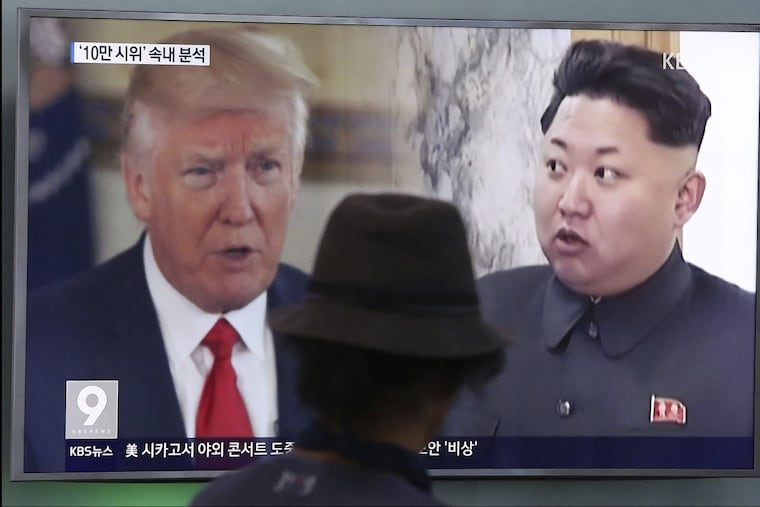
North Korea's advancing nuclear weapons program isn't the only news to unnerve arms-control experts this summer. A new survey has found that Americans are surprisingly willing to make a first nuclear strike — and kill millions of civilians abroad.
The survey casts doubt on the power of what experts call the "nuclear taboo," said Stanford University historian David Holloway, author of Stalin and the Bomb. The idea, or hope, behind the concept is that it's not just luck that humans haven't dropped any nuclear weapons in 70 years — that there's a stigma that makes the use of nuclear weapons unthinkable.
But many Americans say it's quite thinkable. The taboo may be eroding, or it may never have been the protective barrier people thought it was.
The survey designers sketched out a hypothetical conflict with Iran — a country without nuclear weapons. About 60 percent of those polled said that if Iran provoked the United States with some nonnuclear aggression, they'd approve of blowing up two million Iranian civilians using nuclear weapons rather than sacrificing 20,000 American lives in a ground attack.
"That just means they haven't thought about it," said Brian Toon, a professor of atmospheric science at the University of Colorado. They think nuclear weapons are just big bombs that blow up lots of people, he said, without considering the way a nuclear conflict — even a "small" one involving about 10 percent of the U.S. arsenal — might poison millions of men, women, and children and change the climate enough to starve hundreds of millions.
Today, it's not Iran but North Korea that's the focus of concern, with its continued testing of nuclear missiles despite President Trump's threat of "fire and fury." Serious people are starting to consider the possibility of nuclear conflict. Though the North is unlikely capable of sending nuclear missiles all the way to the United States, at least for now, there are plenty of ways casualties could escalate. "There are nuclear reactors all over North Korea," Toon said. So you might have Fukushima-type contamination all over the country.
Perhaps if people more clearly understood the destruction of human life that would result, the taboo would regain its power. In the early years of the Cold War, the power of nuclear weapons apparently surprised Daniel Ellsberg, a Rand Corp. analyst on loan to the Pentagon for the purpose of nuclear-war planning.
"One day in the spring of 1961, soon after my 30th birthday, I was shown how our world would end," he wrote in 2009. Ellsberg, who is famous for leaking the Pentagon Papers in 1971, has spent recent decades examining the potential for nuclear catastrophe. His latest book, The Doomsday Machine: Confessions of a Nuclear War Planner, will be released in December.
The end of the world was described in a highly classified document, Ellsberg said. Though it didn't necessarily spell extinction for the human race, it estimated a nuclear war would kill at least 600 million people — or, as Ellsberg put it, "a hundred Holocausts."
Is there some logic to accepting two million deaths but not 600 million? Is there some number of Holocausts that would be acceptable? Holloway said such mass killing would be considered unacceptable under the philosophical framework called just-war theory — a set of criteria that political and military leaders have used to determine whether a war would be justifiable. Still, mass bombings during World War II familiarized people with the idea of targeting civilians. And the advent of nuclear weapons made it seem unavoidable.
A nuclear exchange might remain limited — but then, it might not. If the United States launched a first strike against North Korea, experts say, there's no guarantee that China or Russia wouldn't join in, either on purpose or by mistake. The actions of other countries are hard to predict in a state of confusion and fear.
Recent calculations suggest 50 or 60 nuclear weapons might be enough to change the climate if they're dropped on cities where massive fires would release sky-darkening smoke into the atmosphere. Hundreds of millions or even a billion people could starve in such a nuclear winter. "The scary thing is that this could potentially kill the majority of people on the planet," said Toon. That would seem to be more than enough reason to keep up the nuclear taboo.
Faye Flam, a Bloomberg View columnist, is the author of "The Score: How the Quest for Sex Has Shaped the Modern Man." She was a columnist for the Inquirer.