Phila. has a long history of black baseball
Rich Westcott is the author of 19 sports books As the Phillies get set to pursue the 2009 World Series championship, it's a good time to consider another successful part of the city's rich sports history.
Rich Westcott is the author of 19 sports books
As the Phillies get set to pursue the 2009 World Series championship, it's a good time to consider another successful part of the city's rich sports history.
African American baseball in Philadelphia dates back to the 1860s. It continued through the first half of the 20th century, when Philadelphia played host to some of the sport's most prominent teams and players.
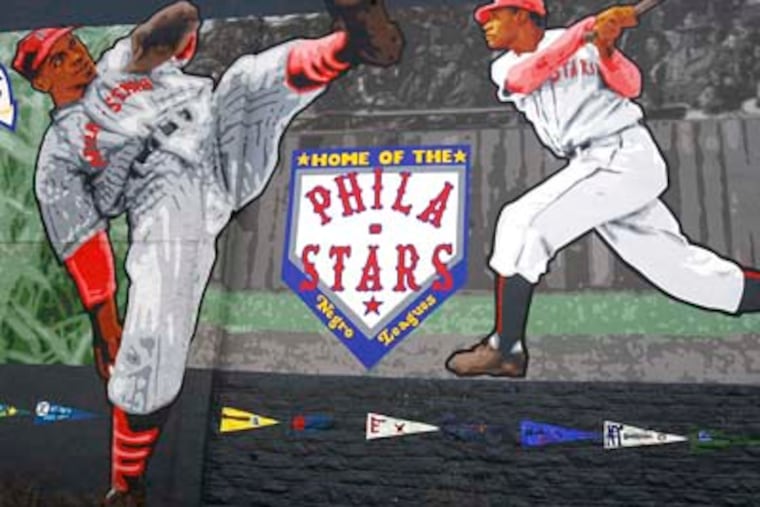
Teams such as the Pythian Club, and later professional teams such as the Philadelphia Giants, Hilldale Daisies, and Philadelphia Stars, played in the region, and big crowds were the norm.
Some of the most highly decorated players, including Hall of Famers William "Judy" Johnson, Oscar Charleston, Rube Foster, Martin Dihigo, and Leroy "Satchel" Paige, performed with Philly teams. Among the 17 Negro Leaguers who entered Cooperstown in 2006, seven - players Frank Grant, Pete Hill, James "Biz" Mackey, Louis Santop, Sol White, and Jud Wilson, and team owner Effa Manley (a native of Germantown) - had Philadelphia connections.
Players were eager to perform for area teams. The pay was decent, off-season jobs were always available, and one could find satisfactory housing. Moreover, by 1920, Philadelphia had the country's second-highest black population, which strongly supported the clubs.
African American baseball first surfaced in Philadelphia during the Civil War, when black soldiers, as well as freed slaves, played. By the late 1860s, there were numerous teams in the city.
The Pythians were especially noteworthy, not only because of their success on the field, but because of their leader. Octavius V. Catto, an Army officer, teacher, and fervent civil rights activist, helped to organize the Pythians, then became their promoter, manager, and second baseman.
Under Catto, the Pythians were highly successful against other black teams, with games often followed by dances and picnics. They were also credited with being the first black team in Philadelphia to face an all-white club (the City Items, a team sponsored by one of Philadelphia's daily newspapers). The Pythians flourished until Catto was murdered in 1871 by a white segregationist as he walked to his home on Election Day.
Professional black baseball appeared in 1902, with the formation of the Philadelphia Giants.
The Giants, begun by Walter "Slick" Schlichter, the white sports editor of the Philadelphia Item, quickly became one of the leading black teams in the country. In 1903, they lost in what was billed as the "World's Colored Championship." The following year, they won the title.
With players' salaries ranging from $60 to $90 a month, the Giants claimed to have compiled a record of 426-149 from 1903 through 1905, including a 134-21 mark in 1905. The Giants played until 1917.
Meanwhile, the Daisies had been formed in 1910 by post office employee Ed Bolden as a team for young black men from Darby. They turned professional in 1917, playing an independent schedule that included games against barnstorming major-league all-star teams, one featuring Babe Ruth.
Hilldale joined the Eastern Colored League in 1923 and won three straight championships. In 1924, a postseason series was arranged with the Negro National League. Hilldale lost to the Kansas City Monarchs in the "Colored World Series." The next year, the Daisies beat the Monarchs to win the title, triumphing in the final game at their home park in Yeadon before an estimated crowd of 8,000.
The Daisies folded in 1932, but there were still numerous sandlot teams throughout the area. In North Philadelphia, West Philadelphia, and South Philadelphia, and in Ambler, Ardmore, Camden, Chester, Norristown, and Wilmington, high-caliber African American teams played heavy schedules before large crowds.
The Stars were formed in 1932. They, too, operated as an independent team until joining the newly reformed Negro National League the following year.
With local sports entrepreneur Eddie Gottlieb serving as the principal owner and Bolden running the team, the Stars captured the NNL title in their first year. They never won another crown, but they performed respectably throughout the 1930s and early 1940s.
In 1947, Jackie Robinson became the first African American in the 20th century to play major-league baseball. Soon afterward, other blacks signed contracts with major-league teams, taking many fans with them. Like all black teams, the Stars sold players to big-league teams, including one (Ted Washington) to the Phillies in 1952. (Drafted during the Korean War, Washington never played in the Phillies' system. Chuck Randall, originally from Glassboro, holds that honor after being signed in 1955.)
The 1952 season was the last one for the Stars. When they disbanded, they took with them a long history of black baseball in Philadelphia.