Bosnia's scars still deep
Physically, it is recovering from the 1990s civil war. But it remains a land divided in many ways.
Cynthia Henry
is an Inquirer staff writer
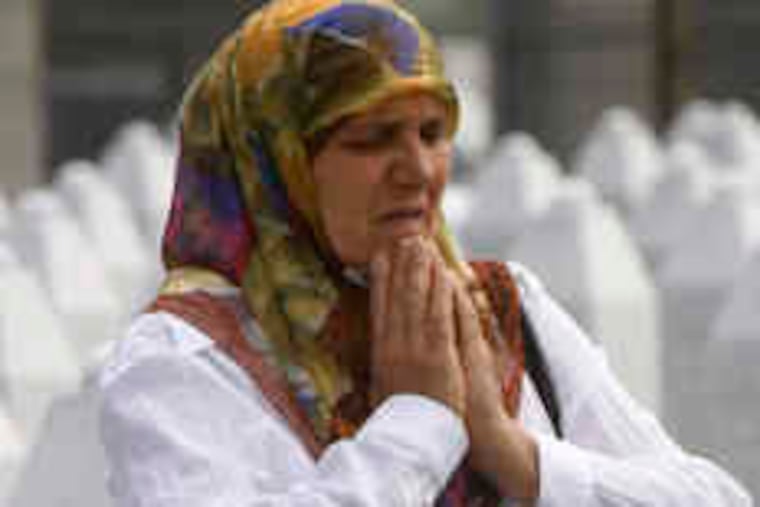
POTOCARI, Bosnia - Hatidza Mehmedovic wants to bury her son, but she can't sort out his bones.
Along with his brother, father, and as many as 8,000 other Muslim Bosniaks, he died in the 1995 massacre in Srebrenica - Europe's worst mass killing since World War II.
In 2007, DNA from bones in a newly unearthed mass grave matched Mehmedovic, but science can't tell her whether they belong to 21-year-old Azmir or 19-year-old Almir. So, more than a decade after Yugoslavia's bloody breakup, she waits, hoping for another discovery that provides closure.
Women in their 60s should be celebrating weddings and birthdays, she says, not "be joyful just to get the remains of our beloved."
Physically, Bosnia is recovering from the 1992-95 civil war, which birthed the phrase ethnic cleansing. The famous Sarajevo roses - concrete scars caused by mortar shells during a relentless siege later filled by red resin as memorials - are fading on sidewalks, often unnoticed now by passersby. Cranes fill the city sky as shiny new office buildings go up, and malls replace damaged storefronts.
Psychologically, though, the stress of high unemployment, uncomfortable reconciliation, and continual reminders of unresolved war crimes threaten to roil nationalistic passions again.
Ethnic conflict erupted after Bosnia declared independence from Yugoslavia in 1992, and the country's Orthodox Christian Serbs, Roman Catholic Croats, and Muslim Bosniaks fought for land. At least 97,000 people died, and two million were displaced. Bosniak civilians suffered the highest casualties.
The Dayton (Ohio) Peace Agreements, signed in December 1995, ended the war but divided the country of Bosnia and Herzegovina into two entities, the Bosniak-Croat Federation and the Republika Srpska, which has a Serb majority. Each has its own governing and legal powers, often favoring one ethnicity over another.
The legacy of war is harder to see these days, although bombed-out houses and shuttered factories still dot the countryside.
In one Jajce school, Bosniak and Croat elementary students learn on different floors and use separate bathrooms. Muslim children attending the renovated village school in Trnopolje daily pass the ruins of a notorious detention camp and rape house.
In Sipovo, Serb retirees, cradling photos of grandchildren, lamented the lack of jobs and the distance their children had to move to find work. On the verdant hillsides near Srebrenica, once a U.N. safe zone, only women and children were left to harvest berries.
"Bosnia is many things," a Kozarac imam said - a land of wonderful cuisine, welcoming hosts, and turbulent Byzantine, Ottoman, and Austro-Hungarian history. Visitors don't have to stay long to sense tension among townspeople and realize the depth of the shrapnel wounds on building facades.
Journalist Srecko Latal, who covers Bosnia and Herzegovina for the Balkan Investigative Reporting Network, recently pondered whether Bosnians could ever shed their ghosts and live in the present.
While waiting for his family to prepare for a Saturday outing, Latal flipped on TV news to find scenes of unearthed skulls and memorial services - quite a contrast to the "chirpy life taking place outside my window on the bustling streets of Sarajevo," he wrote in his Aug. 3 blog on www.balkaninsight.com.
"From World War II offensives to the 1992-95 war massacres, it seemed that there was not a day in a year in which somewhere back in the history of this country someone didn't kill someone else," he wrote. "Are we stuck endlessly reliving our past traumas and horrors? Or are we allowed to have 'normal lives,' going to swimming pools after work and to parks, parties, cafes or discos in the evening?"
Indeed, news services this summer revisited a stream of Bosnian horrors:
Forensic experts discovered a remote ravine in central Bosnia believed to contain the remains of 200 Muslims and Croats executed by Bosnian Serbs on Aug. 21, 1992.
In pretrial war-crimes hearings at the Hague, former Bosnian Serb leader Radovan Karadzic sought evidence in an attempt to show the Srebrenica death toll had been exaggerated and suggested Muslim, not Serb, soldiers fired mortars that killed scores in a Sarajevo market.
A U.N. war-crimes court convicted two Bosnian Serb cousins of killing at least 119 Muslims, ranging in age from two days old to 75 years, by burning them alive in their homes in 1992 in Visegrad.
Serbia's application to the European Union may hang on capturing Bosnian Serb military commander Ratko Mladic, charged with genocide for his role in the Srebrenica massacre and in the deaths of thousands of civilians during the siege of Sarajevo.
While Vice President Biden warned the Federation Parliament in May that this kind of news could ignite "ethnic chaos," war survivors such as Mehmedovic say they seek justice, not revenge.
As a leader of the association Mothers of Srebrenica, she shares her life story with visitors to the massacre memorial "aware of the fact that no one can get our families back," but, she insists, "the war criminals must be punished."
"What the Serbs did to my family . . . I would not be able to revenge if they would bring any Serb child or the whole Serb people before me," said Mehmedovic, who lost 140 relatives in the war. "All the kids are the same; they are innocent, as were my children."
Hope for changing Bosnia's patterns lies in that innocence. Warily at first but eagerly as days wore on, about 1,200 of Bosnia's children crossed ethnic lines to play games, sing songs, and eat lunch during summer camps run by Americans in June. Along with teenage interpreters, who rejected nationalism, many seemed open to forging a new path.
"Whoever planned this [1992-95] conflict didn't succeed, because they planned to plant a seed of hate," said Emsuda Mujagic, a detention-camp survivor who runs the Srcem do Mira (Through Heart to Peace) nongovernmental organization in Kozarac. "My hope is that other souls are not touched with hatred and that they are open to the world."