Editorial: Counting on Karzai
Elections can be messy. But in the end, sometimes even messy results must be accepted. Take the 2000 U.S. presidential contest, for example.
Elections can be messy. But in the end, sometimes even messy results must be accepted. Take the 2000 U.S. presidential contest, for example.
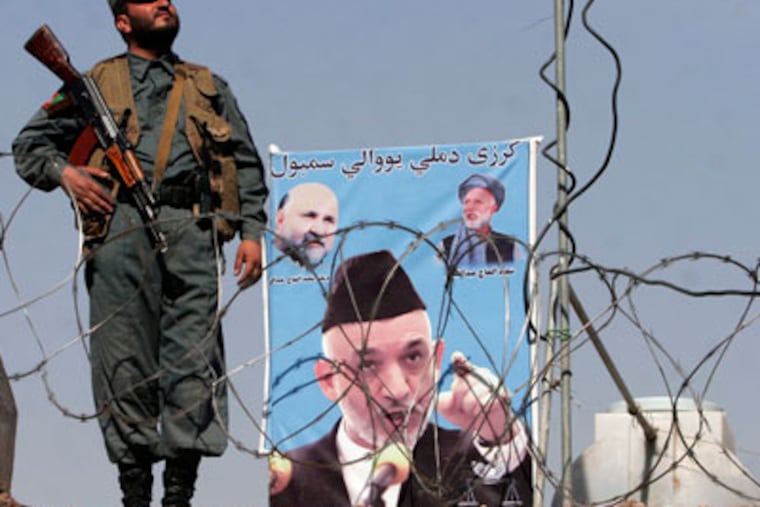
Now, there's Afghanistan's apparently fraud-infested presidential race. The dubious results were nevertheless ratified Monday when plans for a runoff fell through after second-place finisher Abdullah Abdullah withdrew.
Given those circumstances, President Obama had little choice other than to congratulate Afghan President Hamid Karzai on his victory. But, appropriately, Obama added a caveat to his good wishes, urging Karzai to remove the stains of corruption from his government.
That's a price that should be paid for the blood shed by U.S. soldiers in Afghanistan. Their mission in general terms is to keep that country from again falling under the control of the Taliban, which played host to al-Qaeda, sponsor of the 9/11 terrorist attacks.
Obama has struggled for weeks to decide the best strategy. Counterterrorism tactics might require fewer soldiers by limiting their targets to specific al-Qaeda leaders. The current counterinsurgency approach may mean another troop surge, as requested by the U.S. commander in Afghanistan, Gen. Stanley McChrystal.
Now that Karzai's election has been certified, Obama's political foes are beating the drums even more loudly in support of McChrystal's request. "The president has no further pretext for delaying the decision," said House Minority Leader John Boehner (R., Ohio).
Boehner's comment is specious. The president isn't shirking his responsibility to make a decision. He's taking the time he needs to make the right move. That calculation must consider not only who will be Afghanistan's leader but what type of leader he will be.
Americans are questioning why their soldiers should die to protect a regime accused of propping up the same illegal drug industry that bankrolls the Taliban. Those accusations go as far up as Karzai's brother Ahmed Wali Karzai, who is said to be hip deep in the opium poppy trade.
Obama, correctly, wants more than Karzai's assurances that his government will do a better job fighting corruption and training Afghan security forces. "As I indicated to him, the proof is not going to be in words; it is going to be in deeds," Obama said.
The president's critics should understand that in evaluating Karzai and which U.S. military strategy is best, Obama is also reassessing the very nature of the "war on terror." He is right to pay heed to those who point out that kicking the terrorists out of Afghanistan and Pakistan won't deprive them of other likely bases.
The stated goal in going to Afghanistan was to make it safer for Americans at home. Obama is closer to deciding whether more troops are needed to achieve that goal. Karzai's election has helped provide an answer. But it's not the only factor.