As a role model, Alice deserves an A
Megan S. Lloyd is a professor of English at King's College and the author of "Unruly Alice: A Feminist View of Some Adventures in Wonderland" in "Alice in Wonderland and Philosophy"
Megan S. Lloyd
is a professor of English at King's College and the author of "Unruly Alice: A Feminist View of Some Adventures in Wonderland" in "Alice in Wonderland and Philosophy"
I was brought up on Disney princesses, helpless heroines in flowing locks, off-the-shoulder gowns, cinched waists, and little attitude. Lewis Carroll's Alice was never my favorite, what with her pushy, aggressive nature, eating and drinking what she sees without asking, intruding uninvited, speaking whenever she pleases.
But as I have watched Sleeping Beauty and Cinderella with my unruly daughter, I have come to respect and appreciate Alice as a far better role model for young women and girls. Not one who naively and obliviously follows those around her or who passively or inertly waits for help to come, Alice requires no fairy godmother, huntsman, or prince - just her own wits and ingenuity - to navigate through Wonderland successfully, keeping her head intact.
Alice is not only more age appropriate in dress and behavior than the scantily clad Ariel, Belle, Aurora, and Jasmine, whom my 4-year-old mimics by wearing her top off her shoulders; Alice, like my daughter, is a little girl who fends for herself. Indeed, Alice's self-assurance and indomitable spirit speak to today's young women.
Even before my daughter, young women in my First Year Seminar at King's College helped me realize Alice's appeal. For one class period in our course about Unruly Women, we turned to fairy-tale heroines. Two students argued that Alice was the best model because of her candid, autonomous approach to life. The more I considered this, the more convinced I became.
In Carroll's classic, even before venturing down the rabbit hole, Alice rejects the dutiful, compliant passive female world her sister occupies. Throughout her journey in Wonderland, Alice questions and challenges stereotypical female traits, and prevails over seemingly powerful females and males alike, including the Queen of Hearts, the Caterpillar, the Mad Hatter, and Cheshire Cat. Alice disregards the sexist Mad Hatter and his good-old-boy tea party, which requires women to think but doesn't give them a chance, and she confronts the Duchess, who wants Alice to take a "dumb blond" approach to life.
Alice even engages in what seems like a pro-life/pro-choice discussion with the long-suffering mother Pigeon and sees the Duchess as unfit for motherhood. At court, she challenges the King and works to uncover the truth. Levelheaded and confident, Alice navigates her treacherous path and takes care of herself.
Sadly, almost 150 years after Carroll's publication, Alice's intrepid attitude still strikes some people as too aggressive, not just for girls of 7 but even for women of 27, 37, or 47. Indeed, Alice eats and drinks what she sees, and barges in, taking her seat at the tea party uninvited. She uses her intellect to solve problems and frequently speaks her mind. This is just what young women should do.
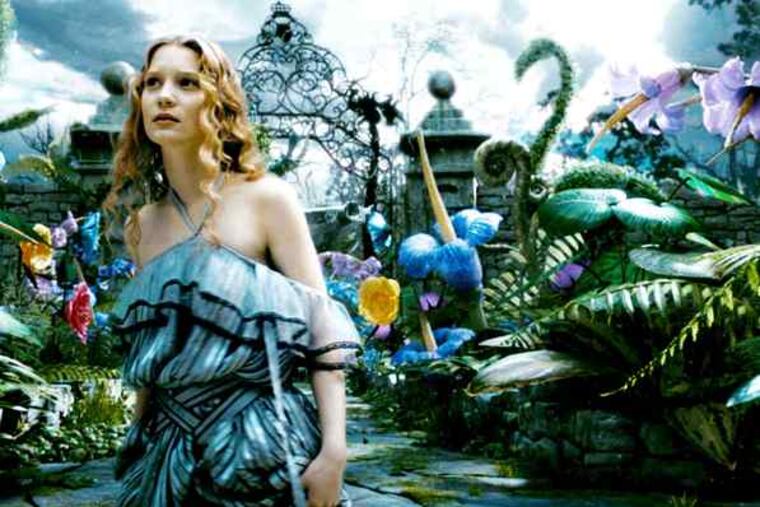
Now with his new film, Tim Burton will answer a question I have debated with my students: Whatever happened to Alice? Let's hope she hasn't changed, for there is still much work to be done in dispelling gender stereotypes.
In Burton's film, Alice is no longer a young girl but a young woman pushing 20. Let's hope that her advanced years do not make her dependent on figures around her. Let's hope that she remains resourceful and curious, and that she continues to show the initiative of a confident young woman who leads herself safely through Wonderland and the world at large and thinks "that very few things indeed [are] really impossible."
What a wonderful model for our young women to look up to! We need you, Alice.