Inquirer Editorial: Message needs to be heard
The mood was more festive than confrontational as the Occupy Wall Street movement made its debut in Philadelphia Thursday. Gathering on the west side of City Hall, several hundred protesters seemed happy to have a forum for airing their varied grievances and made no moves to shut down any aspect of business in the city.
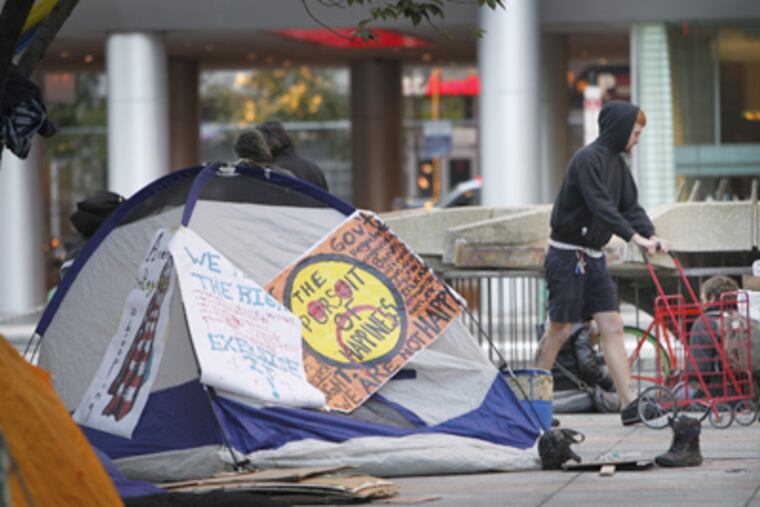
The mood was more festive than confrontational as the Occupy Wall Street movement made its debut in Philadelphia Thursday.
Gathering on the west side of City Hall, several hundred protesters seemed happy to have a forum for airing their varied grievances and made no moves to shut down any aspect of business in the city.
Sign-wavers waited for the light to change before surging back and forth across 15th Street. Hand-lettered cardboard signs urged protesters not to litter.
With no bullhorns or sound system, it was hard to hear those who jumped up on a ledge to address a corner of the crowd.
More noise came from an outdoor media event Mayor Nutter had staged around the corner. A small scattering of police stayed on the fringes of the protesting crowd, with nothing to do but watch.
Though protesters' messages covered a range of complaints, there was an important unifying theme that Philadelphia and the nation need to hear:
It's the 99 percent of Americans who are suffering in today's dysfunctional economy, not the wealthy. While the top 1 percent is doing better than ever, everyone else is struggling.
Government policies allowed this to happen, letting an economy based on greed run amok. The Occupy Philadelphia protesters want fundamental change that will make life better for the vast majority of Americans.
This protest movement is proudly decentralized and small-d democratic, so such a disparate collection is unlikely to ever unite behind a 15-point plan for political action. But its basic point is dead on: Today's struggling economy works for only a privileged, fortunate few.
On one point, the protesters actually have common ground with the tea-party movement. Both agree government played a huge role in creating today's sorry state of affairs.
But unlike the tea party, Occupy Wall Street's answer is not to emasculate government. Its protesters offer an answer more in keeping with the American traditions of democracy and self-government. They want government to respond to the needs of the many, not to the demands of the well-off and well-connected.
Thursday afternoon, a middle-aged woman with short salt-and-pepper hair jumped onto a ledge to speak. An airline worker, she'd had no raise since 2001, and recently took a 16 percent pay cut. In four of those years, she said, the corporation's executives enjoyed more than $200 million a year in bonuses.
The woman told the crowd they had planted a seed and were watering it, but they didn't know yet what that seed would produce.
To produce real change, some of them will have to take a page from the tea-party playbook and take their grievances from the streets into congressional town hall meetings and to the voting booth in 2012.