Rethinking life's priorities
Mother-in-law's illness forces a woman's family to reorganize its life in ways she had not imagined.
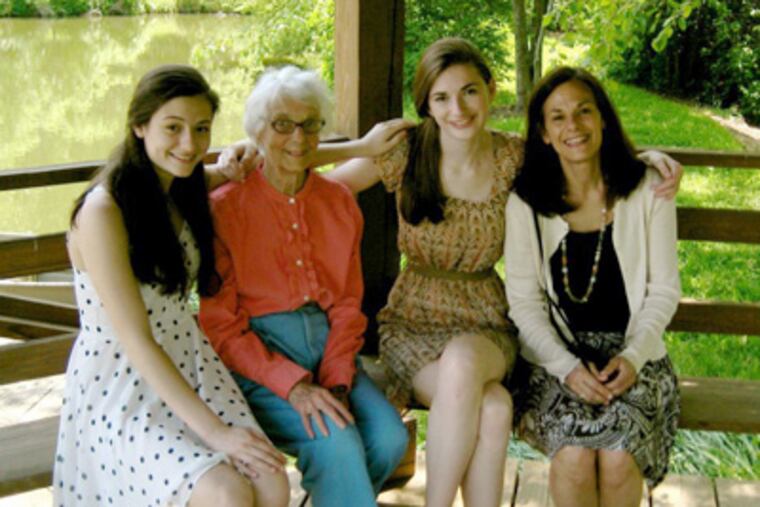
I always imagined that my mother-in-law would spend the end of her life in our home. In my mind, I converted my first-floor office to a bedroom, took Marjorie on slow walks through our neighborhood, and served her tea in our sunny kitchen while my daughters were at school. That dream plan has been dashed by a series of unexpected events: her ovarian cancer diagnosed last summer and her swift decline after my father-in-law's death in May. Now I find myself, instead, driving six hours round-trip on I-95, back and forth from my home in Wayne to Asbury Methodist Village in Gaithersburg, Md., where hospice workers care for Marjorie and I am a visitor.
When I'm not with Marjorie - when I'm teaching or meeting deadlines or touring colleges with my oldest daughter - I want to be there. And when I'm with her - sitting bedside, holding her hand, coaxing her to eat - I feel the pull of other family responsibilities. Like many 50-something people I know, I'm a fulcrum between developing kids and declining parents (my husband's and mine, in Arizona), trying to balance shifting weights on either side of a midlife seesaw.
This year, my husband has spent most of his vacation days in Gaithersburg, and my brother-in-law in California has come out to help several times. Each of us relieves pressure for the others - as my two brothers and I did for each other when my mother's Alzheimer's reached a critical point four years ago. Even so, we're all exhausted. I've barely had time to mourn my mother's memory loss or my father-in-law's passing, only pulling over briefly to collect myself on the shoulder of the long journey still ahead.
I'm not complaining. I'm grateful for our parents' longevity, which allowed them time to pursue other interests after retirement - and my children time to know their grandparents. My daughters are particularly close to Marjorie, who took care of them while I ran a summer writing program at Bryn Mawr College, who played along at their birthday parties, who helped them learn to swim, who took them to puppet shows and museums in Washington, who made dolls and dresses and quilts for them, and who taught them how to knit and sew.
Maybe because my grandparents died when my parents (and I) were young, I didn't know how a longer life curve could change all of our lives - practically, emotionally and financially. I'm disappointed in the cornucopia of medications that don't cure disease but only treat conditions - in Marjorie's case, blood clots caused by chemotherapy and blood thinners that could prolong but not necessarily improve her life. And I'm heartbroken to discover that nursing her is not simply the act of love I'd imagined, but rather, a task requiring professionals licensed to dispense painkillers.
According to the AARP Public Policy Institute, even elderly people who pay for long-term care services rely on family, partners, and close friends for most of their care and support. In 2009, this unpaid care amounted to 40 billion hours with an economic value of $450 billion. My in-laws' prudent decision to move to a continuing-care community (with access to assisted living, skilled care and memory support services) only relieves us of part of our burden - and reminds us how our lives are entwined. We know that Marjorie is receiving excellent care; we make the journey to Gaithersburg because we love her, because her bills need to be paid, because she is distressed, because it is her 87th birthday, because one of her caregivers reports that she is talking to ghosts and trying to pack for a trip.
At Asbury, Marjorie is cared for by patient and skilled women, many of them immigrants: Maria from El Salvador (who disguises bitter medication in homemade applesauce), Marianne from the Philippines (who serves meals in tiny, pretty containers to make food more appealing), Fatou from Guinea-Bissau (who shares Marjorie's love of fabrics and talks to her about quilting). Thanks to these caregivers, my role has gradually shifted; the farther a weight is from the fulcrum, the easier it is to lift.
But relieved of much of my labor - the happy distraction of washing dishes, doing laundry, making meals, getting mail - my main job is to feel. It's August now, stiflingly hot outside but chilly in Marjorie's air-conditioned room. I sit next to her bed in the apartment that is a lockbox containing our lives: our wedding photos on her dresser, the Oriental rug on which our two babies crawled, the gold-rimmed champagne glasses our family sipped from every Christmas Eve - things that signify Marjorie's privilege, though her suffering is all too common. I feel the weight of joy and sorrow that comes at the end of a good novel, when all the threads twine together and you're reminded of the beginning.
I stroke her brow and tell her stories of happy times, hoping to convey how she has shaped my children, and how much she matters to me. "Remember when . . . ?" I keep saying, as if I could anchor her here, because it's hard to let her go and harder for me to leave. Then, when she sleeps, I drive the three hours home, lost in thought, lost on this well-worn path, driving and listening to the ghostly voice on the GPS: Follow highlighted route. Recalculating.