Dylan is a reminder of what some forget
Walt Whitman might have gotten a good laugh out of this. I know I did - a rueful, doleful laugh, but a laugh nonetheless.
I mention Whitman because of a recent incident at the rest stop on the New Jersey Turnpike named after him, a place offering food that didn't exist in Whitman's time, and a stream of vehicles that would have terrified the most American of our poets, a versifier who dreamed of our nation's lofty promises and luscious possibilities.
One thing Whitman didn't dream about was how, more than a century after his death, a pit stop along a 12-lane highway would affirm my pet peeve about Americans' cultural and historical amnesia.
While waiting in line to pay for a candy bar, I heard the usual music that's piped into these places: Carole King and Elton John and, of course, Bruce Springsteen, the poet laureate of the Garden State. Then came a voice halfway between singing and droning and that really didn't seem to care which it was doing as long as it got the point across that something was amiss in our country:
Oxford Town, Oxford Town
Ev'rybody's got their hats bowed down
The sun don't shine above the ground
Ain't a-goin' down to Oxford Town
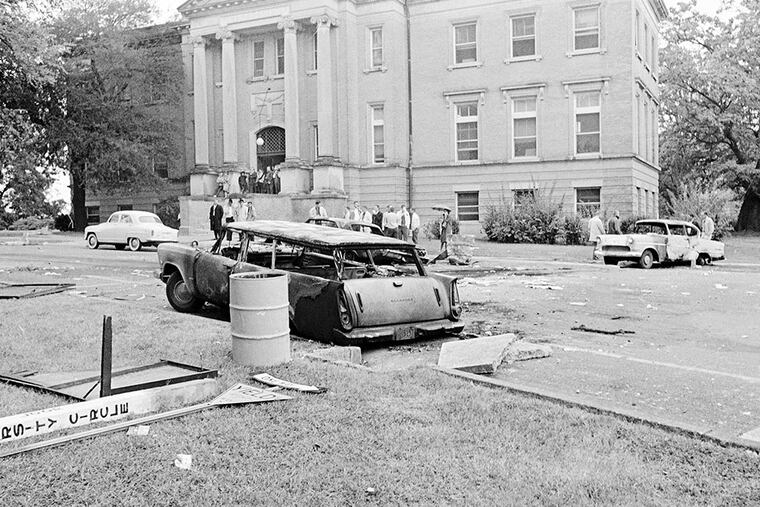
This was Bob Dylan singing "Oxford Town," a dirge about the riots that engulfed the University of Mississippi when its first black student, James Meredith, enrolled in October 1962. If any singer doesn't belong in a rest stop - if any singer doesn't aspire to help us rest - it's Dylan.
Since his early days, Dylan has been out to provoke, stir, annoy, amuse, titillate. He's a provocateur, a tease, a rascal. The song coming through loudspeakers a few feet above our heads was seditious, subversive:
Guns and clubs followed . . . [Meredith] down,
All because his face was brown
Better get away from Oxford Town.
Yet no one in the rest stop seemed to notice. I called my daughter over and asked her if she knew the song. I got a shrug. I asked the cashier behind the counter the same question. I got a stare. Both were in their early 30s.
But "Oxford Town" isn't a jingle, a ditty to fill up the aura space alongside a major highway. It's a remembrance of days gone by in the Deep South, not the antebellum South of Stephen Foster, when all the world was sad and weary, but the South of rage and blood: Before Meredith could enter his first classroom at Ole Miss, two men were killed and 200 soldiers, National Guardsmen, and U.S. Marshals were injured. These men weren't wishing they were in Dixie. They wanted to get the hell out of it.
A few weeks ago, we commemorated the 50th anniversary of the March on Washington. Next month is the 51st anniversary of the riot at Ole Miss. William Faulkner, who lived in Oxford, famously wrote: "The past is never dead. It's not even past." That's true - most of the time. The past is past - a temporal corpse, if you will - when we've never heard of it, when the events that preceded us are unknown or long forgotten, buried under the flotsam, jetsam, and assorted rubbish, when the demands of today push out the whispers and lessons of yesterday.
Americans are notoriously lax about their past. Between 1943 and 2011, at least seven national studies concluded that American students "do poorly" in history, "know little" about history, are "ignorant" about history. The latest survey, for instance, found that only 20 percent of fourth graders could identify Abraham Lincoln but had no idea why he was important. This was eerily similar to a 1943 study, which determined that only 22 percent of high school students knew two of Lincoln's achievements as president.
In this country, historical literacy is elusive. It probably never existed. So I shouldn't have been surprised when Dylan's song raised barely an eyebrow at the Walt Whitman rest stop. But maybe that would have been fine with Whitman.
In his poem "To a Historian," Whitman dismissed those "who celebrate bygones" and treat "man as the creature of politics, aggregates, rulers and priests. . . ." "Pressing the pulse of the life," Whitman - that indefatigable celebrator of the Self and of himself - believed he possessed the power to outline "what is yet to be" and "project the history of the future."
For the poet, every man was his own historian, and every man created his own history. But time and history don't come full blown from this instant. They gestate and mature, circling back upon themselves to find the tangled roots of their origins. That's why I find solace in this line near the end of Dylan's song: "Somebody better investigate soon." Dylan was talking about the "two men [who] died 'neath the Mississippi moon." I'm talking about the holes in our heads where even our recent history is missing, turning our present into a mystery and the mystery into a blur.