A new home for Legion hall's art treasure?
Brian Wright O'Connor is a Boston writer who frequently visits the Lehigh Valley LEHIGHTON, Pa. - Locals remember Franz Kline as the kid from up the hill who painted the mural for beer money. He laid out oilskin tablecloths in the American Legion hall, concocted a paste made of oatmeal and lager, and glued them to the wall behind the bar.
Brian Wright O'Connor
is a Boston writer who frequently visits the Lehigh Valley
LEHIGHTON, Pa. - Locals remember Franz Kline as the kid from up the hill who painted the mural for beer money. He laid out oilskin tablecloths in the American Legion hall, concocted a paste made of oatmeal and lager, and glued them to the wall behind the bar.
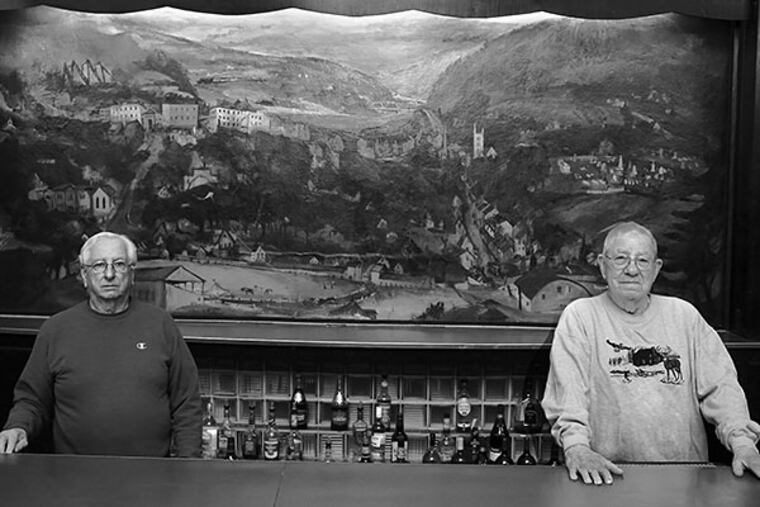
With a cigarette dangling from his lip, he compressed the world onto the makeshift canvas, mixing memory, paint, and imagination to produce a 14-by-6-foot masterpiece of American art.
That was in 1946, when towns like Lehighton were flush with returning veterans, men who had fought at Remagen and Normandy, Tunisia and Sicily, Guadalcanal and Okinawa. Like all the tough mining towns up and down the valley, Lehighton sent more than its share of scrubbed young men off to war.
Standing at the bar, looking at the mural through glass beer mugs, a generation of soldiers, sailors, and airmen could see what they had fought for - the goalposts of youth, a kite rising above the fairgrounds, church steeples, the town square, and rows of modest houses.
But alongside the images of village life were trains rushing to destinations unknown, darkened factories, an airfield with a sagging wind sock, and a cemetery with monuments rising like teeth from the earth's acid-green jaw: the dark energy of a fading industrial America amid the remnants of home, all laid out beneath a glowering sky.
Who knew the brooding trainman's son who hung out with a fast crowd in Greenwich Village possessed such strange talent - a 20th-century Bruegel, capturing the world in the stylized landscape of Carbon County? Or that, within a few years of finishing the mural, the hometown painter would storm the art world, his huge canvases distilling the kinetic force of locomotion and the anthracite ridges of memory into broad swaths of black on white?
Kline's midcentury evolution from a son of the Ashcan School to an avatar of abstract expressionism brought him international fame and sales that in recent years have reached as high as $40 million for one of his distinctive abstract works.
Meanwhile, in Lehighton, in the Legion hall, Kline's mural endures another winter, another set of flakes pulling away from the oilcloth.
Cornelius McHugh, 93, is the only Legionnaire still alive who drank with the artist. Back then, Kline was better known for his gridiron exploits than his painting talents. The popular athlete grew up a few houses down on South Ninth Street and used to swing by McHugh's house after catching the train from New York to visit his family.
"What was he like? Like any regular guy who was broke," says the World War II vet, sipping a Budweiser beneath his grape arbor. "He liked to have a beer. He'd stop by and we'd walk up to Mrs. Diehl's for nickel drafts until I ran out of nickels."
McHugh, along with American Legion Post 314 Commander Floyd Brown, has sadly watched membership decline at the post and the old frame building on Bridge Street begin to sag. Putting a glass cover over the mural in the post's cavernous drinking hall has slowed but not halted its deterioration. The cycle of hot and cold will inevitably degrade it.
Meanwhile, the school that nurtured Kline's artistic ambitions, Lehighton High, could use more art supplies. And veterans from the latest wars are coming home with baffling injuries that camaraderie and cocktails can't cure.
"The mural has had a great home for almost 70 years, but it's time to find a new one," says Brown, a Vietnam veteran. "We want to sell it so that it'll survive forever as tribute to this town. But we also want to keep the post from falling to pieces, expand art classes for the children of Lehighton, and do something for our wounded warriors."
In a world of hedge-fund tycoons vying with mysterious foreign bidders in the gilded auction halls of New York, there must be someone with the beat of a blue-collar heart who can rescue Kline's masterpiece - scrub away the tobacco stains, and give it a new home, ideally in a museum.
The Lehighton Legionnaires would settle for a photographic replacement behind the bar. Art aficionados could view the original in a climate-controlled chamber.
But Kline pilgrims could still climb the winding road from the Lehigh River to see the spot behind the arc of the 60-foot bar where the hometown football hero, drawing colors from his veins, painted the fading world the boys of Lehighton risked their lives to defend.