Sleeping watchdog
Where is the Federal Election Commission when you need it? With more money than ever swirling around political campaigns, the FEC should be making sure rules are followed. Instead, it's stuck in the same partisan funk that has debilitated the watchdog agency since 2008.
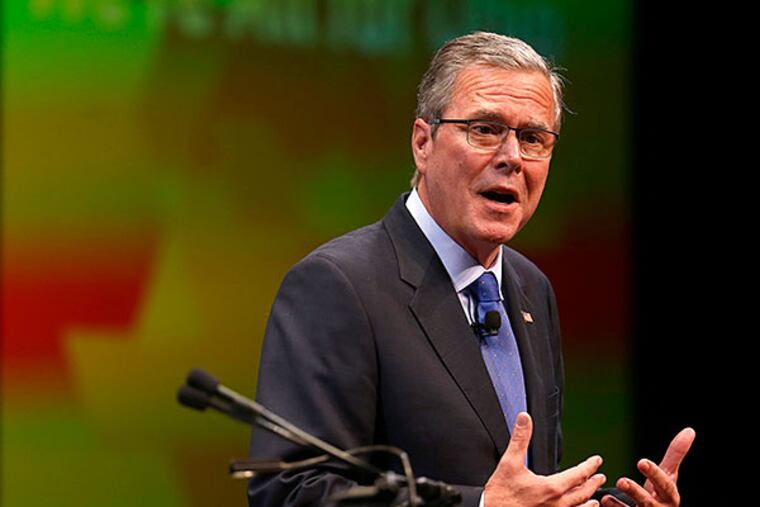
Where is the Federal Election Commission when you need it? With more money than ever swirling around political campaigns, the FEC should be making sure rules are followed. Instead, it's stuck in the same partisan funk that has debilitated the watchdog agency since 2008.
That's when Senate Minority Leader Mitch McConnell (R., Ky.) decided to gum up the works. By law, the FEC, created in 1975, has three members nominated by Democrats and three nominated by Republicans. The six are supposed to be nonpartisan, and they were for the most part until McConnell, who is now majority leader, chose three Republicans who made it their mission to act as obstructionists.
The number of enforcement actions by the FEC subsequently dropped from more than 700 a year to 135 in 2012, according to the nonpartisan reform group Public Citizen. Last year, the FEC reportedly acted on only 16 of 132 cases and issued fines that amounted to less than $207,000. That's a very low price to do business for political campaigns spending millions of dollars.
Given the FEC's stupor, it's hard to believe it would act on promised complaints from two campaign-finance reform groups, Democracy 21 and the Campaign Legal Center, alleging illegal collusion between political campaigns and supposedly independent fund-raising groups known as super PACs.
The groups are pointing fingers at prospective Republican presidential candidate Jeb Bush, who seems to be skirting the rules by delaying an official announcement of his campaign. So long as he is not an officially declared candidate, Bush can work with super PACs. That direct link must be cut once Bush announces, but the FEC still could rule it illegal if Bush's acolytes become his PAC proxies.
But who can depend on the moribund FEC to take any action in its current state of partisan inertia? There is another possibility: action by the Justice Department, which in February successfully prosecuted a case involving coordinated payments to a Virginia congressional candidate's campaign committee and a super PAC that supported him. The criminal case, leading to a guilty plea, was a first for the Justice Department. Here's hoping there will be more.
Super PACs, along with political groups hiding behind tax laws to keep their donors secret, have also been influencing local elections. Millions in third-party cash has been spent on television ads for Democratic mayoral candidates Anthony Williams and Jim Kenney. Because super PACs aren't bound by Philadelphia's law limiting individual donations to candidates, it's going to be up to voters to prove they can't be bought.