In city's first free library, lofty goal
Philadelphia's first free library was not the Free Library of Philadelphia. Bookworms without means in the mid-19th century turned to the Philadelphia City Institute.
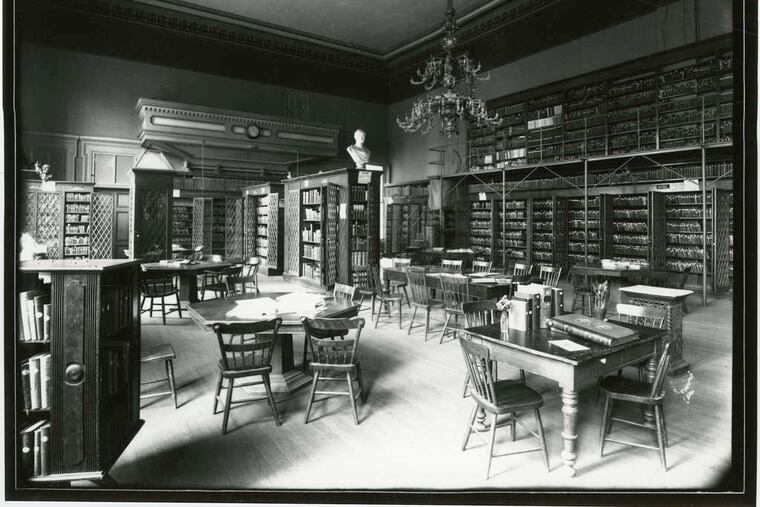
Philadelphia's first free library was not the Free Library of Philadelphia. Bookworms without means in the mid-19th century turned to the Philadelphia City Institute.
Founded in 1852, PCI originated from the Young Man's Institute, an organization striving to provide Philadelphia's youths with positive alternatives to the "perils to which they are exposed in a large city."
PCI was particularly interested in drawing young men away from the brigandry of the city's ganglike fire brigades. In 1852, the "City" was the area bounded by the Schuylkill and Delaware River and Vine and South Streets. PCI concentrated its efforts in the area west of Broad Street.
The organization's goal was clear: "The promotion of the moral and intellectual improvement of young persons by means of a Library and Reading Room, Lectures and class instruction, and such other measures as the Board of Managers may adopt."
Initially reserved for young men, PCI soon extended the services and "advantages of the Institute to females."
PCI offered membership for $1 a year, with its first annual report in 1856 citing 295 subscribers. In the early years, paying members were important to cover the expenses of the library.
However, PCI did not exist exclusively for subscribers. Its first constitution permitted nonmembers to use the Reading Room and borrow books "upon such terms as may be directed by the Managers upon giving satisfactory security."
The earliest written reference to a free library is included in the 1865 Annual Report, which described the classes of membership and added, "All others free."
Later, the PCI Library is frequently, and prominently, described in its publications as a "free library." This predates the Free Library of Philadelphia, which was chartered in 1891.
Though modeled on Britain's Mechanics Institutes - which provided mostly technical training funded by industrialists - PCI was a self-styled "Literary Institute." Evening lectures included topics such as "Physiology," "William Penn and the Holy Experiment," and "Naples and Its Vicinity."
Once Philadelphia began providing free night school in the late 1880s, PCI began concentrating efforts on its library and the development of children's programs.
The first library building was at 18th and Chestnut Streets. Later, PCI moved to South 19th Street. In 1944, PCI joined the Free Library system and relocated to 1905 Locust St. in Rittenhouse Square - where it currently resides.
The first librarians of the PCI Library were men. But from 1864 to 1944, the PCI librarians and assistant librarians were women - including Mary A. Fell, who began as an assistant librarian in 1871 and retired as head librarian 48 years later, in 1919, at age 84.
Today, PCI Library operates as a branch of the Free Library of Philadelphia. Throughout its history, PCI has maintained its focus on Center City and public programming for young people, while also providing dynamic programming and materials for adults.