Stokowski and the sound of history
Vincent Fraley is communications manager for the Historical Society of Pennsylvania As the Philadelphia Orchestra tunes up for this week's performances of Gustav Mahler's Symphony No. 8, consider the story of the man who introduced the orchestra to the world: Leopold Stokowski.
Vincent Fraley
is communications manager for the Historical Society of Pennsylvania
As the Philadelphia Orchestra tunes up for this week's performances of Gustav Mahler's Symphony No. 8, consider the story of the man who introduced the orchestra to the world: Leopold Stokowski.
Born in London to a Polish carpenter father and an Irish mother, Stokowski (1882-1977) studied at Britain's Royal College of Music and Queen's College, Oxford, before working as an organist and choirmaster.
With little experience as a conductor, Stokowski assumed the position of music director at the Cincinnati Symphony Orchestra in 1909. Three years later, the fiery and flamboyant conductor had caught the ears of the Philadelphia Orchestra's board of directors.
While Stokowski was en route to New York after resigning his post in Cincinnati, his socially connected first wife, Olga Samaroff, stopped in Philadelphia. It was on the platform of the Broad Street train station that she signed the contract with the orchestra, on Stokowski's behalf.
On the eve of his appointment in 1912, the Philadelphia Orchestra did not enjoy the preeminent national - and international - status it commands today.
"It was no orchestra at all," Stokowski recalled. "It had a stiff rhythm, hard tone, and no flexibility or imagination."
Founded in 1900, the orchestra performed the works of Mendelssohn, Schumann, and Wagner for a regional, often commuting, audience. It was not uncommon for attendees of Friday matinees to leave their seats "in the middle of the concert to catch the 4:00 train back to the Main Line," writes historian Steven Ujifusa.
Stokowski began his first rehearsal with the orchestra on Oct. 8, 1912, declaring, "Guten Tag. Brahms! First mooment," in his odd brogue. His abruptness was characteristic as well as necessary - the first concert was slated for Oct. 11.
Stokowski's reception in Philadelphia "was not that of an audience merely glad that it had a competent conductor, but wildly enthusiastic because it had discovered a genius," remarked Arthur Judson, the soon-to-be orchestra manager.
Stokowski combated not only audience members with a train to catch but also the conservatism of the board of directors in his effort to mount what would become the orchestra's first national triumph: the American premiere of Mahler's Symphony No. 8.
Described as the closest he ever came to writing an opera, Mahler's opus is one of the grandest choral works in the classical concert repertoire. Stokowski, having himself witnessed the Mahler-conducted world 1910 premiere, considered the piece "one of the greatest compositions of the 20th century."
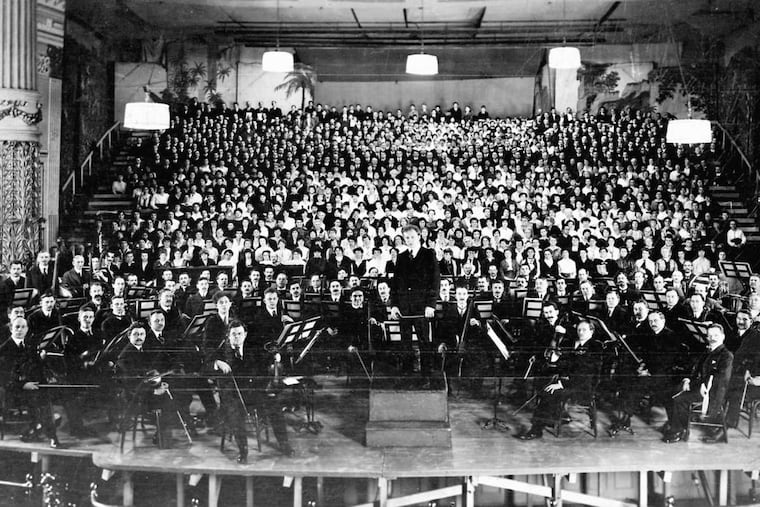
As its nickname implies, a performance of "The Symphony of a Thousand" required gargantuan resources. Stokowski called for 950 choristers (150 of whom were children), a 110-member orchestra, and eight vocal soloists. For the Academy of Music - the orchestra's ancestral home - to accommodate such a crowd, extensions to the stage would have to be constructed.
The costs of performing Mahler's work ran to more than $14,000 - $320,000 in today's greenbacks. The orchestra's board, which considered Stokowski's choice of symphony "debatable," worried that the number of performers would outnumber attendees.
Their doubts were soon assuaged: Scheduled performances quickly sold out, with scalped tickets inflating from 35 cents to more than $100 apiece.
More than 2,000 people waited anxiously at the March 2, 1916, premiere as the curtain rose on 1,069 performers. With the orchestra's opening E-flat-major chord, a new chapter in Philadelphia's music history sounded.
The next day's review in the Philadelphia Public Ledger read, "[Stokowski] scored, so famous musicians agreed, the greatest triumph of his career, the greatest triumph the Philadelphia Orchestra has known in its 16 years of life, and he had done it on a stupendous scale."
Buoyed by applause so great that it could be heard across Broad Street, the premiere catapulted the orchestra and its 33-year-old conductor to the forefront of American symphonic music.
Stokowski's legacy did not end with 1916's "Mahler Mania." Under his direction, the orchestra became the first to make electrical recordings (1925) and provided the soundtrack to the Disney classic Fantasia (1940). It is Stokowski's silhouetted figure that shakes hands with Mickey Mouse.
Stokowski's most lasting musical influence on the orchestra is the "Philadelphia Sound" (originally known by the more alliterative "Stokowski Sound"), a hallmark of which is the lush strings, which he accomplished by encouraging "free bowing" from his string section.
By the time of Stokowski's formal departure in 1941, the days of concertgoers leaving early to catch a train had long ended. The Philadelphia Orchestra "is the finest . . . the world has ever heard," Sergei Rachmaninoff trumpeted.
On March 8, HSP will host music director Yannick Nézet-Séguin and others to explore the connection shared among Stokowski, the orchestra, and Mahler's "Symphony of a Thousand." To register, visit hsp.org/Music.