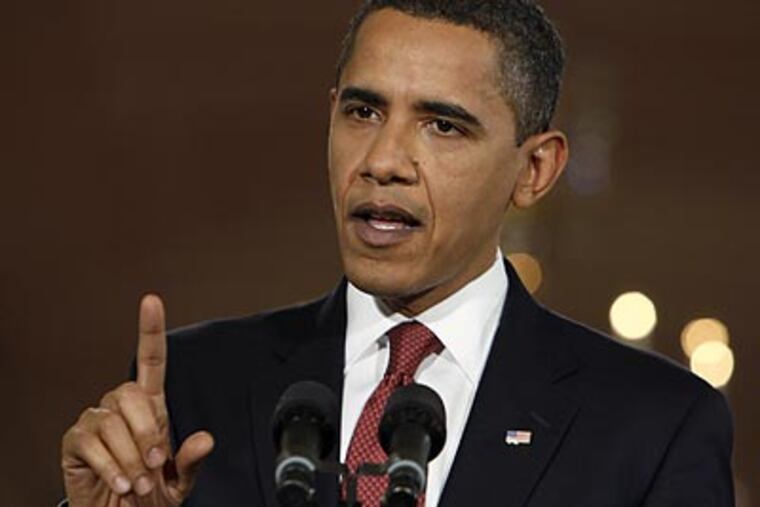
President Obama is pushing an economic recovery package with justifiable urgency, but Congress still needs to make the final plan stronger.
Speaking yesterday in northern Indiana, where the unemployment rate in one county has risen to more than 15 percent, the president said the nation "can't afford to wait" for a jobs bill. He's right. More than 3.6 million workers have lost their jobs since December 2007 - half of them in the last three months.
Spurred by those alarming losses, Sen. Arlen Specter (R., Pa.) and a few other Senate moderates reached agreement Friday night on an $827 billion recovery package. Without them, the Senate probably wouldn't have been able to complete a deal.
That's not to say the proposal hammered out by Specter and friends is as good as it can get. In some key areas, it is weaker than the House version. There is still time to improve the package as House and Senate negotiators work to iron out their differences this week.
For all the flaws in the House bill, one of its most important features was to provide aid to cash-strapped states to jump-start the economy and prevent service cuts or tax increases. Specter and friends cut $40 billion from that pot, mostly targeted for education, plus an additional $16 billion intended for school construction.
Specter said that those cuts were the price of getting a deal, and that half a loaf is better than none. But restoring some of these cuts would have a more immediate impact on state budgets and the services they provide.
For example, Gov. Rendell was counting on $493 million from that federal pot to help pay for rising state prison costs, and to prevent cuts in state aid to counties and community colleges. Reducing or eliminating that total increases the likelihood of more cuts in Harrisburg or by county governments, including layoffs.
Gov. Corzine said both the House and Senate bills "are considerably better than doing nothing."
"Getting moving is essential because this is as much about confidence," he said. "We need the federal government to act."
The Senate version also spends less than the House bill on aid to the unemployed for health-care insurance, and less on food stamps, two items directly related to job losses in this severe recession. Negotiators should ensure that spending is restored to blunt the worst effects on families who've temporarily lost their breadwinners.
Contrasted against such cuts, Specter added $6.5 billion for research at the National Institutes of Health, bringing the total in the bill to $10 billion. It's estimated that money would create as many as 70,000 high-paying jobs within three years.
The Senate version would do far more to spur the housing industry by spending $35.5 billion on tax credits of up to $15,000 for each home buyer. Real-estate agents are reporting increased activity just on the possibility of this credit. It could be an important feature to stop the freefall in the housing market.
As lawmakers work on a final economic package, they should still be guided by a few basic principles. This bill should ease the blow on the unemployed through extended benefits, and spur direct job creation as quickly as possible in a variety of industries.