Editorial:
Specter's green campaign It's no secret how Sen. Arlen Specter (R., Pa.) intends to woo Pennsylvanians on the left and right for his reelection bid in 2010: with bushels of government aid.
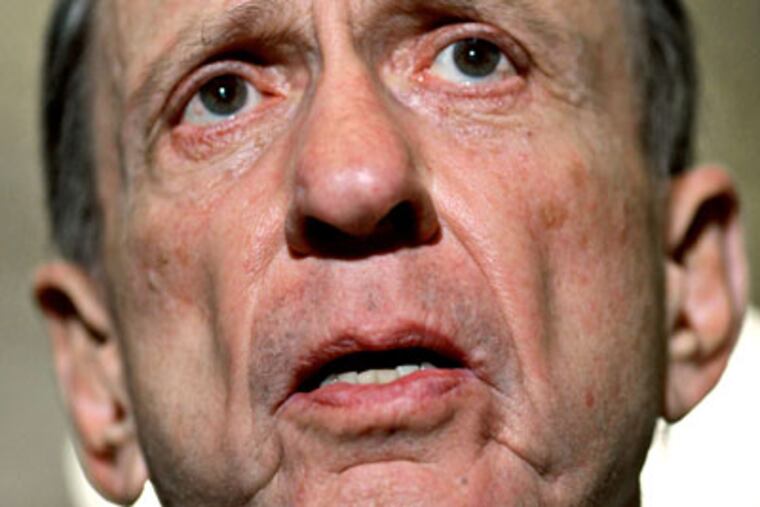
Specter's green campaign
It's no secret how Sen. Arlen Specter (R., Pa.) intends to woo Pennsylvanians on the left and right for his reelection bid in 2010: with bushels of government aid.
Specter, who infuriated conservatives by voting for the $787 billion economic stimulus bill in February, also angered Democrats this week by announcing his opposition to a bill that would make it easier for workers to form unions.
But Specter obviously is still an adherent of the philosophy that money talks. Just look at some of the grants and appropriations he's been busy announcing this month.
There's more than $15 million in Homeland Security funding for more than 60 fire companies throughout Pennsylvania, including $270,320 for the West Grove Fire Company in Chester County and $240,350 for the Amity Fire Department in Berks County.
There's a stimulus grant through the Justice Department of $2.2 million for south-central Pennsylvania communities. There's $6.7 million for six health centers throughout Pennsylvania. And don't forget that $190,000 for the SouthEastern Pennsylvania Consortium for Higher Education in Montgomery County.
That's just a partial list. Look for lots more government aid to come Pennsylvania's way before the GOP Senate primary in 2010.
Rather than switching from Republican to Democrat, as Gov. Rendell has urged, maybe Specter should join the "green" party.
Homeless in the airport
For years the homeless could find a safe place to sleep overnight inside Philadelphia International Airport in the baggage-claim areas.
But now airport police are enforcing a regulation that allows only ticketed passengers or employees inside terminals between midnight and 5 a.m. The law has been on the books but often ignored.
The homeless have been jumping on public transportation and heading to the airport. Weary travelers have been complaining, forcing the airport to take action.
Instead of abruptly rounding up the homeless and forcing them back onto the cold streets, officials are handling the homeless with compassion. They are given three options: leave on their own, be driven to a shelter, or be charged with defiant trespassing.
The crackdown, which began in February, has worked - with fewer than a half-dozen homeless now showing up at the airport on a typical night. As many as 40 people had been sleeping there nightly.
Airport officials deserve credit for trying to deal with a thorny issue that is symptomatic of the city's homeless problem. The airport spends thousands of dollars sending roaming teams out five nights a week, trying to coax the homeless into shelters.
Several hundred destitute people, many suffering from mental illness or addictions, live on city streets. Thousands more live in city and private shelters.
Moving the homeless from the airport is a temporary fix. The city must do more to prevent and reduce homelessness by providing social services that include drug and mental health counseling.
A true trailblazer
Do a Google search of "African American studies" and you'll have 25 million sites to explore. Try "African American history texts" and the number of selections grows to more than 700 million.
But before there was the easy research that comes with the Internet, before there was a prolific African American studies movement, there was John Hope Franklin. The great historian and civil rights icon died Wednesday of congestive heart failure in North Carolina. He was 94.
Franklin wasn't the first to tell the story of African Americans. But his seminal work, From Slavery to Freedom: A History of Negro Americans, published in 1947, became a touchstone for all that would follow. Now in its eighth edition, the book is still widely used in history courses today.
The descendant of slaves was born only 50 years after the end of the Civil War. Franklin was 6 when his family lost everything during the race riots in Tulsa, Okla., in 1921, which killed at least 40 people.
The injustice he witnessed and experienced inspired a lifetime of promoting justice through research and storytelling. He did so, honestly and forcefully, ensuring that the nation could never again ignore the history and contributions of its African American citizens.
Some of that research would help Thurgood Marshall and the NAACP win the historic Brown v. Board of Education desegregation case in the 1950s. Some of it would lead the Harvard-trained historian to become the first African American to chair a history department at a predominantly white college and become the first black to lead the American Historical Association.
Franklin would testify before Congress numerous times over the years. He would chair President Bill Clinton's advisory board on race and be awarded the Presidential Medal of Freedom.
Perhaps most important, John Hope Franklin's lifetime of truth-telling has inspired generations of historians, ensuring that From Slavery to Freedom was just a beginning.
Cheer for ol' Notre Dame
The University of Notre Dame's decision to invite President Obama to speak and receive an honorary degree at its graduation ceremony in May has stirred a silly backlash aimed at the renowned institution for higher learning.
Critics are outraged that the Roman Catholic university would honor a political figure who is pro-choice and allows federal funding for research using embryonic stem cells.
Some want the school to rescind its invitation to Obama. More than 150,000 have signed an online protest petition, while the bishop of South Bend, Ind., where the school is located, plans to boycott Obama's commencement speech.
Father John Jenkins, Notre Dame's president, said the invitation to Obama isn't an endorsement of his positions on abortion or stem cells.
The university has a rich tradition of honoring presidents from both parties, including Ronald Reagan, who was divorced, and others, like George W. Bush, who supported the death penalty - two issues that also run counter to Catholic teachings.
Jenkins rightly said Notre Dame views the differences the church has with some invited speakers as a catalyst for dialogue.
"You cannot change the world if you shun the people you want to persuade, and if you cannot persuade them . . . show respect for them and listen to them," he said.
Jenkins called Obama an inspiring leader and said the invitation and honorary degree in part reflect the historic election of the nation's first African American president.
Not to mention, Notre Dame's mission calls for providing a forum where "free inquiry and open discussion ... may intersect with all the forms of knowledge found in the arts, sciences, professions, and every other area of human scholarship and creativity."
While anyone is free to differ with Obama on his positions, Notre Dame's invitation to the president is in keeping with the university's mission and the belief that a college campus is a place where a broad range of ideas and beliefs are welcome.
All quiet on SEPTA front
It's good news, but please don't shout about it: SEPTA is expanding its "Quiet Ride" service systemwide after a successful trial run. Starting next month, riders on most rush-hour trains seeking a respite from cell-phone conversations and loud yakkers will have one rail car designated for quiet.
Transit agency officials are delivering on their promise of service improvements as more riders turn to SEPTA. Also, the agency just announced a handy new one-day pass for unlimited rides on SEPTA and the Phlash tourist buses.
On the Quiet Ride, it's smart to respond so quickly to the overwhelmingly positive reviews of the pilot program started in January on express trains to Lansdale and Doylestown. In time, SEPTA officials should consider expanding the program to most of the cars on each train.