Springs - Arab and otherwise
"An old man sat on the sidewalk, placed a hat in front of his crossed legs, and a sign next to them that read: 'I am blind. Please help me,' " my student began.
"An old man sat on the sidewalk, placed a hat in front of his crossed legs, and a sign next to them that read: 'I am blind. Please help me,' " my student began.
An Egyptian psychologist, Professor Saleh, along with two other visiting professors, was taking English lessons funded by a grant from the U.S. Agency for International Development. The professors were to publish in an American journal during a nine-month stay in the United States, and I was to help them make sure their writing was appropriately polished.
This day's content focused on behavioral conditioning. Professor Saleh, eager to contribute his expertise to the lesson, leaned forward in his chair, easing into the more familiar role of professor.
"The old man continued like this for days," he went on. "He sat there collecting only pennies until one day, he noticed his hat was filled to the brim. He wondered what was different about today - not a national holiday, nor a religious celebration - and asked a person near him to read his sign out loud.
"This is what was read back to him: 'We are in spring. Enjoy its beauty.' "
According to the professor, a behavioral expert had changed the old man's sign that day, drawing on his knowledge that people respond better to optimism than they do to appeals for pity.
I looked around the table at these professors, who had spoken of their country's recent revolution only in the context of pride and hope. It was the revolution, after all, that had ultimately enabled them to apply for sabbaticals to continue their research in the United States. And yet Saleh's colleague, Professor Ali, had shown me cellphone pictures of his friends' bodies in Tahrir Square.
"We just kept going, kept shouting," he explained. Death was a part of this rebirth - an accepted loss before the new season could arrive.
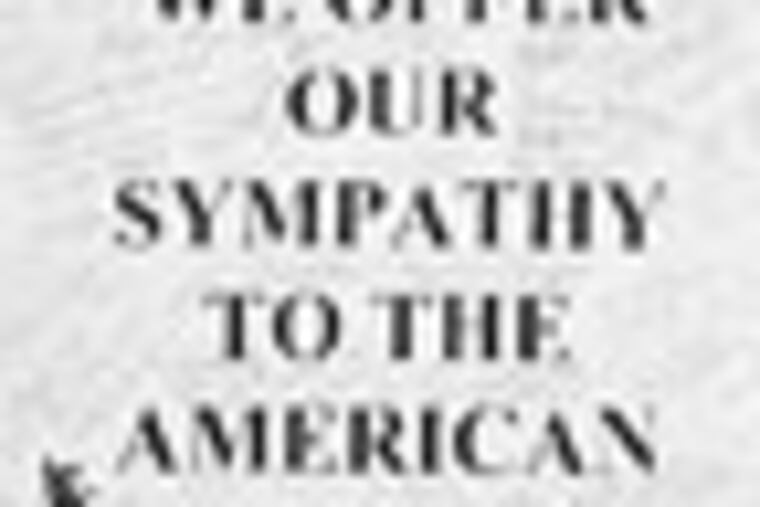
I remembered a sign I had seen in Italy, where I was studying political science in 2001. It was September, just after the 9/11 attacks. Passing through the San Lorenzo market in Florence, among Italians, Iranians, Brazilians, and Syrians noisily hawking their wares, I came across a sign that read: "We offer our sympathy to the American people." Dozens of signatures filled the spaces between the text.
I caught the eye of an Iranian woman selling leather jackets at the stand next door. We both smiled, broadly, before I moved on.
I often think of that sign, of the months and years that followed 9/11, and of all that has militarized, galvanized, polarized, and unified us in a country permanently altered by the events of that day. That sign was our own hat, chock-full of pennies.
Foreign friends of mine frequently remark on the lightness of the American spirit - on how we are beloved and respected by many as a people, however they feel about our government. It was this spirit that people responded to after 9/11, when we were blinded by our pain.
I wonder what will happen to my Egyptian professors after they return home in a few months, to a country still reeling from loss and struggling to heal. It falls to us now to encourage them, and to remember the support we gratefully accepted in our days of chaos. It is up to us to toss in our pennies, sign our names, and turn the sign to face our neighbors to the east, reminding them that their spring, too, will be beautiful.