Requiem for a coffee shop
By Matt Katz I've been sitting in this coffee shop for 20 minutes and have yet to hear a word spoken. Two customers are enveloped in huge headphones; three others are stoically sunbathing in the glow of their laptops. I feel the barista counting down the minutes until quitting time.
By Matt Katz
I've been sitting in this coffee shop for 20 minutes and have yet to hear a word spoken. Two customers are enveloped in huge headphones; three others are stoically sunbathing in the glow of their laptops. I feel the barista counting down the minutes until quitting time.
I hate this place. And I miss Beauty Shop Café.
My local coffee shop - the one on the corner of my block in the Graduate Hospital neighborhood, the one where I really did know everyone's name, the one with the old-school hair dryer in the corner paying homage to its beauty shop past - was sold last month. Closed ever since, it sits like a corpse of community.
The Beauty Shop was for freelancers and artists, suits-and-ties and service-industry types alike. For a core group, it was the first place they went each morning. For some, it was the only place they went all day.
Since the Beauty Shop closed, I've seen regulars wandering the streets like dazed refugees. They complain on Facebook, talk about reuniting for drinks (at night?!), and bemoan their futile search for a replacement.
Belle & Sebastian was on in the background, but the sound of the Beauty Shop was the conversation. Free-flowing and often hilarious, it welcomed comers and goers with constantly evolving topics and characters.
The topics: City politics, local development, smack talk, but mostly scrutiny of the Phils' double-A lefthanded options. The characters: Some you knew and some you didn't. People like Johnny Goodtimes, Philly's king of quizzo, and Fergie, its king of pubs, were regulars.
Jon, the owner, was the town crier, with an answer to any question you might have about our little patch of Philadelphia. When is the yoga place across the street opening? How much did the house next door go for? Why are they tearing down that beautiful church and putting up cookie-cutter condos? (Have a seat for the answer to that one. It might take a minute.)
Sarah, the barista, loved the place as if it were her baby. Exuberantly friendly, she clearly wasn't from Philly. Raw and honest, she clearly was now.
Kevin acted as the unofficial greeter, standing at the counter with an extra-extra hazelnut coffee and an Inquirer. Two months ago, he made beautiful photo collages of the regulars' babies and dogs and hung them on every wall. If someone at Starbucks did that, they'd call the cops.
Weeks before the café closed unexpectedly, Kevin moved unexpectedly to the West Coast. I've heard it theorized that he somehow felt it coming.
From my window seat, I filed articles, interviewed sources, and more than once had all three meals in the same spot. I was there so often that Jon once texted me to ask if Sarah had put away the milk delivery yet.
On Saturday mornings, I'd bring my daughter, and she was fawned over like family. At home, she'd get cabin fever. At the Beauty Shop, she'd smile, eat brioches, and watch the door. She was comfortable, calm, and curious about who was coming in next. So was I.
The sociologist Ray Oldenburg conceived of a "third place" beyond one's first place, the home, and second place, the office, filled with strangers, regulars, cheap drinks, and laughter. There are a lot of coffee shops, but they're not all third places. The Starbucks barista may call you by name, but only because it's written on your cup. The Beauty Shop was more like Central Perk on Friends, except the cast was cooler and not as good-looking.
Jon could occasionally come off as ornery, sure, but he also remembered your name and drink from the first time you came in. And he did a lot of little things right: You paid after you were done, which made it more familial and less transactional. The sandwiches were simple - you've never seen a Foreman grill work so hard. And the chipped mugs and sticky countertops made it feel like home, your imperfect little home.
At 400 square feet, it was indeed little. Scale had a lot to do with its success and intimacy.
I miss having a town square in my neighborhood, which may be changing more dramatically than any in the city. I miss how the Parking Authority ticket-writers would use the bathroom, and how we'd make fun of them while they were in there. I miss how nice everyone was to the mentally disabled man who came in every afternoon, bought a Pepsi, and repeated the phrase, "That's good, right?" I wonder where he goes now, and who he talks to.
The Beauty Shop was bought by the owners of a Center City restaurant who have said they want to keep it a coffee shop. Apparently they're going to fix it up a bit and reopen next month.
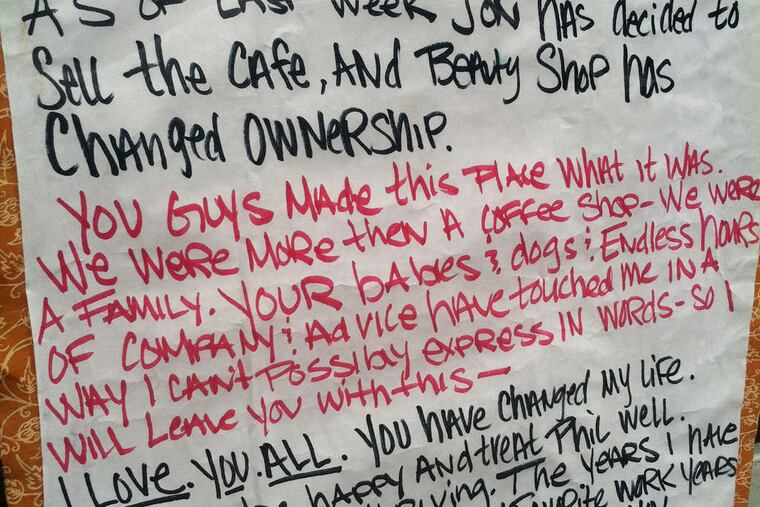
We hope so. The place may not be a gold mine, but it is a civic treasure. Just read what Sarah wrote on the sign that stills hangs on the window: "You guys made this place what it was. We were more than a coffee shop - we were a family. Your babies and dogs and endless hours of company and advice have touched me in a way I can't possibly express in words."
Words, conversation, coffee: I hope we can keep it all flowing.