Success goes beyond 600 wins on the court
Abington Friends School's boys' basketball coach Steve Chadwin notched his 600th win last week when his Kangaroos dispatched visiting Masterman, 58-36. True to form, Chadwin downplayed the achievement.
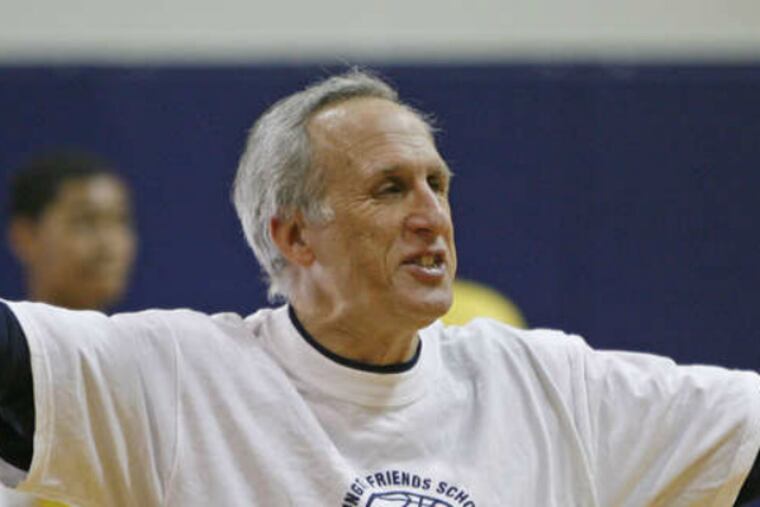
Abington Friends School's boys' basketball coach Steve Chadwin notched his 600th win last week when his Kangaroos dispatched visiting Masterman, 58-36. True to form, Chadwin downplayed the achievement.
In noting that all of Chadwin's 600 wins have been for one school, the coach modestly replied, "I'm not the only person who's done it, but it's a unique group."
Bill Ellerbee, who amassed 451 victories at Simon Gratz, was so impressed with Chadwin that he steered many gifted student-athletes to AFS, including his own son.
That's high praise for a coach from the Friends Schools League, once considered inferior to the Philadelphia Public and Inter-Academic Leagues.
Over the course of his 36 years at AFS, Chadwin's teams have won 16 Friends Schools League titles, the last coming in 2012. They've also elevated the competition in the league to such a high level that it's now a feeder for many top Division I programs, including Georgetown and the University of North Carolina.
But there is much more to Chadwin's success.
I should know. I was one of his assistants in the early 1980s, when he began his career at AFS.
Abington Friends, founded in 1697 by the Religious Society of Friends, or Quakers, was an unlikely basketball powerhouse at the time. It was a predominantly white, upper-middle-class, K-12 prep school. Administrators and faculty discouraged high-profile athletic competition, fearing that the Quaker emphasis on participation would be compromised by the quest for victories and league championships.
Steve quickly found common ground. His easygoing personality, genuine concern for youth, and strong commitment to diversity complemented the school's Quaker mission perfectly. That doesn't mean building the basketball program was easy.
As AFS increased minority enrollment, the need for stronger academic and peer support became greater. Many of the new students came from less advantaged backgrounds and had difficulty adjusting to the culture and academic rigor of the school.
Some teachers feared that scholarship was being compromised for diversity, and that they were being forced to choose between the two. The Quaker process of consensus decision-making often resulted in stalemate.
I often wondered why Steve didn't become discouraged and leave. Only years later did I realize that basketball was simply the vehicle he used to teach kids the important life lessons that cannot be learned in a classroom. The AFS job wasn't his "ticket" to another coaching position at a higher-profile school or in the college ranks.
So "C," as he is known to his players, remained at AFS for more than three decades.
On the court, he not only taught the pick-and-roll, zone defense, and full-court press, but also discipline, sportsmanship, and, above all, teamwork.
Off the court, C found a network of like-minded teachers to offer the academic support that students needed. He created social opportunities for all the kids - black and white, Jewish and gentile, wealthy and not-so-wealthy - to learn from each other. He mentored them, cultivating personal responsibility and an enduring sense of self-esteem. What's more, C did it all with discipline, encouragement, and love.
At a time when high school sports is becoming a way station to Division I scholarships and coaching positions, Steve Chadwin is a rare teacher-coach who is more passionate about the moral and educational development of his student-athletes than personal ambition or the number of victories on his resumé.
For those whose lives he's touched, C is the most beloved of all educators. Here's to 600 more victories, on and off the court.