Why Kelly was called a racist
In the context of events outside professional football, accusations that racism played a role in Eagles coach Chip Kelly's decisions to trade several black players are understandable, though not believable.
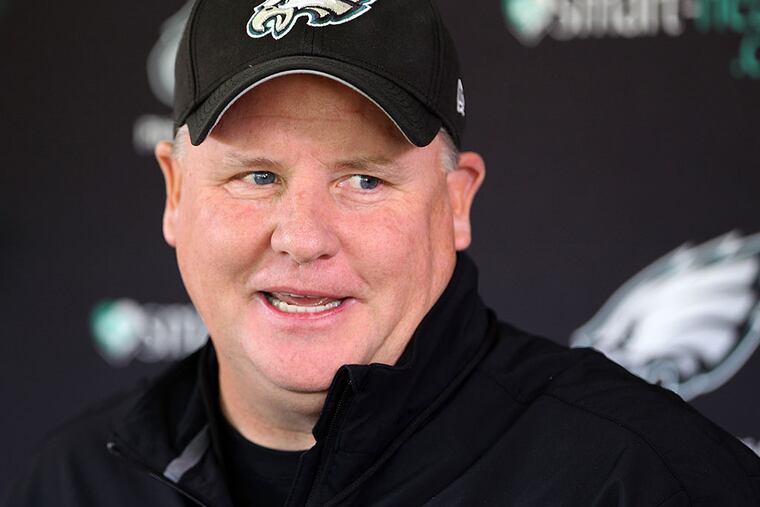
In the context of events outside professional football, accusations that racism played a role in Eagles coach Chip Kelly's decisions to trade several black players are understandable, though not believable.
In recent months, this country has seen evidence of the unequal treatment African Americans face at the hands of police, at times resulting in death. It has heard charged rhetoric in defense of an odious emblem embraced by racist groups, the Confederate battle flag. Meanwhile, schemes persist to further erode protections provided to blacks by the Voting Rights Act.
With such evidence of racial discord playing in the background, Kelly traded running back LeSean McCoy in March and cornerback Brandon Boykin last week, only to have them echo wide receiver DeSean Jackson, who suggested after being traded last year that race played a role in Kelly's decision.
Trading players is part of fielding a pro team. But in the context of the times, the racism charge has resonated despite being flimsy. Kelly says that could be because he opted not to trade Riley Cooper, a white wide receiver who two years ago was caught on video calling a security guard the N-word at a country music concert.
Winning games will likely repair any damage the racism accusations have done to Kelly's reputation and his psyche. A Super Bowl victory would restore the faith of Eagles fans of any ethnicity. But the societal ills and inequities outside sports, which make racism charges easier to believe, require stronger medicine.
The first dose could be restoring key provisions of the Voting Rights Act that were invalidated by a 2013 Supreme Court ruling, which determined that states with a history of racial discrimination no longer need federal approval to change their voting laws. Congress could give states affected by the law more flexibility without ending federal oversight.
It was hypocritical for Congress to celebrate last week's 50th anniversary of the Voting Rights Act without restoring its strength. That only adds to the air of racial suspicion. Various state legislatures' efforts to manipulate elections with voter-ID and other laws discouraging minority voters show the act is still needed.
Even so, it may be easier to topple roadblocks impeding people's ability to vote than to erase the distrust of police among African Americans, fueled by what they see as blatant bias. A litany of police misconduct cases, including the shooting deaths of unarmed black men in Ferguson, Mo., and North Charleston, S.C., have raised valid questions about the depth of racism.
Since their integration, beginning with baseball in the 1940s, most professional sports are viewed idealistically as occurring in settings where performance matters more than race, religion, and, increasingly, gender. This ideal is an illusion, as any athlete who has endured racial insults during a game will confirm.
Such racism may be tuned out more easily than when it's suspected of a coach. And while a coach accused of prejudice may offer heartfelt assurances to the contrary, his actions and relationships with players over time will be the test.