Supreme opportunity
Three hundred eleven years ago, the last time Pennsylvania's highest court had three vacancies, their replacements were up to the royal governor and, by extension, the queen. The three court vacancies to be filled on Nov. 3, two of them due to scandal, don't reflect the best work of the democracy that determines the composition of today's state Supreme Court. Dramatic reform, not to say another revolution, is in order.
Three hundred eleven years ago, the last time Pennsylvania's highest court had three vacancies, their replacements were up to the royal governor and, by extension, the queen. The three court vacancies to be filled on Nov. 3, two of them due to scandal, don't reflect the best work of the democracy that determines the composition of today's state Supreme Court. Dramatic reform, not to say another revolution, is in order.
Fortunately, Pennsylvanians have the power to reshape the court this time, as well as a field of promising candidates to do so.
How to retrieve a high court from a low point? With jurists who grasp the gravity of its deficiencies and have the experience, integrity, and will to address them.
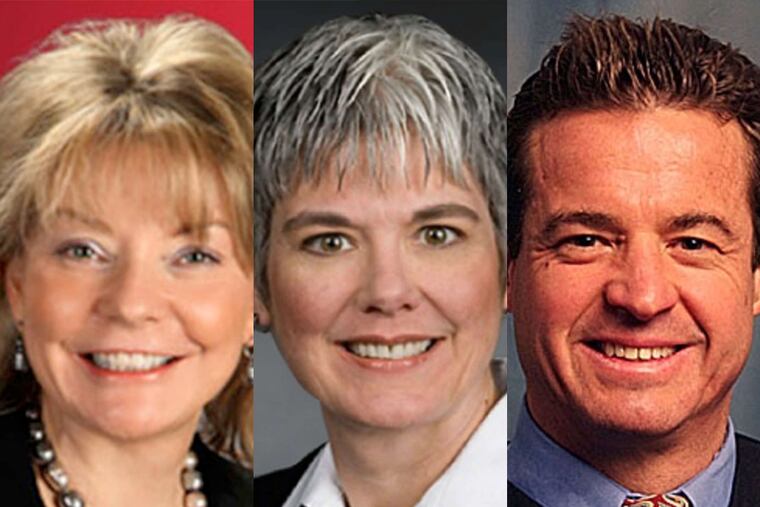
As evidenced by faltering attempts to investigate two justices' involvement in a pornographic email scandal, the shortcomings of the judicial disciplinary system are particularly pressing. Superior Court Judge CHRISTINE L. DONOHUE stands out not only for having served on the panels responsible for disciplining judges and attorneys, but also for understanding the system's excessive secrecy and sluggishness. The daughter of a coal miner, the Pittsburgh Democrat favors making appointments to the disciplinary entities more transparent and using private attorneys as hearing officers to expedite cases.
Her fellow Superior Court Judge JUDITH F. OLSON's emphasis on respect for the law, the system, and one's colleagues provides a welcome contrast to the bitter feuding and blackmail allegations among justices over the past year. Previously an attorney specializing in complex commercial litigation, the Allegheny County Republican is appropriately concerned about threats to the courts' reputation. And she has combined refreshingly anemic fund-raising with political strength, winning the most votes in crowded contests for the GOP nomination in the spring and for Superior Court six years ago.
On the other end of the funding spectrum, one of the best-financed candidates in the race, DAVID N. WECHT, has more to recommend him than his war chest. The Democratic Superior Court judge and Allegheny County Court alumnus has a breadth of judicial experience unparalleled in the field, having been a prolific author of appellate opinions as well as an advocate for more consistent handling of family cases in Pittsburgh. While the details of his five-point ethics and transparency plan are subject to quibbling, he is right to stress systemic reform.
Wecht, Olson, and Donohue also have the distinction of being "highly recommended" by the Pennsylvania Bar Association, which noted their well-reasoned opinions, judicial temperaments, and integrity. The bar, which conducts extensive independent evaluations of candidates, rated the rest of the field "recommended" with the exception of Commonwealth Court Judge Anne E. Covey, who has strenuously disputed her "not recommended" rating.
The argument comes down to a 2011 campaign spot that ran afoul of the bar's proscription of misleading advertising, though it was otherwise standard political fare that doesn't seem to justify Covey's failing grade. The Bucks County Republican and former Pennsylvania Labor Relations Board member is in other respects a competent candidate and the only one on the court that handles government-related appeals. Her views on the high court's ethical crisis, however, fall short of the urgency articulated by the other appellate judges in the race.
The other three candidates hail from trial courts and share a lack of appellate-level seasoning. The most promising is Republican Michael A. George, the president judge of Adams County Court in Gettysburg, who ran against the wishes of the Republican leadership and is the lone candidate from the state's rural center. George says he helped lead an evaluation and reorganization of his court and could bring the same spirit to Harrisburg.
Kevin M. Dougherty is another impressive trial judge who has held a series of leadership positions in Philadelphia's Common Pleas Court. The well-funded Democrat from South Philadelphia has an even demeanor and admirable passion for improving the justice system's treatment of the disadvantaged. But his financial and familial ties to politically connected unions - his brother, John J. Dougherty, runs the city's powerful electricians' local - raise questions about his candidacy for a court that needs to de-emphasize partisan politics.
Speaking of which, Paul P. Panepinto is the race's only independent, having left the GOP after repeated unsuccessful runs for an appellate judgeship. Also a Philadelphia Common Pleas judge, Panepinto has healthy frustrations with the judiciary but doesn't appear to be the candidate most qualified to address them.
Replacing partisan elections with an appointment process holds the most promise for bringing Pennsylvania's age-old high court up to modern standards. A bipartisan bill passed by the state House Judiciary Committee last week may have begun that years-long process. Meanwhile, those hoping to change the court sooner - say, next week - should choose Donohue, Olson, and Wecht.