She's fashion's go-to girl this fall
Standing high on its heels among the round-toed, T-strapped and spectator pumps this fall is the Mary Jane. A must-have accessory for this season's tailored skirt suits, wide-legged pants, empire-waist frocks, and dressed-up denim, the shoe is dazzling in patent, metallic and animal-skin styles.
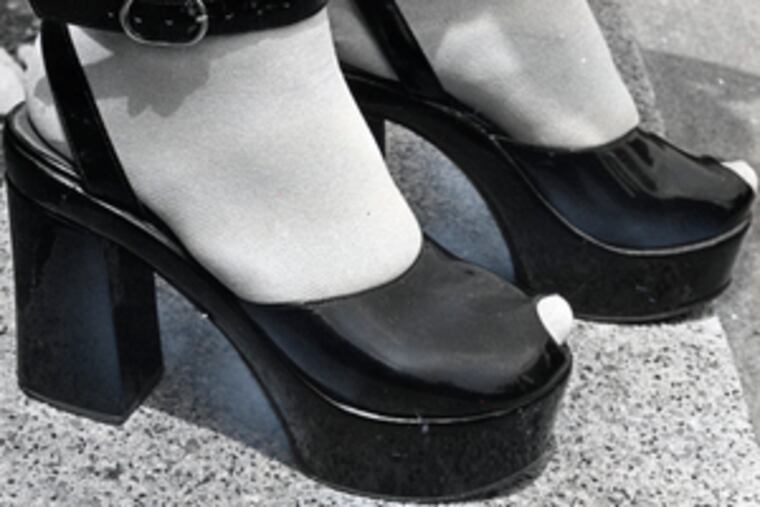
Standing high on its heels among the round-toed, T-strapped and spectator pumps this fall is the Mary Jane.
A must-have accessory for this season's tailored skirt suits, wide-legged pants, empire-waist frocks, and dressed-up denim, the shoe is dazzling in patent, metallic and animal-skin styles.
"Women are building their entire wardrobes around this shoe," said Sherri Guggenheim, owner of the recently opened ViVi G. Shoes in Glen Mills. "The architecture, the color schemes, the mix of metals - the shoe is so modern."
The Mary Jane wasn't always a go-to shoe for fashionable ladies.
Mary Janes were introduced in the early 1900s as a shoe for little girls - inspired by the Buster Brown comic strip, where Buster and his sister, Mary Jane, wore them.
"A lot of shoe designs have come from illustrations," explained Ellen Goldstein, chairwoman at New York's Fashion Institute of Technology accessories department.
"Most little girls wanted to emulate her. Even today, all children's wear designers have at least one Mary Jane in their collection."
Whether your Mary Jane is chunky or kitten-heeled, spectator or patent leather, Manolo Blahnik or REI, the bar that runs across the center of the shoe is what makes it a Mary Jane, said Clara Henry, director of Philadelphia University's design program.
"Mary Jane is a classic shape when it comes to footwear, and it will never go away," Henry said.
A Walk Through Mary Jane History
1900-1910
In 1902, comic strip creator Richard Outcault sold the rights to his illustrations to the Brown Shoe Co., which made a version of the shoe and called it the Mary Jane.
Early 1900s
With its low, kitten heel, the shoe became the high-fashion choice for flappers. The look, however, would not yet truly shake its little-girl reputation. 1924
Little Orphan Annie, created by Harold Gray, first appeared in national comic strips wearing Mary Janes. They were a must with that pretty little red dress.
1930s
Shirley Temple tap-danced her way into America's hearts in frilly dresses and Mary Jane tap shoes.
1960s-70s
Designers Yves Saint Laurent, Pierre Cardin, Christian Dior and André Courréges ushered in the baby-doll dress that paired perfectly with Mary Janes, according to Henry. Shoe designers Manolo Blahnik, Salvatore Ferragamo and Capezio Shoes added chunky platform heels that defined the era.
Late 1990s
Mary Janes became the preferred shoe for the grunge generation. Designers Marc Jacobs, and Rei Kawakubo for Comme des Garçons, began adding fashion colors to their runway collections. REI also introduced a sporty Mary Jane. Today, Nike does a Mary Jane-style running shoe.
Early millennium
Christian Louboutin and Jimmy Choo did pointy-toed versions of Mary Janes. Ouch!
2006
Stacy "Fergie" Ferguson of the Black Eyed Peas recorded "Ode to Mary Jane" on her solo album The Dutchess.
Fall 2008
The Mary Jane is back at every price point from Marc Jacobs to Dru to Nine West to Payless. Hot colors: wine and emerald green. You also want a pair of metallic and black spectators.