Working Mother marks three decades of change
When Working Mother magazine debuted 30 years ago this month, employers believed women worked to pay for the "extras" that made life nicer, not to build a career, support their families, or find personal fulfillment - and paid them less as a result.
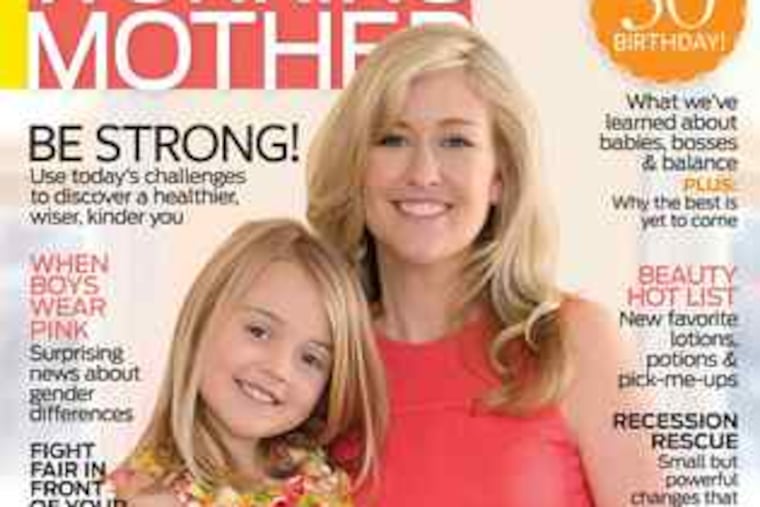
When Working Mother magazine debuted 30 years ago this month, employers believed women worked to pay for the "extras" that made life nicer, not to build a career, support their families, or find personal fulfillment - and paid them less as a result.
In its early days, the magazine reflected that.
"We used to do stories about saving 'pin money' to spend on Christmas gifts," said Carol Evans, president of Working Mother Media, which sells 825,000 copies of the magazine eight times a year and estimates its readership at two million per issue.
"That persisted for some time, until it was proven again and again that working moms were an economic powerhouse. They controlled the household budgets, and they were picking the car, not the color."
The number of working mothers has almost doubled, from 16 million in 1979 to 30 million today, and women make up nearly half the workforce. Many are the primary breadwinners. They have made inroads into just about every profession, moving up the ladder and into executive suites, and forming networks to bring other women along.
Mothers in the workforce used their clout to help enact family-friendly laws and corporate policies, from the Family and Medical Leave Act of 1993 and the Lilly Ledbetter Fair Pay Act of 2009 to paid parental leave and workplace flexibility. Working Mother began highlighting and encouraging these changes in 1986 with its annual Best Companies for Working Mothers edition.
"We are constantly reinventing the magazine to stay ahead of our readers," Evans said. One of its founders, Evans worked there for 10 years, left for 12, then bought the publication in 2001. Last year she sold it to Bonnier Corp. of Sweden but still runs the operation.
The magazine used to not pay attention to part-time workers or those who dropped out of the workforce for a few years. "Then we started to embrace all kinds of working mothers. Generation X, for example, wanted to move in and out of the workplace. Flexibility didn't just mean going in early and leaving early. It meant that you could turn down a promotion because of home responsibilities but still be ready for it in five years."
Working Mother also dropped the "Guilt Department," a column that used to explore the many reasons employed mothers felt bad about the work/family dynamic. "After 15 years, we recognized that we still felt guilty, but we didn't need to train ourselves on it in every issue."
The magazine also realized that work/family issues changed as children aged.
"We'd never looked that closely at how working affects every age stage," she said. Gone are the "from den mother to working mother" stories about those who had stayed home for 15 years.
"We don't do those anymore," Evans said. "Seventy-two percent of all moms go back to work now. It's the norm. They don't need articles about how to dress, do their hair, or put on makeup for the first time in years. Moms are so hip and fashionable, it's hard to keep up with them."
In the workplace, she said, child care is no longer seen as a purely personal issue for employees. Companies realize that workers are more productive when they are not worried about their children and have responded with on-site or near-site facilities or vouchers. In addition, there are more child-care options available than there were 30 years ago.
And mothers who find their employers too rigid might just quit their jobs and open their own businesses.
On the other side of the coin, Evans said, is the rising stress caused by the economic downturn and layoffs.
"The hardest-hit sectors are blue-collar manufacturing and white-collar sectors like banking and finance," she said. Because 80 percent of those laid off are men, mothers are picking up the slack, even as they remain on the low end of the wage scale.
"Families have become very dependent on income from moms, which adds to the stress. They're also working longer hours because fewer people have to do the same amount of work."
Yet the division of household labor remains uneven. "A new study showed that when men lose their jobs, they sleep, watch TV, and look for work," Evans said. "When women lose their jobs, they take care of the kids and the house and look for work."
Evans believes that Working Mother's annual Best Companies ranking has been influential in improving workplace conditions for mothers.
The rankings have drawn huge amounts of attention to the top companies, and to the needs and strengths of working mothers.
"It's a way of shining the spotlight," Evans said.
And a far cry from pin money.